Independent picks for detailing your own car. We stock nothing, so we have nothing to move.
01
Polishers & correction
The best finishing pads
A finishing pad is a consumable you need four of and a spec sheet nobody publishes. So the only honest way to rank them is on construction, cost per pad, and how many panels they survive.
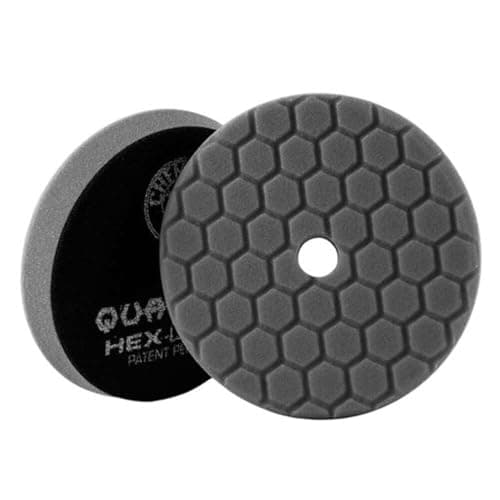
Our top pick: the Chemical Guys Hex-Logic Quantum Finishing Pad, Black (5.5 in).
How this is funded: we earn an Amazon commission when you buy through our links, at no extra cost to you. We sell nothing and stock nothing, so a pick is never a product we are trying to move. Prices are pulled live from Amazon and were last checked November 19, 2026; where we cannot verify a price we say so rather than print an old one. Full disclosure.
Research-basedPicked from published manufacturer specifications and the consistent pattern across verified-purchase owner reports. Every product here scores 8.4 or better on our rubric.How we pick
Best finishing padChemical Guys
Chemical Guys Hex-Logic Quantum Finishing Pad, Black (5.5 in)
A single black Quantum pad costs about what a coffee does, which is the whole point: finishing is the stage where you need three or four clean pads for one car, and this is the only pad here you can buy four of without thinking about it.
Our score9.3Best for: the cheapest way to own four identical finishing pads
Tap any row for the full write-up. Prices come straight from Amazon and are never typed in by hand.
The verdict
Buy four Chemical Guys Hex-Logic Quantum black pads. Finishing is the stage where pad count beats pad quality, the Quantum is the only pad here cheap enough to own four of without flinching, and it finishes down on most modern clear coat. If your machine throws 15 mm or 21 mm, spend the difference on Lake Country HDO instead — not for the finish, but because the HDO interface survives the side loading that tears cheap pads apart.
02
What a finishing pad actually is
Foam pads are sold by color and graded by feel, and the grade that matters least to a beginner is the one that matters most at the end of a job. A cutting pad is dense and firm; it carries an abrasive and takes clear coat off. A finishing pad is soft and open; it carries almost no cut and its job is to refine what the cutting stage left behind, or to spread a sealant evenly without working it into the paint.
Which means a finishing pad is not a weaker version of a cutting pad. It is a different tool for the step after. Use a cutting pad with a finishing polish and you will put marring back in; use a finishing pad with a compound and you will spend twenty minutes achieving nothing and blame the compound. Compound against polish is the liquid half of the same decision.
03
The four criteria, in the order they should decide your purchase
Because no useful density numbers exist, the ranking below is built on four things that are either published or directly observable, in descending order of how much they should change what you buy.
01Cost per pad. This is first, and it surprises people. A finishing stage on one car needs three or four clean pads, because a pad saturated with spent polish stops finishing and starts smearing. The cheapest pad you can own four of beats the best pad you can only afford one of, every time. How many polishing pads do I need has the arithmetic.
02Interface construction. The failure mode of a foam pad is not the foam wearing out. It is the hook-and-loop interface tearing away from the foam, and on a 15 mm or 21 mm long-throw machine that happens fast, because the pad is being shoved sideways as well as spun. A pad built for that — Lake Country's HDO, Maxshine's rubber backing — lasts several times longer on a long-throw machine than one that is not.
03Face geometry and size. A 5.5 in pad on a 5 in plate gives you overhang, which is free coverage on a short-throw machine and a liability on a long-throw one, where the unsupported edge takes the worst of the load. A dimpled face holds product; a flat face puts more foam on the paint. What size polishing pad covers the plate-to-pad arithmetic.
04Finish quality. Last, deliberately. Every pad on this page finishes down acceptably with a fine polish on ordinary clear coat. The differences only become visible on soft dark paint in direct sun — which is a real scenario, but a narrower one than the first three criteria.
What to buy on, in order
Criterion
What to look for
Why it is ranked here
Cost per pad
Sold as singles or pairs, low unit price
You need four for one car, not one
Interface
HDO, rubber backing, or a stated long-throw fitment
Interface tearing is how pads actually die
Face size
5 in for long throw, 5.5 in for short throw
Overhang is coverage or a liability, depending on the machine
Face pattern
Dimpled to spread sealant, flat to jewel paint
Changes what the pad is good at, not how good it is
Finish quality
Softest foam you can find
Only visible on soft dark paint
Published density
Nothing — no maker states one
Cannot be used, so it is not used
04
The ranked picks
Six finishing-grade foam pads, sorted by overall score. Prices are live from Amazon, and these are consumables — the cost per pad column matters more than the headline price.
No. 01Chemical GuysOutstandingSpec-verified
Chemical Guys Hex-Logic Quantum Finishing Pad, Black (5.5 in)
Best for: The cheapest way to own four identical finishing pads
A single black Quantum pad costs about what a coffee does, which is the whole point: finishing is the stage where you need three or four clean pads for one car, and this is the only pad here you can buy four of without thinking about it. The hex pattern vents heat and holds polish, and the closed-cell black foam is soft enough to finish a soft clear coat without hazing it.
Finish
Strong
Longevity
Good
Heat control
Strong
Cost per pad
Exceptional
Why we picked it
By far the lowest price per pad of anything here, so owning four is realistic
Hex grooves vent heat and hold polish rather than squeezing it all out on contact
Closed-cell foam soaks up less product than an open-cell pad
Sold as singles, so you buy exactly the number you need
Good to know. 5.5 in on a 5 in plate is a lot of overhang for a 21 mm long-throw machine
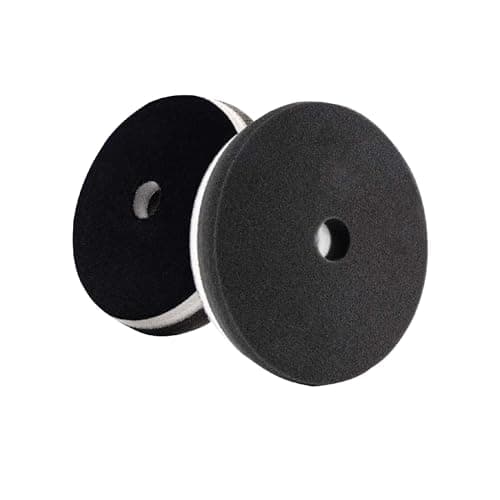
HDO stands for Heavy Duty Orbital, and it is the construction rather than the foam that earns this pad its place: a thicker, denser interface built for the side loads a long-throw machine puts through a pad. Lake Country publishes the pad as a finishing grade for painted surfaces on a 5 in plate, and it is the one here that still looks like a pad after a full car.
Finish
Exceptional
Longevity
Exceptional
Heat control
Strong
Cost per pad
Adequate
Why we picked it
Built for the side loading of a long-throw machine, which is where cheap pads tear at the interface
Holds its shape across a whole car rather than going soft after two panels
Lake Country publishes it explicitly as a finishing grade for painted surfaces
Flat face with no grooves, so it rinses clean in seconds
Good to know. Roughly double the cost per pad of the Hex-Logic, which matters when you need four
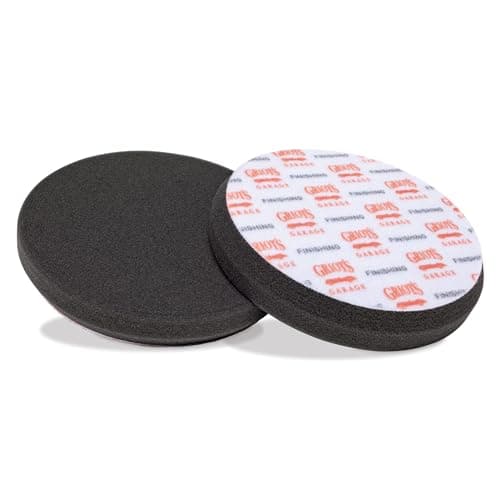
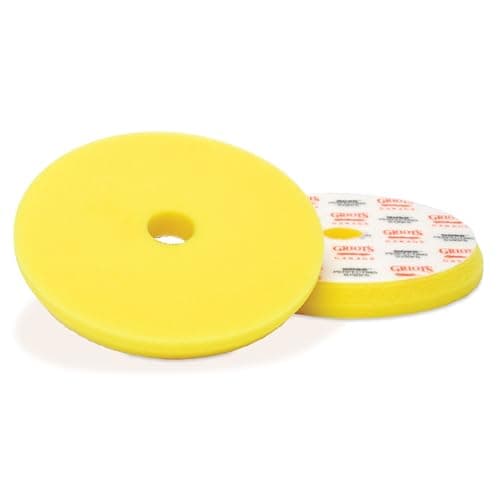
Griot's sells these as a pair, which is the honest way to sell a finishing pad, and the foam is the softest here. On soft Japanese or Korean clear coat — the paint that hazes if you look at it wrong — a black Griot's pad with a fine polish is the combination that finishes down in one pass instead of two. The listing also names sealant application as an intended use, and it is good at that.
Finish
Exceptional
Longevity
Good
Heat control
Strong
Cost per pad
Good
Why we picked it
Softest foam in this group, which is exactly what a soft clear coat wants
Sold as a pair, so one order is half a car's worth of clean pads
Finishes down with a fine polish in a single pass on most modern paint
Griot's names sealant application as an intended use, and it spreads evenly
Good to know. Highest price per pad of the three 5.5 in singles-equivalent options here
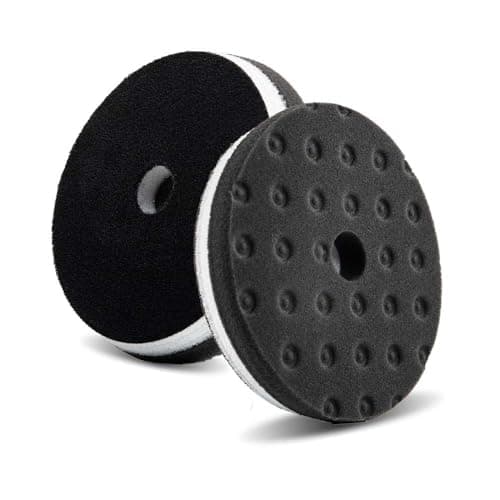
The same HDO construction as the plain black pad, with Lake Country's CCS dimples molded into the face. The dimples are small reservoirs: they hold product and release it gradually instead of letting the first pass squeeze it all into the paint. On a finishing polish that mostly saves product, but on a machine-applied sealant or glaze it is the difference between an even film and a dry patch.
Finish
Strong
Longevity
Exceptional
Heat control
Strong
Cost per pad
Adequate
Why we picked it
CCS dimples meter product out across a panel instead of dumping it on the first pass
Noticeably less product used per panel than a flat finishing pad
Same heavy-duty interface as the flat HDO, so it tolerates a long-throw machine
The best pad here for machine-applying a sealant, glaze or wax
Good to know. Costs more than the flat HDO for a feature not everyone needs
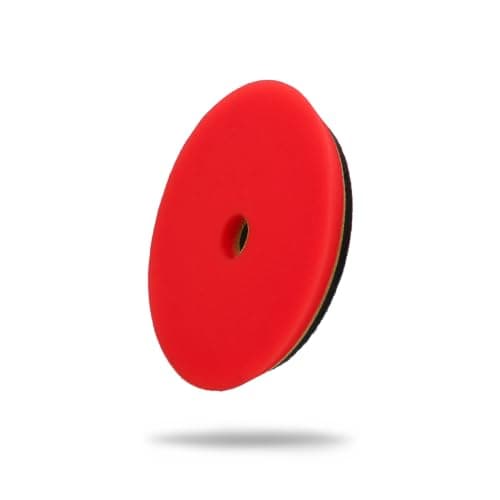
The only pad here built around the long-throw problem rather than retrofitted to it. Maxshine publishes it as a low-profile pad with a rubber backing and an EVA foam layer for heat and pressure absorption, on a 5 in face — so on a 15 mm or 21 mm machine there is no overhang working the pad edge to death. If your machine throws long, start here.
Finish
Strong
Longevity
Strong
Heat control
Exceptional
Cost per pad
Strong
Why we picked it
5 in face on a 5 in plate means no overhang for a long-throw machine to chew
Published EVA layer is there specifically to absorb heat and pressure
Rubber backing resists the interface tearing that kills cheap pads on 21 mm machines
Cheaper per pad than either Lake Country option
Good to know. No overhang also means less coverage per pass on a short-throw machine
Not a finishing pad, and that is why it is here. Perfecting is the grade above finishing: enough bite to take out light swirls with a fine polish, soft enough to leave an acceptable finish doing it. If the question is which single pad to buy, this is the honest answer — a dedicated finishing pad is the second purchase, not the first.
Finish
Good
Longevity
Strong
Heat control
Strong
Cost per pad
Good
Why we picked it
Genuinely does two jobs — light correction and an acceptable finish
The right first pad for someone who owns no pads at all
Sold as a pair, and the pair covers a small car's light-swirl pass
Griot's lists waxing among the intended uses, so it doubles as an applicator
Good to know. Pairs only, which makes building to four pads awkward
A single pass over a hood with a fine polish loads a finishing pad with spent abrasive and removed clear coat. It is no longer finishing anything; it is dragging slurry around. The symptom is a panel that looks slightly hazier at the end of the pass than at the start, which people almost always read as the polish being wrong.
The fix is a clean pad, and on one average car that means somewhere between three and five of them for the finishing stage alone. You can wash and dry pads between panels, and for a long job you will — but a wet pad does not finish the same way a dry one does, so a rotation of four is the practical minimum.
Why pad count is the first criterion
Pads owned
What the finishing stage looks like
One
Hood looks great. Everything after the hood gets smeared slurry.
Two
Front half acceptable. You start washing pads mid-job and working with a damp one.
Four
The whole car gets a clean dry pad. This is the target.
Eight
Comfortable, and overkill unless you detail other people's cars.
06
Short throw against long throw, and why it changes your pad
Orbit throw is how far the pad's center travels per rotation. An 8 mm machine like a Porter-Cable or a TORQX moves the pad in a small circle; a 15 mm or 21 mm machine moves it in a big one. The pad does not care how fast it spins. It cares a great deal how hard it is being pushed sideways.
Match the pad to the throw, not to the brand of machine
Finishing against perfecting, and the one-pad question
Griot's calls the grade above finishing "perfecting", other brands call it polishing, and it is the grade people actually want when they ask which single pad to buy. A perfecting pad has enough bite to remove light swirls with a fine polish and finishes down acceptably doing it. A finishing pad does neither — it has no bite at all.
So the honest answer to "which one pad" is a perfecting pad, which is why the Griot's yellow pair is on this page despite not being a finishing pad. It is the first purchase. A dedicated finishing pad is the second, and it earns its place the first time you put a black car in direct sunlight and look at it properly — which is much easier with a real inspection light.
Buying your first pad ever: a perfecting or polishing grade. One pad, two jobs.
Correcting swirls on anything: a cutting pad plus a finishing pad, two stages. How to remove swirl marks has the sequence.
Machine-applying a sealant or wax: a dimpled finishing pad, and nothing else needed.
Jeweling soft black paint: the softest flat finishing pad you can get, and a fine polish.
08
How long a finishing pad actually lasts
Longer than people expect, if it is washed, and dramatically shorter if it is not. Dried polish in the foam is abrasive — a pad that has been left to dry with product in it is a mild cutting pad the next time you use it, which is the opposite of the job. Nobody publishes a cycle count, so the honest figure is: until the interface starts separating or the foam stops springing back.
01Rinse under a tap immediately after the last panel, before anything dries.
02Work the foam with your thumbs under running water until the water runs clear. Grooved and dimpled faces need a soft brush.
03Squeeze — do not wring. Wringing is what tears the interface.
04Air dry face up, away from heat. A warm radiator shrinks the foam.
05Replace when the interface lifts at the edge, or when the foam stays compressed after a squeeze.
09
Our recommendation
Buy this one
Chemical Guys Hex-Logic Quantum Finishing Pad, Black (5.5 in)
A single black Quantum pad costs about what a coffee does, which is the whole point: finishing is the stage where you need three or four clean pads for one car, and this is the only pad here you can buy four of without thinking about it.
HDO stands for Heavy Duty Orbital, and it is the construction rather than the foam that earns this pad its place: a thicker, denser interface built for the side loads a long-throw machine puts through a pad.
What is the difference between a polishing pad and a finishing pad?
Cut. A polishing pad has enough bite to remove light defects with a fine polish; a finishing pad has essentially none, and its job is to refine the surface a cutting stage left behind or to spread a sealant evenly. Using a finishing pad with a compound achieves nothing — the pad cannot carry the abrasive. Polishing pad colors explained covers how each brand labels the grades.
What is the most cost effective finishing pad?
The Chemical Guys Hex-Logic Quantum black pad, by a wide margin, because it is sold as a single pad at the lowest unit price here. That matters more than it sounds: a finishing stage on one car needs three or four clean pads, so the pad you can afford four of beats the pad you can afford one of. Live prices are in the ranked picks above.
How many finishing pads do I need for one car?
Three to four. A pad saturated with spent polish stops refining and starts smearing slurry, which happens roughly every panel and a half on a fine polish. Four clean dry pads covers an average car without stopping to wash any of them mid-job. How many polishing pads do I need breaks it down by stage.
Which finishing pad lasts the longest?
The Lake Country HDO, and the reason is construction rather than foam. HDO stands for Heavy Duty Orbital and it is a thicker, denser interface built for the sideways loading a long-throw polisher puts through a pad — which is the load that separates foam from backing on cheaper pads. No manufacturer publishes a cycle count, so this is a construction judgment, not a measured figure.
Does a finishing pad size have to match my backing plate?
No, but the overhang changes what the pad is good for. A 5.5 in pad on a 5 in plate gives you unsupported foam at the edge: that is extra coverage on a short-throw machine and a wear point on a 15 mm or 21 mm one. On a long-throw machine, match the pad to the plate. What size polishing pad has the full pairing.
Can I use a finishing pad to apply wax or sealant?
Yes, and a dimpled one is the best tool for it. The CCS dimples on the Lake Country HDO-CCS hold product and release it gradually across a panel instead of letting the first pass squeeze it all out, which is exactly what you want when spreading a thin even film. A flat pad works too, it just needs re-priming more often.
11
Sources
Every published figure on this page traces to one of these. Where a manufacturer does not publish a number, the page says so rather than estimating it.
Last reviewed November 2, 2026. Think a figure here is wrong? Tell us at contact@detailingandwax.com and we will check it, fix it and date the correction — see our editorial policy.