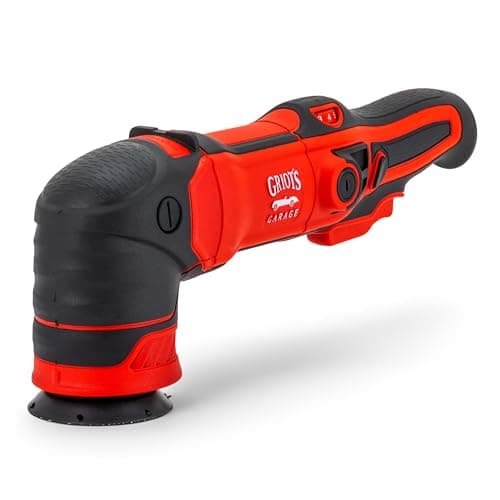
Our top pick: the Griot's Garage Griot's Garage G8 Orbital Polisher.
How this is funded: we earn an Amazon commission when you buy through our links, at no extra cost to you. We sell nothing and stock nothing, so a pick is never a product we are trying to move. Prices are pulled live from Amazon and were last checked October 5, 2026; where we cannot verify a price we say so rather than print an old one. Full disclosure.
Research-basedPicked from published specifications and the pattern across verified-purchase reports. We have not used these ourselves and do not pretend otherwise.How we pick
Quick picks — Best for beginners
#
Product
Best for
Throw
Price
01
Griot's Garage G8 Orbital Polisher
Tight panels, spot correction and nervous first-timers
Tap any row for the full write-up. Prices come straight from Amazon and are never typed in by hand.
The verdict
Buy the Griot's Garage G8 if you want a machine you will keep, or the Chemical Guys TORQX kit if you want to correct paint this weekend without placing a second order. If you are genuinely unsure you will enjoy this, the AVID POWER kit costs a third as much and will tell you.
02
Why short throw is the right first machine
Every machine here has an 8mm throw or thereabouts, and that is deliberate. A short throw covers less paint per pass, which makes it slower — and it also makes it far harder to burn an edge, because the pad spends less time traveling and generates less heat in one place.
The places beginners do damage are consistent: raised body lines, the edges of panels, around badges, and on plastic bumpers where the clear coat is thinnest. A long-throw machine reaches those faster and punishes a stalled pad harder. You can always buy a faster machine later; nobody has ever repainted a fender because their first polisher was too gentle.
03
Four machines that are hard to get wrong
Ranked by how forgiving they are, not by how fast. Prices are live from Amazon.
No. 01Griot's GarageSpec-verified
Griot's Garage G8 Orbital Polisher
Best for: Tight panels, spot correction and nervous first-timers
The G8 is the G9's shorter, lighter sibling, and for a lot of people it is the better buy. An 8mm throw is slower across a hood and considerably more forgiving within an inch of an edge, which is exactly where beginners do damage.
Who should skip it. Correcting a full-size truck with an 8mm throw is a long afternoon. If most of your work is big flat panels, the extra throw of the G9 genuinely saves time rather than just sounding better.
Correction speed
7.0
Control
9.5
Ergonomics
8.5
Build
9.0
Value
8.5
What works
Lighter than the G9 and easier to hold against a door for an hour
8mm throw is the most forgiving option near edges and badges
Same lifetime warranty as the rest of the Griot's line
What does not
Slower on large flat panels — this is the real trade-off
Griot's does not publish a wattage figure we could verify
Priced close enough to the G9 that the decision is genuinely about throw
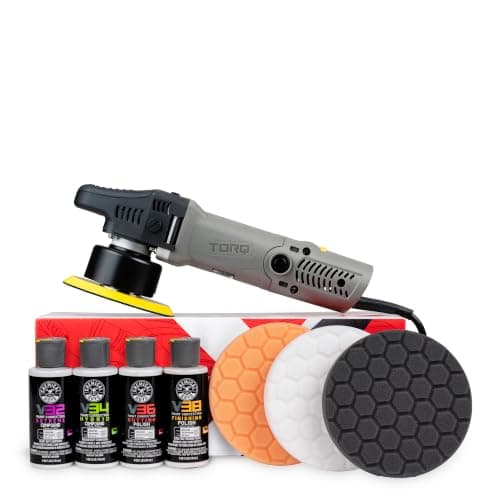
The TORQX is a competent 800W short-throw machine, and the reason to buy it is the kit: it arrives with pads and liquids, so you are correcting the same day rather than placing a second order. For a first-time buyer that convenience is worth real money.
Who should skip it. If you already own pads and compounds, you are paying for a bundle you do not need, and the bare machine is not better than a G8 or G9. The included pads are serviceable rather than good — most people replace them within a year.
Correction speed
7.0
Control
9.0
Ergonomics
8.0
Build
7.5
Value
8.5
What works
Genuinely complete out of the box — pads, liquids, machine
800W is adequate for the short throw it drives
The least intimidating entry point of the serious machines
What does not
Included pads are the weakest part of the package
Worse value than a bare machine if you already have consumables
Chemical Guys does not publish a backing plate size we could verify
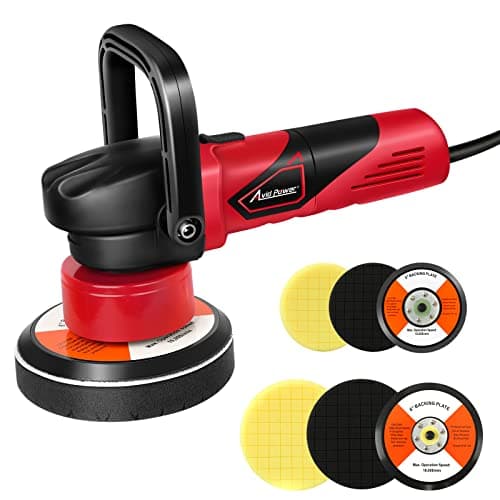
This is the machine to buy if you are not yet sure you will use one. It is a six-speed dual action at roughly a third of the price of the established names, it comes with pads, and it will remove light swirls from a daily driver perfectly well.
Who should skip it. Anyone who already knows they will correct more than one car a year. The build quality gap is real — bearing noise and backing plate wobble are the two complaints that recur in owner reports — and you will want a better machine within a season.
Correction speed
6.5
Control
7.5
Ergonomics
6.5
Build
5.5
Value
9.0
What works
The lowest-risk way to try machine polishing
Two backing plate sizes included, which is unusual at this price
Perfectly capable of removing light swirl marks
What does not
Bearing noise and plate wobble recur in owner reports
No published throw figure, which makes it hard to compare properly
Not a machine to do a full correction on a dark car with
Published specifications
Throw
Not published
Motor
Not published
Speed settings
6
Backing plate
5 in and 6 in
In the box
Kit with pads
No. 04PORTER-CABLEOwner reports
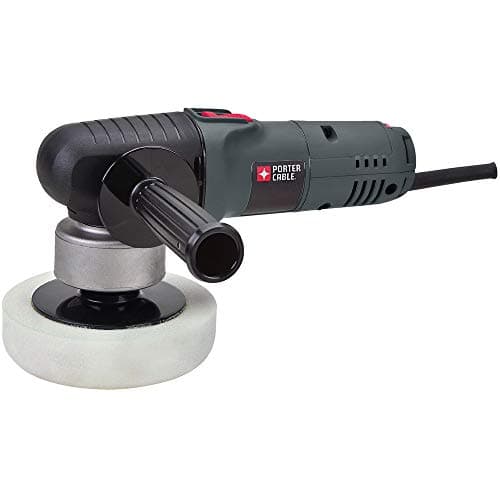
PORTER-CABLE 7424XP Variable Speed Polisher
Best for: The machine that taught a generation to polish, still cheap
The 7424XP has been the default budget dual action for well over a decade, and the reason is simple: it is almost impossible to damage paint with one, and parts and backing plates are everywhere. It is slower than anything modern and it does not care.
Who should skip it. Anyone who wants to finish a correction in one session. It is genuinely slow by current standards, and the modern short-throw machines are more comfortable to hold. Buy it for the price and the parts ecosystem, not for performance.
Correction speed
6.0
Control
9.5
Ergonomics
6.5
Build
8.0
Value
8.5
What works
Enormous aftermarket of backing plates and parts
Extremely hard to damage paint with — the original safe machine
Routinely the cheapest genuinely reliable dual action available
What does not
Slow by modern standards, on every panel
Porter-Cable does not publish a throw figure we could verify
Ergonomics are dated next to a G8 or G9
Published specifications
Throw
Not published
Motor
Not published
Speed settings
Variable, 6 positions
Backing plate
6 in
In the box
Tool
04
What else you have to buy
A bare machine does nothing. The honest total for a first correction setup is the machine plus roughly the same again in consumables, and it is worth knowing that before you order.
The consumables a first correction actually needs
Item
How many
Why
Cutting or polishing pads
Four of one type
A saturated pad stops cutting, around half a hood in
Hybrid one-step compound
One 16 oz bottle
Covers most daily-driver swirls without a second liquid
Painter's tape
One roll
Trim, badges and body lines. The cheapest insurance here.
01Tape the edges and badges first. Every one of them. It takes ten minutes and it is the difference between a mistake and a repaint.
02Work a 2 ft by 2 ft section at a time. Larger than that and the compound dries before you have finished working it.
03Keep the pad flat. A tilted pad concentrates heat on one edge, which is exactly how burn-through happens.
04Let the machine's weight do the work. Enough pressure to keep the pad flat, and no more. If the pad stops rotating you are pressing too hard.
05Do a test section first. One 2 ft square, inspected under a light, tells you whether your pad and liquid combination is right before you commit to a whole car.
If the paint has light swirl marks you can only see in direct sunlight at a specific angle, a machine correction may be more work than the problem deserves. A good glaze or hybrid wax fills and hides light marring for a season, and a coating over corrected paint is a better use of a weekend than correcting paint you will then neglect.
The other case: if the car is leased and going back in a year, the arithmetic almost never favors buying a polisher. What DIY detailing actually costs works through the numbers.
07
Questions people actually ask
Can a beginner use a dual action polisher without damaging paint?
Yes — it is what the design is for. A dual action stalls under excessive pressure instead of digging in. Tape your edges and badges, keep the pad flat, and work a small section at a time, and the risk is genuinely low.
How much does a complete first polishing setup cost?
Roughly double the price of the machine once you add four pads, a compound, tape, towels and a light. Buying a kit that includes pads and liquids narrows that gap, which is the main argument for a kit over a bare machine.
What speed should I use on a dual action polisher?
Speed one or two to spread the product, then four to five to work it. Six is for heavy correction on a flat panel and it generates the most heat, so it is the setting to avoid near edges. Work until the compound goes clear, then stop.
Should I buy a polisher kit or the machine on its own?
A kit if you own nothing, because you will be correcting the same day rather than waiting for a second order. A bare machine if you already have pads and compounds, because kit pads are usually the weakest part of the package.
08
Sources
Every published figure on this page traces to one of these. Where a manufacturer does not publish a number, the page says so rather than estimating it.
Last reviewed October 5, 2026. Think a figure here is wrong? Tell us at contact@detailingandwax.com and we will check it, fix it and date the correction — see our editorial policy.