Independent picks for detailing your own car. We stock nothing, so we have nothing to move.
01
Polishers & correction
Polishing pad colors explained
There is no industry standard. A yellow pad from one brand can be more aggressive than a green one from another, and assuming otherwise causes real damage.
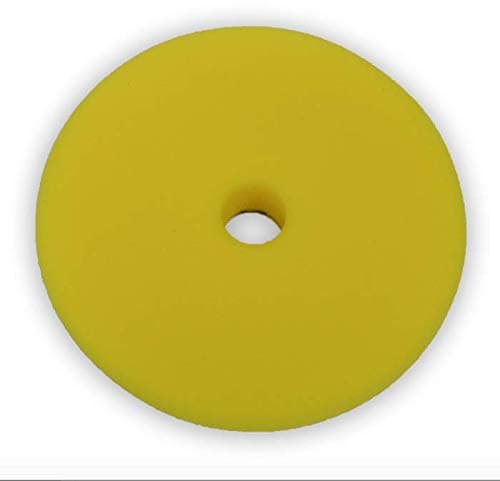
Featured here: the Buff and Shine Buff and Shine Uro-Tec Yellow Polishing Pad, 5 in.
How this is funded: we earn an Amazon commission when you buy through our links, at no extra cost to you. We sell nothing and stock nothing, so a pick is never a product we are trying to move. Prices are pulled live from Amazon and were last checked October 5, 2026; where we cannot verify a price we say so rather than print an old one. Full disclosure.
Research-basedPicked from published specifications and the pattern across verified-purchase reports. We have not used these ourselves and do not pretend otherwise.How we pick
Polishing pads are color-coded by cut level within a brand's own range. They are not color-coded across brands, and there is no standards body that governs it. This genuinely causes damage: someone who learned that orange means cutting on one brand buys an orange pad from another and gets a finishing foam, or the reverse.
02
Read these two things instead of the color
01The manufacturer's own cut description — 'heavy cutting', 'cutting', 'polishing', 'finishing'. This is the only reliable label, and every reputable brand publishes it.
02The foam density or material. Firmer, denser foam cuts more. Microfiber cuts more than any foam. You can feel density with your thumb before you buy if you are in a store.
Color is a convenience for telling your own pads apart mid-job. Treat it as a label on your shelf rather than a specification.
03
The general pattern, with a warning
Across most brands there is a loose convention, and it is loose enough that you should never rely on it:
The loose convention, and how much to trust it
Typical color
Usually means
How reliable
Yellow or orange
Cutting or polishing
Varies most between brands
White
Polishing or light cutting
Reasonably consistent
Black
Finishing, softest
Fairly consistent
Red or blue
Finishing or wax application
Varies
Green
Polishing
Varies
Microfiber (any color)
Heavy cutting
The one genuinely consistent signal
04
Pads across the cut range
One from each of the main systems, so you can see how the descriptions map. Prices are live from Amazon.
Uro-Tec is color-coded by cut and the yellow is the polishing grade — the middle of the range and the one that does most of the work on a daily driver. At this price there is no reason to own one; buy four and swap when the first saturates.
Who should skip it. Heavy defect removal. Yellow is a polishing foam. If the paint has deep swirls you need the cutting grade first, and this pad will only make them look slightly better.
Cut
7.0
Finish
8.5
Longevity
8.0
Value
9.5
What works
Cheap enough to buy the four you actually need
Clear color coding across the range makes cut level unambiguous
5 in is the most useful size on modern panels
What does not
Sold singly — a single pad is not a correction kit
Polishing grade only; heavy defects need the cutting foam
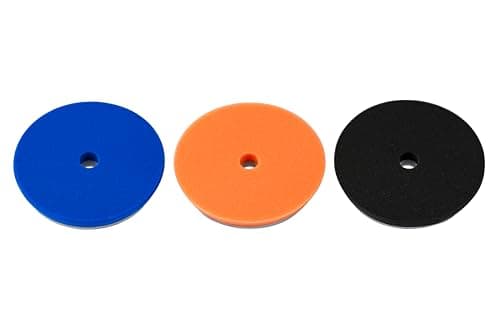
Lake Country makes the foam a great many other brands rebadge, and the HDO line is built specifically for the pressure a long-throw machine puts through a pad. A three-pack of the same pad is more useful than four different ones, because a saturated pad stops cutting and you need a spare mid-panel.
Who should skip it. Short-throw machines under heavy pressure — HDO foam is designed around orbital machines and is firmer than a general-purpose finishing pad. If you only ever finish, buy a softer foam.
Cut
8.0
Finish
8.0
Longevity
8.5
Value
8.5
What works
Multiple identical pads, which is how pads should be bought
Built for the pressure a long-throw machine applies
Lake Country foam is the reference other brands rebadge
What does not
Firmer than a general-purpose finishing foam
5.5 in is too large for tight panels — you will want smaller too
No cutting and finishing variety in a single-type pack
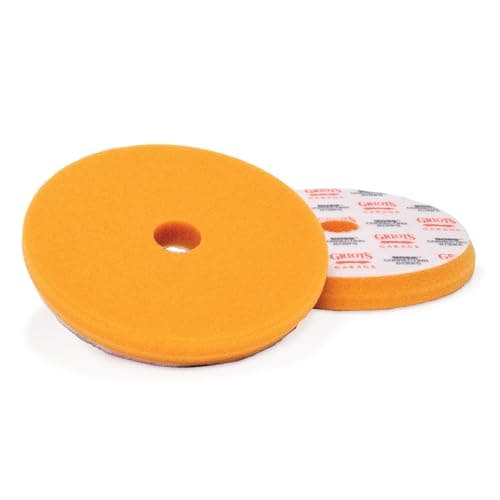
Griot's designed the BOSS foam around their own throw figures, and the pairing shows — on a G8 or G9 these track flatter and run cooler than generic foam of the same nominal density. Correcting pads, so they cut rather than finish.
Who should skip it. Final finishing on dark paint. These are the correcting grade; you will want a softer polishing or finishing foam for the last pass if you can see haze.
Cut
8.5
Finish
7.0
Longevity
8.0
Value
8.0
What works
Designed around the throw of the Griot's machines specifically
Runs cooler than generic foam under sustained pressure
Standard 5.5 in size fits any 5 in plate, not just Griot's
What does not
Correcting grade only — not a finishing pad
Costs more than generic foam of similar density
Griot's does not publish a density figure to compare against
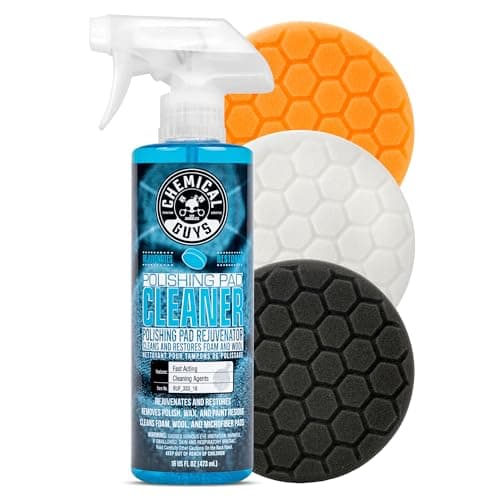
A sampler is the wrong way to buy pads for a job and the right way to find out what your paint responds to. Four cut levels plus the pad cleaner lets you test on a single panel before committing to four of whichever one worked.
Who should skip it. Correcting a whole car. One pad per cut level means you are working with a saturated pad halfway through the hood, which is precisely when cutting ability falls off a cliff.
Cut
7.5
Finish
8.0
Longevity
7.0
Value
8.0
What works
Four cut levels in one purchase — genuinely useful for diagnosis
Pad cleaner included, which people forget to buy
Hex pattern vents heat better than flat foam
What does not
One pad per level is not enough to correct a car
6.5 in is large for modern curved panels
You will end up buying multiples of whichever one worked
The useful thing is not owning one of every color. It is owning four of the cut level you actually use, plus a couple of a softer grade for finishing. A sampler tells you what your paint responds to; it does not get you through a correction.
Four polishing-grade pads — the grade that handles most daily-driver swirls with a hybrid compound.
Two cutting pads for the panels that need more, and for the test section that tells you whether they do.
Two finishing pads if you have dark paint, and none if you do not.
One mini pad set if you own a mini machine for pillars and mirrors.
Once four pads have compound in them, color stops helping. Mark the back of each pad with a permanent marker — 'C' for cutting, 'P' for polishing, 'F' for finishing — the day you buy them. It takes a minute and it prevents the specific mistake of finishing a panel with a cutting pad.
Store pads face up and fully dry. Foam stored damp degrades, and foam stored with compound dried into it is finished. Washing method is in the pad roundup.
07
Questions people actually ask
What do the colors of polishing pads mean?
Cut level, but only within a single brand's range. There is no industry standard, so an orange pad from one maker can be a cutting foam and from another a finishing foam. Always read the manufacturer's cut description instead.
Which polishing pad is most aggressive?
Within foam, the firmest and densest. Across materials, microfiber cuts harder than any foam regardless of color — which is the one consistent signal in this whole category.
What pad should I use for swirl marks?
Start with a polishing-grade foam pad and a hybrid one-step compound, and test a 2 ft section. If the swirls remain, step up to a cutting pad with the same liquid. Starting with the most aggressive combination removes more clear coat than the job needs.
Can you use the same pad for compound and polish?
No. Residual compound in the pad will continue cutting while you are trying to finish, which defeats the point of the finishing pass. Dedicate pads to liquids and mark them so you can tell which is which once they are dirty.
08
Sources
Every published figure on this page traces to one of these. Where a manufacturer does not publish a number, the page says so rather than estimating it.
Last reviewed October 5, 2026. Think a figure here is wrong? Tell us at contact@detailingandwax.com and we will check it, fix it and date the correction — see our editorial policy.