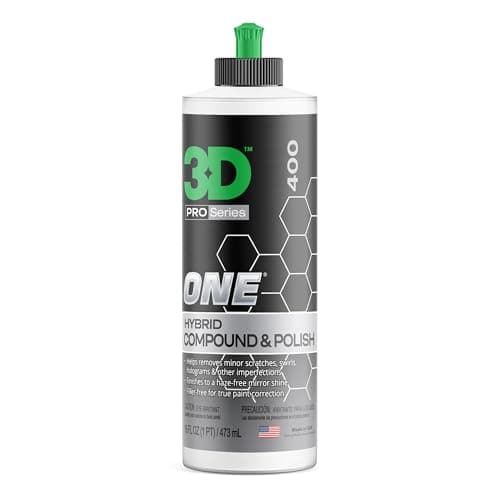
Featured here: the 3D 3D ONE Hybrid Compound and Polish.
How this is funded: we earn an Amazon commission when you buy through our links, at no extra cost to you. We sell nothing and stock nothing, so a pick is never a product we are trying to move. Prices are pulled live from Amazon and were last checked October 5, 2026; where we cannot verify a price we say so rather than print an old one. Full disclosure.
Research-basedPicked from published specifications and the pattern across verified-purchase reports. We have not used these ourselves and do not pretend otherwise.How we pick
The verdict
Buy a hybrid one-step first. On a daily driver in a light color it is almost certainly all you need, and you can add a dedicated finishing polish later if — and only if — you can actually see haze under direct sun.
02
The difference in one paragraph
A compound uses larger abrasive particles to cut through clear coat quickly, which removes defects and leaves finer marks of its own. A polish uses smaller particles to remove those finer marks and bring up gloss. Historically that meant two passes over every panel. Modern diminishing abrasives break down as you work them — starting coarse and ending fine — which is how a single bottle can do both jobs.
The three liquid types compared
Compound
Polish
Hybrid one-step
Abrasive size
Large
Fine
Large, breaking down to fine
Removes swirls
Yes, quickly
Light ones only
Yes, moderately
Leaves haze
Yes
No
Usually not
Passes needed
One, plus a polish after
One, after a compound
One, total
Right for
Heavy defects, hard clear coat
Finishing dark paint
Most daily drivers
03
One of each, plus the all-rounder
A hybrid, a heavy compound, a dedicated finishing polish, and the budget all-rounder. Prices are live from Amazon.
3D ONE is a genuine one-step: it starts as a compound and the abrasives break down as you work, so the same pass that removes the defect also finishes it. On a medium pad it handles most daily-driver swirls and leaves paint that does not need a second liquid.
Who should skip it. Anyone who wants maximum cut. A dedicated heavy compound removes more, faster. ONE is a time-saver and a simplifier, not a defect-removal champion.
Cut
8.0
Finish
9.0
Ease of use
8.5
Value
8.0
What works
Truly finishes down, so most cars need only this one liquid
Very low dusting compared with traditional compounds
Flexible — cut level changes with the pad you pair it with
What does not
Less outright cut than a dedicated heavy compound
Costs noticeably more per ounce than Ultimate Compound
Needs working properly; rushing the pass wastes the diminishing abrasive
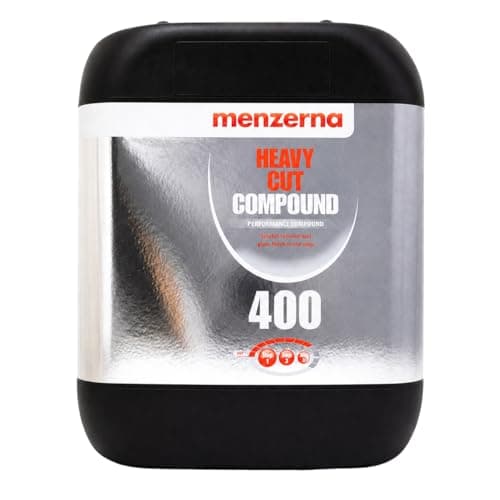
Menzerna's heavy cut is what people reach for when a daily-driver compound has made no visible difference, which happens on hard European clear coat more often than anywhere else. It cuts hard and, unusually for its grade, finishes well enough that one follow-up polish is normally enough.
Who should skip it. Soft paint and light swirls, where it is simply more abrasive than the job needs. The listing here is a 128 oz jug, which is far more than a home detailer will use in years.
Cut
9.5
Finish
7.5
Ease of use
7.5
Value
6.5
What works
Cuts hard clear coat that consumer compounds cannot touch
Finishes better than most compounds of this abrasive grade
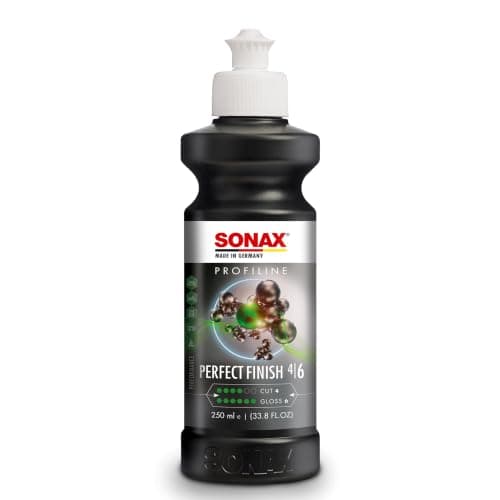
Perfect Finish is the liquid you reach for when the correction is done and you can still see haze under direct sun on black paint. It cuts enough to remove light defects on soft paint and finishes to a genuinely clear gloss that a compound cannot match.
Who should skip it. Defect removal on anything but soft paint. If there are swirls you can see at arm's length, this is the second liquid, not the first.
Cut
5.5
Finish
9.5
Ease of use
8.5
Value
7.5
What works
Finishes to a clarity that compounds do not reach
Enough cut to correct light defects on soft paint in one step
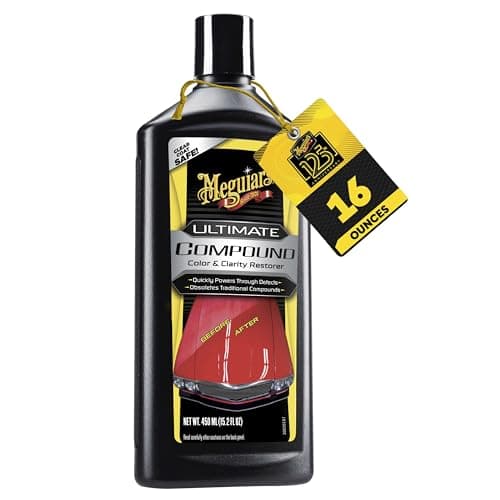
Ultimate Compound is the most widely used correction liquid in home detailing for a straightforward reason: it is inexpensive, it is available everywhere, and it removes light to moderate swirls with very little risk. It is not the fastest cutter and it does not need to be.
Who should skip it. Deep scratches and heavy oxidation, where a dedicated heavy cut compound will save you three passes. It also finishes slightly short of a dedicated polish on very dark paint in direct sun.
Cut
7.0
Finish
8.0
Ease of use
9.5
Value
9.5
What works
Removes light and moderate swirls with very little risk
Works by hand as well as by machine
Costs a fraction of boutique correction liquids
What does not
Slow on deep scratches and heavy oxidation
Finishes slightly short of a dedicated polish on dark paint
Meguiar's does not publish a body-shop-safe claim we could verify
The test that decides whether you need two bottles
Correct one 2 ft square section with a hybrid on a medium pad. Wipe it clean. Then look at it in direct sunlight, from a low angle, with the sun behind the panel. If what you see is clear gloss, you are finished and you do not need a finishing polish. If you can see a faint milky haze, you do.
Three factors predict the answer. Dark paint shows haze that light paint hides completely. Soft clear coat hazes more readily than hard. And the more aggressive your pad, the more likely a second step becomes — which is itself an argument for stepping down a pad grade before buying another bottle.
05
When a true two-step is genuinely right
Hard clear coat, particularly on German cars, where a hybrid simply does not cut fast enough to be practical.
Heavily neglected paint with deep swirls and oxidation, where the first pass is about removal and finishing is a separate concern.
Black and very dark paint where the finishing standard is genuinely higher because every imperfection shows.
And where a two-step is not right: a light-colored daily driver with ordinary swirls, which is most cars. Our compound roundup ranks the options for both situations.
06
Questions people actually ask
Do I need both a compound and a polish?
Usually not. A modern hybrid one-step on a medium pad corrects and finishes in a single pass on most daily drivers. Add a dedicated finishing polish only when you can see haze under direct sunlight — which in practice means dark paint.
Can you use polish without compound?
Yes, and it is a perfectly reasonable job. A fine polish on a soft pad removes very light marring and brings up gloss without removing much clear coat. For paint that is in good condition and just looks flat, that is exactly the right treatment.
Which comes first, compound or polish?
Compound first, polish second. Compounding after polishing would reintroduce the marks you just removed. In a full detail the order is wash, decontaminate, compound, polish, protect — see the detailing order of operations.
Is a one step polish as good as a two step?
On most cars, close enough that the second pass is not worth the hours. On hard clear coat, heavily neglected paint or black cars, a true two-step removes more and finishes better. Test one section before committing to either approach.
07
Sources
Every published figure on this page traces to one of these. Where a manufacturer does not publish a number, the page says so rather than estimating it.
Last reviewed October 5, 2026. Think a figure here is wrong? Tell us at contact@detailingandwax.com and we will check it, fix it and date the correction — see our editorial policy.