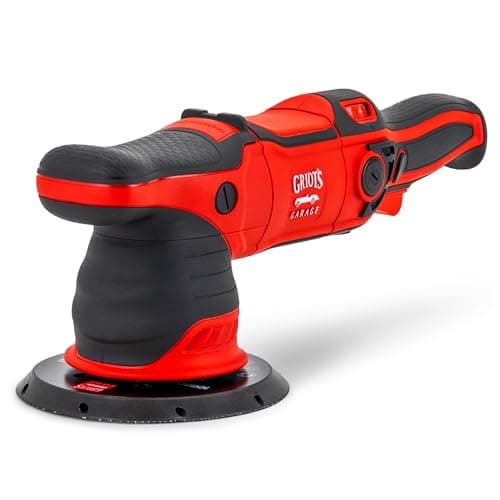
Featured here: the Griot's Garage Griot's Garage G9 Random Orbital Polisher.
How this is funded: we earn an Amazon commission when you buy through our links, at no extra cost to you. We sell nothing and stock nothing, so a pick is never a product we are trying to move. Prices are pulled live from Amazon and were last checked October 5, 2026; where we cannot verify a price we say so rather than print an old one. Full disclosure.
Research-basedPicked from published specifications and the pattern across verified-purchase reports. We have not used these ourselves and do not pretend otherwise.How we pick
Paint correction is the permanent removal of defects from a clear coat by abrading the surface until it is level. It is permanent in both directions: the defects do not come back, and the clear coat you removed does not either.
02
The finite resource nobody mentions
A factory clear coat is roughly 40 to 50 microns thick on most modern cars, and a meaningful correction removes somewhere between 2 and 5 microns. That arithmetic is why correction is not a routine job: a car has perhaps five or six full corrections in it across its whole life, and after that there is not enough clear coat left to work safely.
This is also why the single most valuable thing you can do for your paint is not polish it — it is wash it properly so it does not need polishing. The two bucket method prevents the defects this page removes.
03
Choosing a correction level
Correction levels and what each costs you in time
Level
What it does
Defects removed
Time on a sedan
Enhancement
A fine polish on a soft pad
Very light marring, dullness
3 to 4 hours
One-step
A hybrid compound on a medium pad
Most swirl marks
5 to 7 hours
Two-step
Compound, then a finishing polish
Heavy swirls, light scratches
9 to 12 hours
Multi-step
Wet sanding, compound, polish, refine
Deep defects, orange peel
Multiple days
For a daily driver the honest answer is almost always a one-step. It removes the defects people actually notice, it finishes well enough on most paint, and it spends the least clear coat for the visible result. Multi-step correction belongs on show cars and restoration work.
04
The gear each level needs
A machine, a heavy compound for a two-step, a finishing polish, and pads. Prices are live from Amazon.
Griot's GarageSpec-verified
Griot's Garage G9 Random Orbital Polisher
Best for: The default answer for a first serious machine
A 9mm throw and a 1000W motor put the G9 exactly where most home detailers should be: fast enough to finish a car in an afternoon, short enough in the throw to stay predictable near badges and body lines. It is the machine we would buy if we were buying one machine.
Who should skip it. If you already own a competent 8mm machine, this is not the upgrade you think it is — the extra millimeter of throw will not fix inconsistent results. Put the money into better pads and a second liquid instead. It is also heavier than the G8, and you notice that on vertical panels after an hour.
Correction speed
8.5
Control
9.0
Ergonomics
7.5
Build
9.0
Value
8.5
What works
9mm throw is the best general-purpose compromise on the market
1000W does not bog down under pressure on a cutting pad
Griot's lifetime warranty is the strongest in the category
Takes the same 5 in plate and 5.5 in pads as everything else
What does not
Heavier than the G8, which shows on doors and quarters
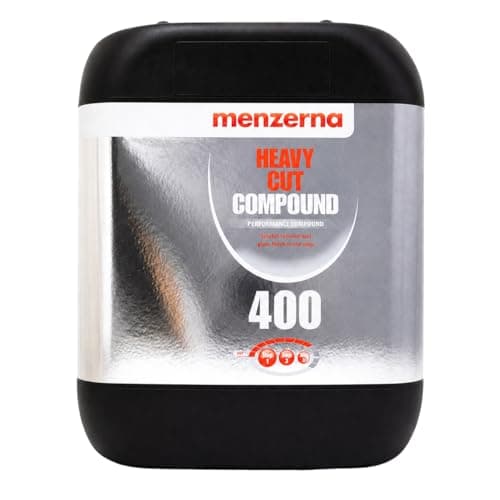
Menzerna's heavy cut is what people reach for when a daily-driver compound has made no visible difference, which happens on hard European clear coat more often than anywhere else. It cuts hard and, unusually for its grade, finishes well enough that one follow-up polish is normally enough.
Who should skip it. Soft paint and light swirls, where it is simply more abrasive than the job needs. The listing here is a 128 oz jug, which is far more than a home detailer will use in years.
Cut
9.5
Finish
7.5
Ease of use
7.5
Value
6.5
What works
Cuts hard clear coat that consumer compounds cannot touch
Finishes better than most compounds of this abrasive grade
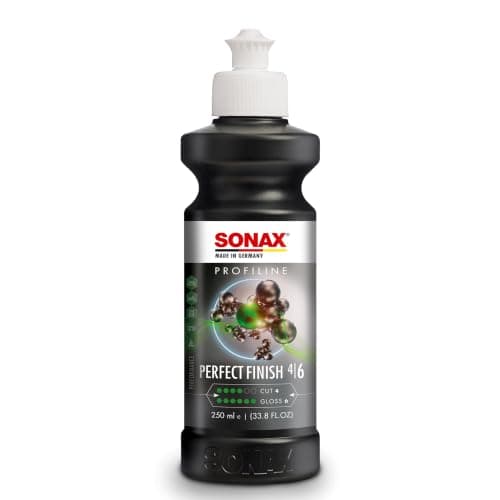
Perfect Finish is the liquid you reach for when the correction is done and you can still see haze under direct sun on black paint. It cuts enough to remove light defects on soft paint and finishes to a genuinely clear gloss that a compound cannot match.
Who should skip it. Defect removal on anything but soft paint. If there are swirls you can see at arm's length, this is the second liquid, not the first.
Cut
5.5
Finish
9.5
Ease of use
8.5
Value
7.5
What works
Finishes to a clarity that compounds do not reach
Enough cut to correct light defects on soft paint in one step
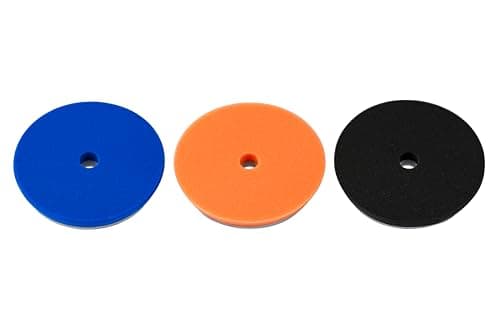
Lake Country makes the foam a great many other brands rebadge, and the HDO line is built specifically for the pressure a long-throw machine puts through a pad. A three-pack of the same pad is more useful than four different ones, because a saturated pad stops cutting and you need a spare mid-panel.
Who should skip it. Short-throw machines under heavy pressure — HDO foam is designed around orbital machines and is firmer than a general-purpose finishing pad. If you only ever finish, buy a softer foam.
Cut
8.0
Finish
8.0
Longevity
8.5
Value
8.5
What works
Multiple identical pads, which is how pads should be bought
Built for the pressure a long-throw machine applies
Lake Country foam is the reference other brands rebadge
What does not
Firmer than a general-purpose finishing foam
5.5 in is too large for tight panels — you will want smaller too
No cutting and finishing variety in a single-type pack
01Wash, decontaminate and dry. Non-negotiable — see how to polish a car for the full prep.
02Tape edges, badges, trim and body lines.
03Test a 2 ft section with a polishing pad and a hybrid compound. Step up to a cutting pad only if that is not enough.
04Work the whole car in 2 ft sections, horizontals first.
05Swap pads every two to three panels. A saturated pad stops cutting.
06Inspect each panel under a light before moving on.
07Wipe down with a panel prep spray if a coating is going on next, to remove polishing oils.
08Protect the same day.
06
The two-step process
Everything above, with one difference: the first pass uses a heavy cut compound on a cutting pad, and a second complete pass follows with a finishing polish on a soft pad. That second pass is what removes the marring the compound left.
The reason to do this is specific: hard clear coat that a hybrid cannot cut, or dark paint where compound haze is visible. On a silver daily driver it is hours of extra work for a result nobody can see. Compound vs polish has the test that tells you which camp you are in.
07
Judging the result honestly
Direct sunlight, low angle, sun behind the panel. This is the only lighting that shows the truth.
A handheld inspection light at a shallow angle in a dark garage is the next best thing, and more repeatable.
Look at the same spot before and after. Memory is unreliable; take a photo of the test section first.
Accept some defects. A perfect finish on a daily driver is not a realistic goal, and chasing the last 5% is where people polish through.
Then change how you wash it. Every swirl this process removed was put there by a wash, and without changing the routine you will be back here in two years with less clear coat to spend.
09
Questions people actually ask
What is paint correction?
The permanent removal of defects from a clear coat by abrading the surface until it is level with the bottom of the defect. Unlike a glaze, which fills and hides, correction removes — which is why the result lasts and why it uses up clear coat.
How many times can you polish a car?
Five or six full corrections across a car's life, roughly. A factory clear coat is about 40 to 50 microns and a meaningful correction removes 2 to 5. Spot work uses far less, which is why addressing individual defects beats correcting the whole car repeatedly.
Is one step or two step paint correction better?
Better for what. A two-step removes more and finishes better on dark or hard paint; a one-step removes the defects most people notice in roughly half the time and spends less clear coat. For a daily driver, a one-step is usually the right call.
Do you need paint correction before a ceramic coating?
You need decontamination. Correction is situational: a coating locks in whatever the paint looks like for years, so any swirl you leave is sealed in. On new paint a chemical decon and panel wipe is often enough — see do you need to polish before coating.
10
Sources
Every published figure on this page traces to one of these. Where a manufacturer does not publish a number, the page says so rather than estimating it.
Last reviewed October 5, 2026. Think a figure here is wrong? Tell us at contact@detailingandwax.com and we will check it, fix it and date the correction — see our editorial policy.