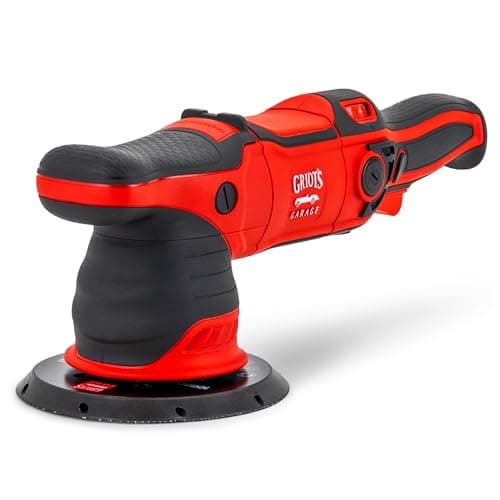
Featured here: the Griot's Garage Griot's Garage G9 Random Orbital Polisher.
How this is funded: we earn an Amazon commission when you buy through our links, at no extra cost to you. We sell nothing and stock nothing, so a pick is never a product we are trying to move. Prices are pulled live from Amazon and were last checked October 5, 2026; where we cannot verify a price we say so rather than print an old one. Full disclosure.
Research-basedPicked from published specifications and the pattern across verified-purchase reports. We have not used these ourselves and do not pretend otherwise.How we pick
Polishing means abrading a thin layer of clear coat so that the surface is level again, which is what makes scratches and swirl marks disappear. It is not a cleaning step and it is not something to do routinely — clear coat is finite, and every correction spends some of it.
02
What polishing does and does not do
What a polish can and cannot reach
Defect
Polishing fixes it?
Notes
Swirl marks from washing
Yes
The most common and the most satisfying to remove
Light scratches you cannot catch a nail in
Yes
These sit in the clear coat
Scratches you can catch a nail in
No
Through the clear. Softens the edges only.
Oxidation and dullness
Yes
Especially dramatic on older single-stage paint
Water spot etching
Sometimes
Test a section; if it does not improve, stop
Bird dropping etching
Sometimes
Same judgment, same test
Stone chips
No
Missing paint. Needs touch-up, not polish.
03
Stage one — wash, roughly 45 minutes
Polishing a dirty car grinds grit into the clear coat. A proper two bucket wash with a pH-neutral shampoo is the minimum, and if you have a pressure washer a foam cannon pre-wash removes most of the loose grit before anything touches the paint.
04
Stage two — decontaminate, roughly 45 minutes
Two separate jobs. An iron remover dissolves bonded brake dust chemically; a clay bar shears off tar, sap and overspray mechanically. Chemical first, always — claying over bonded iron drags those particles across the paint.
Test whether you need to clay at all: put your hand in a plastic sandwich bag and run it over the paint. Rough means clay. Smooth means skip it.
05
What this process needs
A machine, a one-step compound, matched pads and a sealant for afterwards. Prices are live from Amazon.
Griot's GarageSpec-verified
Griot's Garage G9 Random Orbital Polisher
Best for: The default answer for a first serious machine
A 9mm throw and a 1000W motor put the G9 exactly where most home detailers should be: fast enough to finish a car in an afternoon, short enough in the throw to stay predictable near badges and body lines. It is the machine we would buy if we were buying one machine.
Who should skip it. If you already own a competent 8mm machine, this is not the upgrade you think it is — the extra millimeter of throw will not fix inconsistent results. Put the money into better pads and a second liquid instead. It is also heavier than the G8, and you notice that on vertical panels after an hour.
Correction speed
8.5
Control
9.0
Ergonomics
7.5
Build
9.0
Value
8.5
What works
9mm throw is the best general-purpose compromise on the market
1000W does not bog down under pressure on a cutting pad
Griot's lifetime warranty is the strongest in the category
Takes the same 5 in plate and 5.5 in pads as everything else
What does not
Heavier than the G8, which shows on doors and quarters
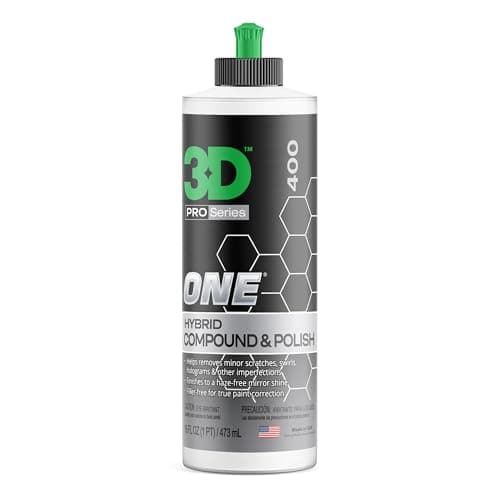
3D ONE is a genuine one-step: it starts as a compound and the abrasives break down as you work, so the same pass that removes the defect also finishes it. On a medium pad it handles most daily-driver swirls and leaves paint that does not need a second liquid.
Who should skip it. Anyone who wants maximum cut. A dedicated heavy compound removes more, faster. ONE is a time-saver and a simplifier, not a defect-removal champion.
Cut
8.0
Finish
9.0
Ease of use
8.5
Value
8.0
What works
Truly finishes down, so most cars need only this one liquid
Very low dusting compared with traditional compounds
Flexible — cut level changes with the pad you pair it with
What does not
Less outright cut than a dedicated heavy compound
Costs noticeably more per ounce than Ultimate Compound
Needs working properly; rushing the pass wastes the diminishing abrasive
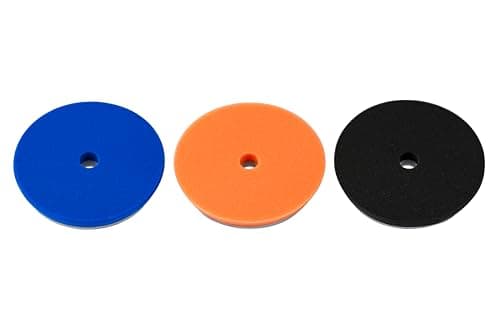
Lake Country makes the foam a great many other brands rebadge, and the HDO line is built specifically for the pressure a long-throw machine puts through a pad. A three-pack of the same pad is more useful than four different ones, because a saturated pad stops cutting and you need a spare mid-panel.
Who should skip it. Short-throw machines under heavy pressure — HDO foam is designed around orbital machines and is firmer than a general-purpose finishing pad. If you only ever finish, buy a softer foam.
Cut
8.0
Finish
8.0
Longevity
8.5
Value
8.5
What works
Multiple identical pads, which is how pads should be bought
Built for the pressure a long-throw machine applies
Lake Country foam is the reference other brands rebadge
What does not
Firmer than a general-purpose finishing foam
5.5 in is too large for tight panels — you will want smaller too
No cutting and finishing variety in a single-type pack
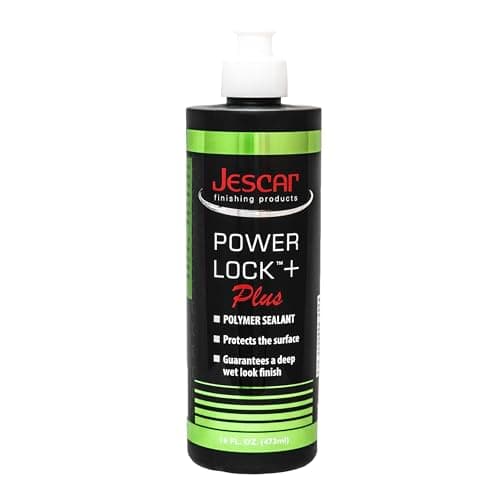
Power Lock Plus is the durability benchmark among consumer sealants, and it applies as easily as anything here — thin coat, short cure, wipe off. If the goal is to protect a car properly and not think about it for six months, this is the product.
Who should skip it. Carnauba warmth. A polymer sealant looks sharp and glassy, and on dark paint some people genuinely prefer the softer carnauba look.
Durability
9.5
Gloss
8.0
Ease of use
8.5
Value
8.5
What works
The longest-lasting sealant in this roundup
Easy, forgiving application for its durability class
Works by hand or by machine
What does not
Glassy rather than warm on dark paint
Needs a properly clean, bare surface to bond
Costs more than the mass-market sealants
Published specifications
Type
Polymer sealant
Claimed durability
Up to 12 months, per Jescar
Volume
16 oz
Form
Liquid
Coating safe
No — a sealant replaces a coating, it does not top one
Do not start on the hood. Pick an inconspicuous 2 ft square — a lower door, the back of the trunk — and correct it with your least aggressive combination first: a polishing pad and a one-step compound. Wipe, inspect under a light, and decide.
Defects gone, no haze: that is your combination. Use it on the whole car.
Defects still visible: step up to a cutting pad with the same liquid, and test again.
Defects gone but hazy: step down to a softer pad, or plan a finishing pass.
No improvement at all with a cutting pad: the defects are deeper than the clear coat. Stop and accept them.
07
Stage four — correct, four to seven hours
Work panel by panel in 2 ft squares. Tape every edge, badge and body line first. Keep the pad flat, move about an inch per second, and work until the compound goes clear. The detailed technique is on how to use a dual action polisher.
Do the horizontal panels first — hood, roof, trunk. They take the most UV and show the most defects, and you will be freshest. Vertical panels and bumpers last, when the technique is in your hands.
08
Stage five — protect, 60 to 90 minutes
Freshly polished paint is completely bare. Whatever was on it is gone, which is precisely why it looks so good and precisely why it must be protected the same day.
A [sealant](/protection/best-paint-sealants) for four to eight months of protection with no cure fuss — the default choice.
A [ceramic coating](/coatings/best-ceramic-coatings-for-cars) if you corrected specifically to coat, and you have a dry space for it to cure.
A [carnauba wax](/protection/best-car-waxes) if you want the warmest look and are happy to repeat it in six weeks.
A polished car left unprotected will look worse in three months than it did before you started, because bare clear coat collects contamination quickly. The full ordered workflow is on the detailing order of operations.
09
Questions people actually ask
How often should you polish a car?
As rarely as the paint allows. Polishing removes clear coat, which is finite. Most daily drivers want a full correction every two to four years with spot work in between. Washing correctly and keeping protection on the paint is what extends that interval.
Can you polish a car by hand?
For a spot repair, yes. For a whole car, it is hours of hard work for a fraction of the result — a machine generates abrading action that a hand cannot. Meguiar's Ultimate Compound is the most hand-friendly option if you are set on it.
Should you polish before or after claying?
After. Claying shears bonded contamination off the surface, and polishing a panel that still has tar and overspray on it drags that contamination under the pad. The order is wash, chemical decon, clay, then polish.
How long does it take to polish a whole car?
Realistically a full day for a first attempt on a mid-size car, including the wash and decontamination that must come first. The polishing itself is four to seven hours; prep is one to two more; protection is another hour.
10
Sources
Every published figure on this page traces to one of these. Where a manufacturer does not publish a number, the page says so rather than estimating it.
Last reviewed October 5, 2026. Think a figure here is wrong? Tell us at contact@detailingandwax.com and we will check it, fix it and date the correction — see our editorial policy.