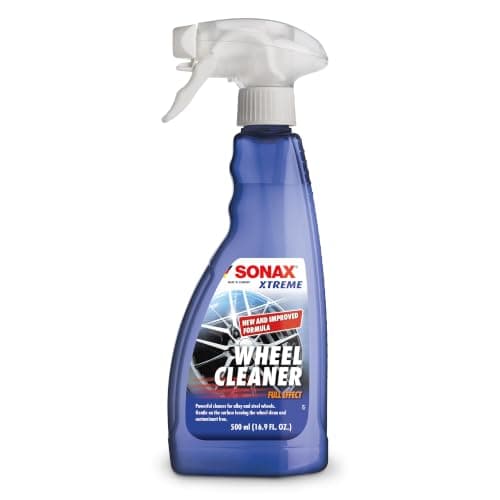
Featured here: the SONAX SONAX Wheel Cleaner Full Effect.
How this is funded: we earn an Amazon commission when you buy through our links, at no extra cost to you. We sell nothing and stock nothing, so a pick is never a product we are trying to move. Prices are pulled live from Amazon and were last checked October 5, 2026; where we cannot verify a price we say so rather than print an old one. Full disclosure.
Research-basedPicked from published specifications and the pattern across verified-purchase reports. We have not used these ourselves and do not pretend otherwise.How we pick
The verdict
On painted or clear-coated alloy — which is almost every modern car — use an iron-dissolving cleaner. On black, satin or matte finishes use a pH-neutral one, because the stronger chemistries dull them over time. On polished or anodized aluminum, never use anything acidic.
02
Identify your finish first
Which chemistry for which finish
Finish
How to tell
Use
Never use
Painted alloy
Glossy, usually silver or gray, feels like paint
Iron-dissolving or pH-neutral
Acidic
Clear-coated alloy
Like painted, often a slight depth
Iron-dissolving or pH-neutral
Acidic
Black or satin
Matte or low-gloss dark finish
pH-neutral
Iron-dissolving repeatedly, acidic ever
Polished aluminum
Mirror-like, no clear coat
pH-neutral only
Acidic — it etches instantly
Anodized
Colored metal, slightly matte sheen
pH-neutral only
Acidic
Chrome
Mirror-like, cold to touch
pH-neutral
Acidic
Coated (ceramic)
Water beads off the wheel
pH-neutral
Anything stronger — it shortens the coating
03
One of each chemistry, with live prices
An iron-dissolving cleaner, a pH-balanced cleaner for dark finishes, a dilutable non-acid cleaner and a gel.
Non-acidic, color-changing, and it dissolves bonded brake dust rather than relying on you to scrub it off. Safe on painted, clear-coated and anodized wheels, which covers essentially every modern car.
Who should skip it. Baked-on neglect. Even the best chemical cleaner needs a brush for a wheel that has not been touched in two years, and expecting a spray to do it alone is how people conclude nothing works.
Cleaning power
9.5
Finish safety
9.5
Dwell behavior
8.5
Value
7.5
What works
Dissolves bonded brake dust rather than needing scrubbing
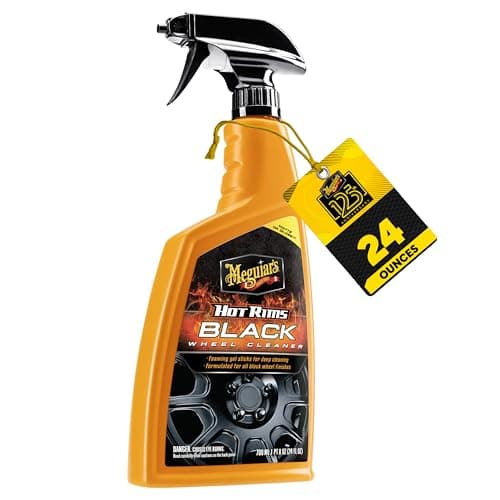
Formulated for the dark and satin-black finishes that have become standard on modern cars, and that some stronger cleaners dull over time. Mild, pH-balanced and cheap enough to use every wash.
Who should skip it. Heavy brake dust. It is deliberately gentle, which is the point, and on a neglected wheel it is simply too mild to finish the job.
Cleaning power
6.5
Finish safety
9.5
Dwell behavior
7.5
Value
9.5
What works
Formulated specifically for dark and satin finishes
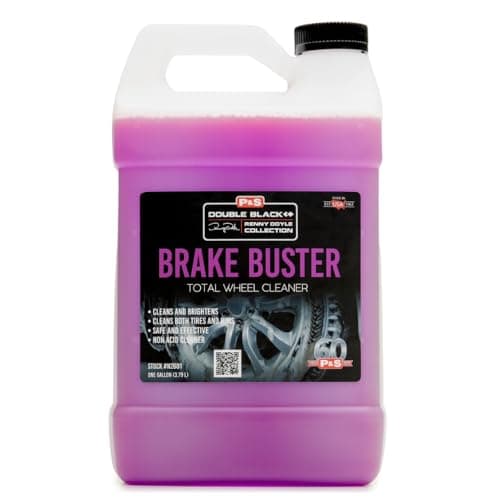
Brake Buster is the professional default, and the reason is that it cleans the tire sidewall as well as the wheel — which is normally two products. Non-acid, dilutable, and a gallon lasts a very long time.
Who should skip it. Heavily bonded iron. It is a surfactant-based cleaner rather than an iron remover, so a wheel with baked-in fallout still wants a dedicated iron product.
Cleaning power
8.5
Finish safety
9.5
Dwell behavior
8.5
Value
9.0
What works
Cleans the tire sidewall as well as the wheel
Dilutable, so it is cheap per wheel
The professional default with a long track record
What does not
Not an iron remover — bonded fallout needs more
No color change, so progress is harder to judge
P&S does not publish a bottle volume we could verify
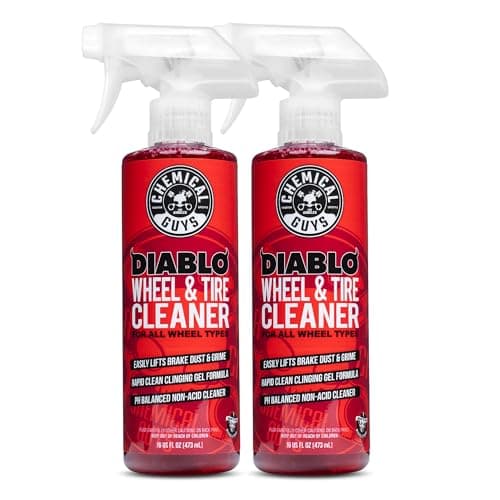
The gel format is the feature: it clings to the wheel instead of running straight off onto the driveway, which means the dwell time is real rather than theoretical. Two 16 oz bottles in the pack.
Who should skip it. Fast work. Gel takes longer to rinse off completely than a thin liquid, and residue in the barrel is a common complaint if you rush it.
Cleaning power
8.5
Finish safety
9.0
Dwell behavior
9.5
Value
8.5
What works
Gel clings, so the dwell time actually happens
Listed safe on polished wheels, which is rare
Two bottles in the pack
What does not
Slower and harder to rinse fully
No color change
Chemical Guys does not publish a dwell time we could verify
Published specifications
Chemistry
Non-acidic gel
Volume
2 x 16 oz
Safe on
Painted, clear-coated and polished wheels, per Chemical Guys
Dark and satin finishes have become standard on modern cars and they are more delicate than they look. The matte appearance comes from a textured clear coat, and repeated use of strong cleaners dulls it unevenly — which shows as patchiness that no polish fixes, because polishing a matte finish makes it glossy.
A mild pH-balanced cleaner used weekly beats a strong cleaner used monthly on these wheels. Meguiar's Hot Rims Black is formulated for exactly this, and the wider list is on the wheel cleaner roundup.
05
The color-change question
Iron-dissolving cleaners turn purple as they work. That is the reaction dissolving bonded iron, and it is genuinely useful feedback — you can see where the brake dust is and whether the dwell has been long enough.
It is not a measure of how dirty the wheel is, and a cleaner that does not change color is not weaker. P&S Brake Buster has no color change and cleans extremely well; it is simply a surfactant doing the work rather than an iron-specific reaction.
06
Dedicated cleaner against a general APC
A diluted APC will clean a lightly dusty wheel perfectly well and costs far less.
It will not touch bonded brake dust, which needs iron chemistry or a lot of brushing.
It is not formulated for wheel finishes, and some APCs stain bare aluminum.
The practical answer: APC at 10:1 for weekly maintenance on painted wheels, a dedicated iron-dissolving cleaner every month or two.
07
Questions people actually ask
What wheel cleaner is safe for black rims?
A pH-neutral or pH-balanced cleaner. Black and satin finishes get their look from a textured clear coat, and repeated use of stronger chemistries dulls it unevenly — which cannot be polished out, because polishing a matte finish makes it glossy.
Can you use acidic wheel cleaner on alloy wheels?
Not on polished or anodized aluminum, where it etches on contact. On painted or clear-coated alloy it will work and it is unnecessary risk — an iron-dissolving cleaner does the same job without the possibility of permanent damage.
Does a wheel cleaner have to change color to work?
No. The purple change is specific to iron-dissolving chemistry and it is useful feedback rather than a measure of cleaning power. Surfactant-based cleaners like P&S Brake Buster clean very well with no color change at all.
Can you use all purpose cleaner on wheels?
Diluted, on painted wheels, for light maintenance — yes, and it is cheap. It will not touch bonded brake dust, and some APCs stain bare aluminum. Keep a dedicated iron-dissolving cleaner for every month or two.
08
Sources
Every published figure on this page traces to one of these. Where a manufacturer does not publish a number, the page says so rather than estimating it.
Last reviewed October 5, 2026. Think a figure here is wrong? Tell us at contact@detailingandwax.com and we will check it, fix it and date the correction — see our editorial policy.