Independent picks for detailing your own car. We stock nothing, so we have nothing to move.
01
Wheels, tires & trim
The best wheel coatings
A wheel is the only part of your car that gets cooked, acid-washed and sandblasted with hot iron in the same week. One maker publishes figures for all three. The rest publish adjectives.
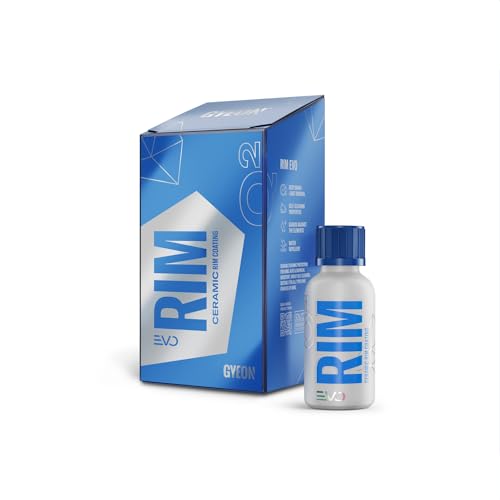
Our top pick: the GYEON Q² Rim Ceramic Wheel Coating Kit.
How this is funded: we earn an Amazon commission when you buy through our links, at no extra cost to you. We sell nothing and stock nothing, so a pick is never a product we are trying to move. Prices are pulled live from Amazon and were last checked November 19, 2026; where we cannot verify a price we say so rather than print an old one. Full disclosure.
Research-basedPicked from published manufacturer specifications and the consistent pattern across verified-purchase owner reports. Every product here scores 8.4 or better on our rubric.How we pick
Best wheel coatingGYEON
GYEON Q² Rim Ceramic Wheel Coating Kit
Gyeon publish Q² Rim the way a coating should be published: a real-world lifespan of up to 18 months or 45,000 km, temperature resistance over 800 degrees C, a pH tolerance of 2 to 11, and a consumption figure.
Tap any row for the full write-up. Prices come straight from Amazon and are never typed in by hand.
The verdict
GYEON Q² Rim is the pick, and it wins on published evidence rather than on reputation: up to 18 months or 45,000 km of claimed life, temperature resistance over 800 degrees C, a pH tolerance of 2 to 11, and a consumption figure. No other wheel coating sold to home detailers publishes any of that. Gtechniq C5 Wheel Armor is the alternative with the deeper track record and a longer claim, if you are content with a brand claim instead of a datasheet. Chemical Guys Wheel Guard is the sensible answer for anyone who wants protected wheels this afternoon rather than next weekend, and the SONAX detailer is the cheapest way to keep a real coating beading between washes.
02
Why wheels need a different coating from paint
A paint coating has to survive UV, rain, bird mess and car wash chemicals. A wheel coating has to survive all of that plus two things paint never sees: brake temperatures that routinely exceed anything on the bodywork, and a weekly dose of either an acidic or an iron-dissolving cleaner designed to dissolve metal particles. Those two stresses are why a general paint coating sprayed onto wheels is a short-lived idea, and why the products on this page are formulated and priced differently.
Brake dust is the mechanism that matters. It is not dirt. It is hot iron particles from the rotor and pad, embedded into the wheel's clear coat while they are still soft enough to do it. Left there they oxidize, and the brown speckling on a neglected wheel is rust growing in the finish rather than sitting on it. A coating stops that by giving the particles nothing to embed into, which is why a coated wheel rinses clean with a hose when an uncoated one needs chemistry.
The second mechanism is the cleaner itself. Every effective wheel cleaner is either iron-dissolving or acidic, and both strip wax and most paint sealants on contact. A wheel coating has to tolerate a pH range that a paint product never meets — which is exactly the figure Gyeon publish and nobody else does. Wheel cleaner types compared goes through which chemistry suits which finish, and it is worth reading before you coat anything, because the coating has to survive whatever you already use.
03
The criteria, in the order they decide the purchase
01A published heat figure. The inside face of a wheel barrel sits next to a rotor that can glow. A coating with no published temperature rating is a coating whose maker has not told you where it stops working.
02A published pH tolerance. If your wheel cleaner is acidic or iron-dissolving — and the good ones are — the coating needs to survive it weekly.
03A published durability figure, from the maker. Not from a store listing. This category is full of two-year claims that trace back to retailer copy and nowhere else.
04Whether it covers the barrels. Most of the brake dust lands on the inside of the wheel, which is also the hardest part to coat. A 15 ml bottle that only does the faces is half a job.
05How much prep and cure it demands. A coating that needs the wheels off the car, a degrease, a fifteen-minute dry and an overnight cure indoors is a different purchase from a wipe-on sealant.
04
Coating, sealant or topper — three different products
The word 'coating' gets applied to all three of these, and they are not the same purchase. The difference is how the product attaches and how long it survives, and it maps almost exactly onto price.
Three product classes, all sold as wheel protection
SiO2 wheel coating
Wheel sealant
Hydrophobic detailer
On this page
Gyeon Q² Rim, Gtechniq C5, CARPRO DLUX
Chemical Guys Wheel Guard
SONAX Ceramic Tire + Wheel
Claimed life
A year or more
A season
Until the next wash
Prep
Degrease, dry, usually wheels off
Clean and dry wheels
Clean and dry wheels
Cure
Hours indoors, out of the weather
None published
None
Survives acidic cleaner
Yes, where pH tolerance is published
Partly
No — it is reapplied anyway
Bottle size
15 to 30 ml, one car
8 oz, several cars
750 ml, many washes
Right for
A wheel you intend to keep clean for a year
A wheel you want protected today
Maintaining a coating, and the tires
This is also why the page features wheel-specific chemistry only. Several excellent general-purpose ceramic sprays list wheels among their surfaces — Griot's 3-in-1, Turtle Wax Hybrid Solutions, Mothers CMX — and every one of them is a paint product with wheels added to the label. They work, briefly, and they are the wrong answer to this question. If a paint coating is what you actually want, the best ceramic coatings for cars is the page for it.
05
The ranked wheel coatings
Ordered on published heat, pH and durability figures first, then on coverage and prep burden. Prices are live from Amazon.
No. 01GYEONCategory-definingSpec-verified
GYEON Q² Rim Ceramic Wheel Coating Kit
Best for: The only wheel coating with a published spec sheet
Gyeon publish Q² Rim the way a coating should be published: a real-world lifespan of up to 18 months or 45,000 km, temperature resistance over 800 degrees C, a pH tolerance of 2 to 11, and a consumption figure. Every one of those numbers matters on a wheel, because a wheel is the only panel on the car that gets cooked, acid-washed and sandblasted with iron in the same week.
Claimed durability
Exceptional
Heat resistance
Exceptional
Published evidence
Exceptional
Value
Good
Why we picked it
The only product in this group with published durability, heat and pH figures
Over 800 degrees C rating is the figure that matters on a brake-heated wheel
pH 2 to 11 tolerance means acidic wheel cleaners will not strip it
Consumption is published, so you know 30 ml is one set of wheels and a spare
Good to know. Dearest kit here, 30 ml is one set of wheels, and the wipe-off window is 10 to 30 seconds.
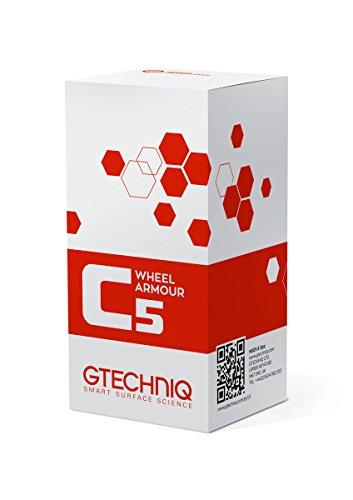
C5 is the wheel coating with the deepest track record: a 15 ml bottle, a wipe-on application, and a claimed life of up to two years on properly prepared wheels. It is the product that made brake-dust-resistant wheels a thing home detailers could do, and on a painted or clear-coated alloy it still does that job as well as anything.
Claimed durability
Exceptional
Heat resistance
Strong
Published evidence
Adequate
Value
Strong
Why we picked it
Longest claimed life of any wheel coating here
Single application covers a set of wheels, including the faces of the spokes
The most widely used wheel coating in the enthusiast world, so prep advice is everywhere
Makes brake dust rinse off rather than needing a dedicated wheel cleaner
Good to know. 15 ml is one set of wheels at a premium price, and no datasheet backs the two-year claim.
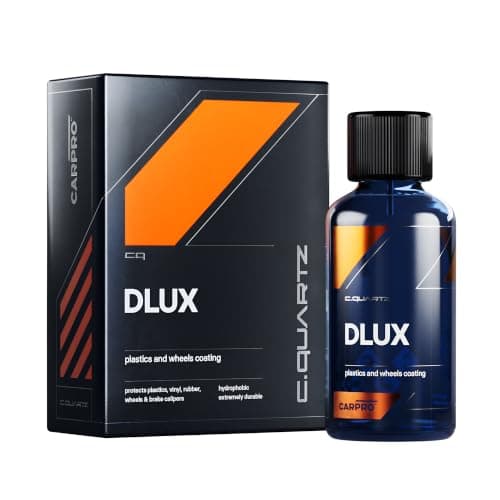
DLUX coats plastic trim and wheels alike, which is sensible because both face the same problem — heat, brake dust and UV. It is the longest-lasting trim treatment here and it demands the most careful prep.
Effectiveness
Exceptional
Durability
Exceptional
Ease of use
Adequate
Value
Good
Why we picked it
Works on wheels and trim from one bottle
Longest claimed life of any trim product here
Makes wheels dramatically easier to clean
Good to know. 30 ml is a small bottle at a premium price
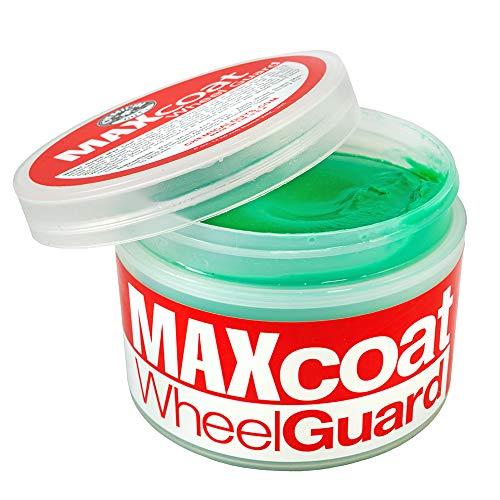
Wheel Guard is a sealant rather than a ceramic coating, and that is the point: 8 oz of wipe-on product, no cure window, no panel-wipe prep, no fifteen-minute wait. It will not survive a season of track days the way C5 claims to, but it is the honest answer for someone who wants protected wheels this afternoon.
Claimed durability
Adequate
Heat resistance
Adequate
Published evidence
Trade-off
Value
Exceptional
Why we picked it
No cure window and no panel-wipe step — it is a wipe-on afternoon job
8 oz is several sets of wheels, so the cost per application is the lowest here
Published as safe on every wheel finish, including the ones acid ruins
Adds visible gloss as well as making the rinse easier
Good to know. 8 oz covers several sets of wheels, which makes it the cheapest per application - but it is a seasonal sealant, not a coating.
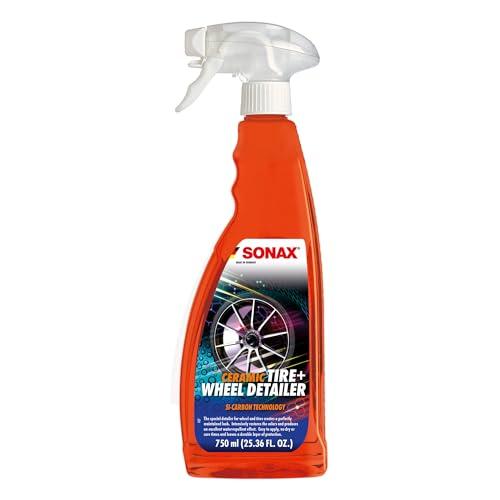
This is not a durable wheel coating and SONAX do not sell it as one — it is a hydrophobic detailer for wheels and tires in a 750 ml trigger bottle, published as safe on painted, chrome and aluminum wheels. As the thing you spray on after every wash to keep a real coating beading, and to stop the tire sidewalls going brown, it is the best value on this page.
Claimed durability
Trade-off
Heat resistance
Adequate
Published evidence
Good
Value
Exceptional
Why we picked it
750 ml at this price is the cheapest per application on the page by a long way
Does the tire sidewalls as well as the wheels, which no coating here does
Published safe on chrome and aluminum, where wheel chemicals usually are not
Perfect maintenance layer over a real SiO2 coating
Good to know. A 750 ml trigger bottle is bulky next to a 15 ml coating, and it is a wash-day topper rather than protection you can plan around.
Published specifications
Claimed durability
Not published
What it is
Hydrophobic detailer for wheels and tires, not a durable coating
A wheel that has been on the road for a year is carrying embedded iron, baked tire dressing overspray, brake pad adhesive and whatever sealant it last had. A coating applied over any of that bonds to the contaminant. The strip is not optional and it takes longer than the coating does.
01Wash the wheels, then use an iron remover and let it do its work without drying. The color change is the reaction finishing, not a gimmick — the best iron removers covers what actually dissolves embedded particles.
02Clay or mitt the faces and the barrels. Iron remover gets the embedded particles; the physical pass gets the film.
03Degrease. Gyeon specify their own prep product and a fifteen-minute dry; an isopropyl alcohol panel wipe is the generic equivalent. Any residual dressing or polish oil and the coating will not bond.
04Coat a cool, bone-dry wheel, working one section at a time, and level and wipe off inside the window the maker publishes. Gyeon's is ten to thirty seconds.
05Keep the wheels dry and indoors through the cure period, then put them back on the car. This is the step that turns a coating into a bonded coating.
07
Heat, and why 800 degrees is not marketing
The headline heat figures in this category sound absurd until you look at where a wheel coating actually sits. A hard stop from highway speed puts a rotor well past 400 degrees C, and the inner barrel of the wheel is a few centimeters away from it, radiating. On a track day, or towing down a long grade, rotor temperatures go considerably higher than that.
A coating that degrades at those temperatures does not peel visibly. It simply stops being hydrophobic on the inner barrel — the part you never look at and the part that collects the most iron. That is the failure mode, and it is invisible until you notice the barrels are brown again while the faces still bead. A published figure over 800 degrees C is a maker saying that will not happen; no published figure is a maker declining to say either way.
For a normal road car driven normally, this matters less than the pH tolerance does. Weekly contact with an iron-dissolving cleaner is a certainty; 800-degree rotor temperatures are not. But the two figures tend to travel together, because a maker who tests for one tends to publish both, and that is the real reason the ranking on this page looks the way it does.
What a wheel coating does not do
It does not make a wheel self-cleaning. A coated wheel still needs washing — it just washes with a hose and a pH-neutral shampoo instead of needing chemistry every time. It also does nothing for a wheel whose clear coat has already failed; a coating over peeling lacquer seals the peeling in place. And it does nothing for the tire, which is the other half of how a wheel looks. The best tire shine covers that, and the SONAX product on this page is the one item here that does both at once.
08
Your wheel finish changes the answer
Everything above assumes a painted or clear-coated alloy wheel, which is what almost every modern car leaves the factory with. Three other finishes are common enough to matter, and on two of them the coating decision is different.
Four wheel finishes, and whether a coating is the right purchase
Finish
Does a coating help?
What to watch
Painted or clear-coated alloy
Yes — this is the case every product here is designed for
Nothing. Strip, degrease, coat, and the weekly wash gets easier
Powder-coated alloy
Yes, and arguably more
Powder coat is porous enough to hold brake dust in the texture; a coating is what stops that
Polished or bare aluminum
Yes, and it is the finish that needs it most
Bare aluminum oxidizes and stains. Never let an acidic cleaner near it, coated or not
Chrome
A sealant yes, a hard coating is usually wasted
Chrome is already non-porous. The SONAX detailer is published as chrome-safe and is the sensible answer
The finish also decides what you can clean the wheel with afterwards, which is where a published pH tolerance stops being an abstraction. An acidic cleaner permanently etches polished and anodized aluminum and dulls chrome, and no coating protects against that — it protects the coating, not the metal underneath. On any finish other than painted alloy, the right routine is a pH-neutral shampoo plus an iron remover, and the coating exists to make that gentler routine sufficient.
09
Cost per year, which is the only fair comparison
Bottle prices in this category are misleading because the volumes are so different. A 15 ml coating with a claimed two-year life, a 30 ml kit claiming eighteen months, an 8 oz sealant good for several applications a season, and a 750 ml detailer used every wash are four different financial propositions, and the cheapest bottle is comfortably the most expensive option over three years.
The honest framing is this: a real SiO2 coating costs more up front and buys you an afternoon of prep once, then a year or more of hose-and-shampoo washing. A sealant costs less and buys you a season. A detailer costs least per bottle and is a recurring task forever. Any of the three is a defensible choice — what is not defensible is paying coating money and skipping the prep, which produces sealant durability at coating prices.
If you only ever buy one thing off this page, and your wheels are painted or clear-coated alloys on a daily driver, the sensible purchase is the wheel sealant plus a pH-neutral shampoo. If you are the kind of owner who already reads how to clean wheels and tires before buying anything, buy the Gyeon kit and take the wheels off.
10
Our recommendation
Buy this one
GYEON Q² Rim Ceramic Wheel Coating Kit
Gyeon publish Q² Rim the way a coating should be published: a real-world lifespan of up to 18 months or 45,000 km, temperature resistance over 800 degrees C, a pH tolerance of 2 to 11, and a consumption figure.
C5 is the wheel coating with the deepest track record: a 15 ml bottle, a wipe-on application, and a claimed life of up to two years on properly prepared wheels.
GYEON Q² Rim, because it is the only wheel coating sold to home detailers that publishes the figures the job actually depends on: up to 18 months or 45,000 km of claimed life, temperature resistance over 800 degrees C, pH tolerance of 2 to 11, and a consumption figure of 15 to 20 ml per set. Gtechniq C5 Wheel Armor claims longer and has a deeper track record, but its durability and heat figures come from retailer listings rather than a manufacturer datasheet.
How long do ceramic wheel coatings last?
The published range is roughly a year to two years, and the only figure with a datasheet behind it is Gyeon's up to 18 months or 45,000 km. In practice the life depends almost entirely on prep: a coating applied over embedded iron or residual tire dressing bonds to the contaminant instead of the wheel and will be gone in months. A wheel sealant rather than a coating is a seasonal product.
Can you use a regular ceramic coating on wheels?
You can, and it will work briefly. A paint coating is not formulated for brake temperatures or for weekly contact with an acidic or iron-dissolving wheel cleaner, which is what separates the products on this page from the general sprays that list wheels on the label. If you want one bottle for everything, expect to reapply it to the wheels several times a year.
Do you need to take the wheels off to coat them?
Not strictly, but most of the brake dust lands on the inside of the barrel and you cannot reach that properly with the wheel on the car. Coating the faces only still improves washing and still looks good; it leaves the dirtiest and hottest surface unprotected. If you are already committing to the prep, jacking the car up is the smallest part of the afternoon.
Will a wheel coating stop brake dust?
It stops brake dust embedding, which is the damage. Hot iron particles from the rotor normally bed into a wheel's clear coat and then oxidize, which is what the brown speckling on a neglected wheel actually is. A coating gives the particles nothing to embed into, so they rinse off with water instead of needing chemistry. The dust still lands on the wheel — it just leaves again.
What is the difference between a wheel coating and a wheel sealant?
A SiO2 coating forms a hard, chemically bonded layer, claims a year or more, and demands a full degrease and a cure period. A sealant is a softer sacrificial layer that wipes on in minutes with no cure and lasts a season. Chemical Guys Wheel Guard is the sealant here and it is the right answer if you want protected wheels the same afternoon; the Gyeon and Gtechniq products are coatings and they want a weekend.
Can you put a wheel coating over an existing sealant?
No. Every coating here needs to bond to bare wheel finish, and an existing wax or sealant is exactly the barrier that stops that. The strip step — iron remover, physical decontamination, then a degrease or alcohol panel wipe — is what removes the old layer. Skipping it is the single most common reason a coating lasts months instead of a year.
12
Sources
Every published figure on this page traces to one of these. Where a manufacturer does not publish a number, the page says so rather than estimating it.
Last reviewed November 10, 2026. Think a figure here is wrong? Tell us at contact@detailingandwax.com and we will check it, fix it and date the correction — see our editorial policy.