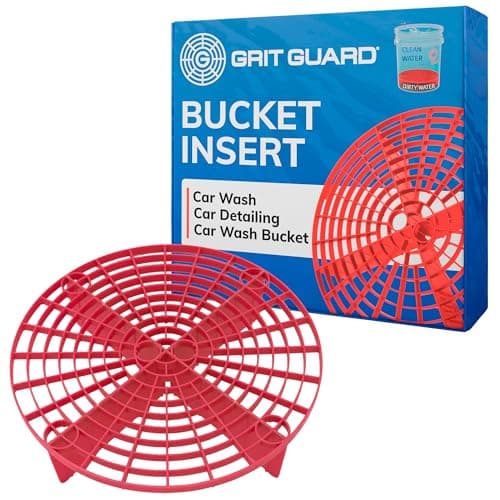
Featured here: the Grit Guard Grit Guard Original Bucket Insert.
How this is funded: we earn an Amazon commission when you buy through our links, at no extra cost to you. We sell nothing and stock nothing, so a pick is never a product we are trying to move. Prices are pulled live from Amazon and were last checked October 5, 2026; where we cannot verify a price we say so rather than print an old one. Full disclosure.
Research-basedPicked from published specifications and the pattern across verified-purchase reports. We have not used these ourselves and do not pretend otherwise.How we pick
Almost every swirl mark on a car's paint was put there during a wash, by grit in the wash mitt being dragged across the clear coat. The two bucket method is the technique that gets that grit out of the mitt before it goes back on the car, and it is the single highest-return change available to anyone washing their own car.
02
Why one bucket fails
With a single bucket, every dunk puts the grit you just removed back into suspension and then back onto the mitt. Two panels in, you are washing the car with dirty water and a loaded mitt, and the rest of the wash is actively damaging the paint.
The second bucket is plain water whose only job is to take grit off the mitt. The grit settles below the grit guard and stays there. The soap in the wash bucket stays clean, because nothing dirty ever goes into it.
03
What the method needs
Two grit guards, a deep-pile mitt and a slippery shampoo. The buckets themselves are cheaper from a hardware store. Prices are live from Amazon.
Grit GuardSpec-verified
Grit Guard Original Bucket Insert
Best for: The single cheapest upgrade on this entire site
A plastic grid that sits in the bottom of the bucket, keeps settled grit down there, and gives you something to scrub the mitt against. It costs almost nothing and it prevents more paint damage per dollar than any product we have written about.
Who should skip it. Nothing. Buy two — one for the wash bucket and one for the rinse bucket. There is no scenario where a single grit guard is the right answer.
Effectiveness
9.0
Durability
9.5
Fit
9.0
Value
10.0
What works
The cheapest meaningful paint-safety upgrade available
Deep, dense microfiber with enough pile to pull grit up and away from the paint rather than trapping it against the surface. Two in the pack, which matters — a mitt that hits the ground is finished, and having a spare stops people picking it up and carrying on.
Who should skip it. Nothing much. It is more expensive than a chenille mitt and worth it, but if your washing technique is the actual problem a better mitt will not save you.
Grit release
9.0
Capacity
9.0
Durability
8.5
Value
8.0
What works
Deep pile pulls grit away from the panel
Two in the pack, so a dropped mitt is not a crisis
Rinses out cleanly between panels
What does not
More expensive than a chenille mitt
Bulky and slow to dry
The Rag Company does not publish a GSM figure for this one
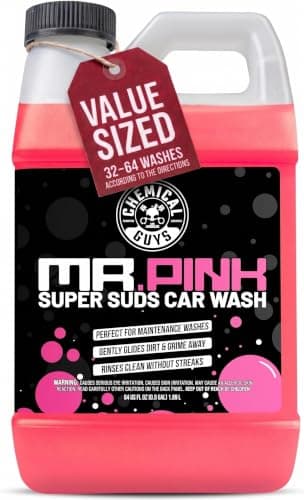
Mr. Pink is pH-neutral, extremely slippery, and works in both a bucket and a foam cannon, which is why it ends up on more shelves than anything else in this category. It does not strip wax or sealant, and it suds enough that you can see where you have washed.
Who should skip it. Stripping a car before a coating — it is deliberately gentle and leaves everything on the paint. It is also not the best foam producer if a thick cannon foam is what you are after.
Lubricity
9.0
Cleaning
7.5
Suds
8.0
Coating safe
9.5
Value
8.5
What works
Genuinely slippery, which is what reduces wash marring
Works in a bucket and a cannon equally well
Safe over wax, sealant and ceramic coatings
What does not
Not a stripping wash — the wrong choice before a coating
Thinner cannon foam than dedicated snow foams
Chemical Guys publishes no dilution ratio we could verify
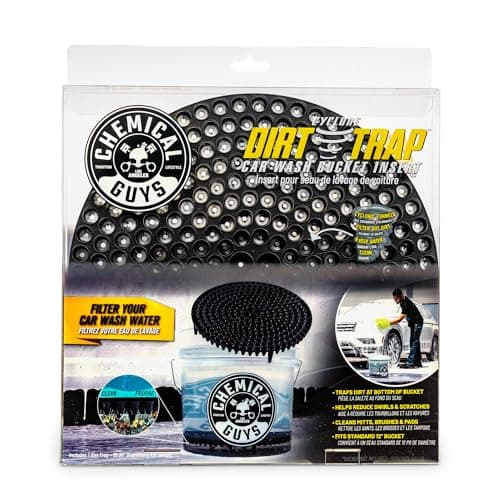
Same idea as the original grit guard with deeper vanes that encourage the water to swirl rather than just settle. Whether that is a real improvement or a marketing flourish is hard to prove, but it is the same money and it does no harm.
Who should skip it. Shallow buckets. The deeper profile eats more bucket depth than the flat original, which matters in a 3.5 gallon bucket.
The wash bucket accumulates grit too, and it goes straight back on the car
Not scrubbing the mitt on the guard
Dunking alone does not dislodge embedded grit
Washing lower panels before upper
Lower panels carry far more grit, and you carry it upward
Carrying on after dropping the mitt
Driveway grit embeds invisibly and scratches for the rest of the wash
Letting the car dry between panels
Water spots, and you have to wash areas twice
Using the paint mitt on wheels
Brake dust embeds in the pile permanently
07
Three buckets, and when it is worth it
The third bucket is for wheels and tires, with its own brushes, its own soap and its own water. It never touches the paint side of the operation. Brake dust is metallic and it embeds in wash media permanently, so this is the cheapest possible guarantee that it stays away from your clear coat.
Washing with one bucket of soapy water and a second of plain water, both with grit guards. After every panel the mitt goes into the rinse bucket and is scrubbed on the guard, so the grit it picked up leaves there instead of returning to the paint.
Does the two bucket method really work?
Yes, and it is the highest-return change available because it costs almost nothing. With one bucket, every dunk reloads the mitt with the grit you just removed, and two panels in you are actively scratching the paint.
Do you need grit guards in both buckets?
Yes. The wash bucket accumulates grit too — not all of it leaves the mitt in the rinse bucket — and without a guard that settled grit gets stirred back up and onto the car every time you dunk.
Should you wash a car top to bottom or bottom to top?
Top to bottom. Lower panels, rockers and bumpers carry far more grit than the roof and hood, so washing them first and working upward carries that grit onto the cleanest, most visible panels.
09
Sources
Every published figure on this page traces to one of these. Where a manufacturer does not publish a number, the page says so rather than estimating it.
Last reviewed October 5, 2026. Think a figure here is wrong? Tell us at contact@detailingandwax.com and we will check it, fix it and date the correction — see our editorial policy.