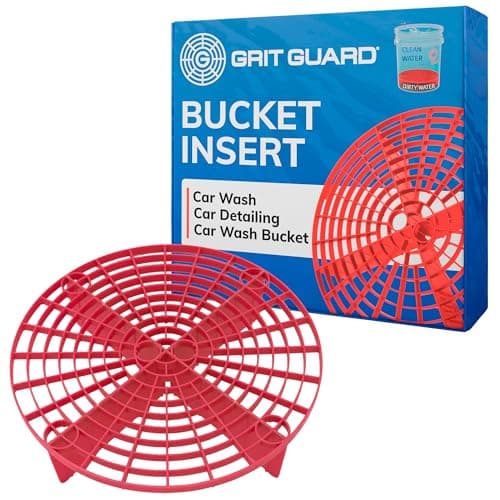
Our top pick: the Grit Guard Grit Guard Original Bucket Insert.
How this is funded: we earn an Amazon commission when you buy through our links, at no extra cost to you. We sell nothing and stock nothing, so a pick is never a product we are trying to move. Prices are pulled live from Amazon and were last checked October 5, 2026; where we cannot verify a price we say so rather than print an old one. Full disclosure.
Research-basedPicked from published specifications and the pattern across verified-purchase reports. We have not used these ourselves and do not pretend otherwise.How we pick
Tap any row for the full write-up. Prices come straight from Amazon and are never typed in by hand.
The verdict
Buy two Grit Guard inserts and two five-gallon buckets from a hardware store. That is the cheapest complete setup and it is also the best one — a five-gallon bucket holds more water than the 3.5-gallon kits, and more water means more dilution of the grit you rinse off.
02
What a grit guard actually does
It is a plastic grid that sits in the bottom of the bucket and does two things. It keeps settled grit below the grid, so dunking the mitt does not stir it back into suspension. And it gives you a hard surface to scrub the mitt against, which is what dislodges the grit in the first place.
Neither of those is sophisticated and both are genuinely effective. For roughly ten dollars each, this is the highest paint-safety return per dollar anywhere in detailing — more than any soap, mitt or wax on this site.
03
The ranked picks
A bare insert, a deeper-vane insert, and a complete bucket kit. Prices are live from Amazon.
No. 01Grit GuardSpec-verified
Grit Guard Original Bucket Insert
Best for: The single cheapest upgrade on this entire site
A plastic grid that sits in the bottom of the bucket, keeps settled grit down there, and gives you something to scrub the mitt against. It costs almost nothing and it prevents more paint damage per dollar than any product we have written about.
Who should skip it. Nothing. Buy two — one for the wash bucket and one for the rinse bucket. There is no scenario where a single grit guard is the right answer.
Effectiveness
9.0
Durability
9.5
Fit
9.0
Value
10.0
What works
The cheapest meaningful paint-safety upgrade available
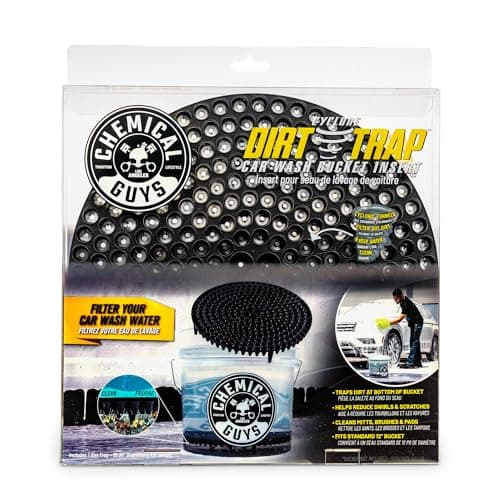
Same idea as the original grit guard with deeper vanes that encourage the water to swirl rather than just settle. Whether that is a real improvement or a marketing flourish is hard to prove, but it is the same money and it does no harm.
Who should skip it. Shallow buckets. The deeper profile eats more bucket depth than the flat original, which matters in a 3.5 gallon bucket.
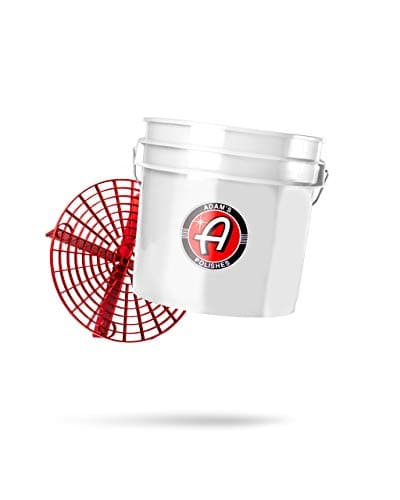
A 3.5 gallon bucket with the grit guard already in it. Buying two of these is the complete two-bucket setup in a single order, which removes the most common reason people never get around to it.
Who should skip it. Anyone who already owns buckets. A 5 gallon bucket from a hardware store plus a grit guard is cheaper and holds more water, which is genuinely better.
Effectiveness
8.5
Durability
8.5
Fit
9.0
Value
7.0
What works
Complete setup in one purchase
Grit guard sized correctly for the bucket
Sturdier than a hardware-store bucket
What does not
3.5 gallons is less water than a standard 5 gallon bucket
One bucket of soapy water becomes a bucket of gritty soapy water within two panels, and every subsequent dunk reloads the mitt with everything you just removed from the car. The second bucket is plain water whose only job is to take the grit off the mitt before it goes back into the soap.
01Wash bucket — soap and water, with a grit guard.
02Rinse bucket — plain water, with a grit guard.
03After every panel: mitt into the rinse bucket, scrub it on the guard, wring it out, then back into the soap.
04A third bucket for wheels, if you have the space. Wheel water never goes near paint.
Five gallons beats 3.5 gallons. More water dilutes the grit further and means fewer trips to refill.
A lid is genuinely useful for storing everything inside the bucket between washes.
A dolly matters more than you expect if your driveway is long. Two full buckets are heavy.
Opaque buckets are better than clear — you want to not see what settles, because you will be tempted to tip it out mid-wash.
06
Questions people actually ask
Do grit guards actually work?
Yes. They keep settled grit below the grid so dunking the mitt does not stir it back up, and they give you a surface to scrub the mitt against. For about ten dollars it is the highest paint-safety return per dollar in detailing.
Do you need two buckets to wash a car?
Yes. One bucket becomes gritty soapy water within two panels, and every dunk after that reloads the mitt. The second bucket is plain water whose only job is to take grit off the mitt before it goes back into the soap.
What size bucket is best for washing a car?
Five gallons. More water dilutes the grit further than a 3.5-gallon bucket and means fewer refills. A hardware store five-gallon bucket plus a grit guard is cheaper and better than most purpose-made kits.
Should you use a separate bucket for wheels?
Yes, if you have space. Brake dust is metallic and embeds in a mitt permanently, so wheel water and wheel media should never come near paint. A third bucket is the cheapest way to guarantee that.
07
Sources
Every published figure on this page traces to one of these. Where a manufacturer does not publish a number, the page says so rather than estimating it.
Last reviewed October 5, 2026. Think a figure here is wrong? Tell us at contact@detailingandwax.com and we will check it, fix it and date the correction — see our editorial policy.