How this is funded: we earn an Amazon commission when you buy through our links, at no extra cost to you. We sell nothing and stock nothing, so a pick is never a product we are trying to move. Prices are pulled live from Amazon and were last checked October 5, 2026; where we cannot verify a price we say so rather than print an old one. Full disclosure.
Research-basedPicked from published specifications and the pattern across verified-purchase reports. We have not used these ourselves and do not pretend otherwise.How we pick
Paint does not get scratched by weather, by sunlight or by age. It gets scratched by things being dragged across it, and the overwhelming majority of that happens during washing and drying. Everything below is organized around one idea: remove as much as possible without contact, and lubricate everything that must be contact.
02
The four rules
01Remove grit before touching the car. Rinse, then foam, then rinse again. Every particle removed here is one that never reaches your mitt.
02Never put grit back. Two buckets, grit guards, mitt rinsed and scrubbed after every panel.
03Keep everything lubricated. A slippery shampoo and plenty of water means grit slides instead of digging.
04Do not drag anything when drying. Pat, lift, or blow the water off — this is the stage careful people still get wrong.
03
The gear this routine assumes
A foam cannon, a deep-pile mitt, grit guards and a proper drying towel. Prices are live from Amazon.
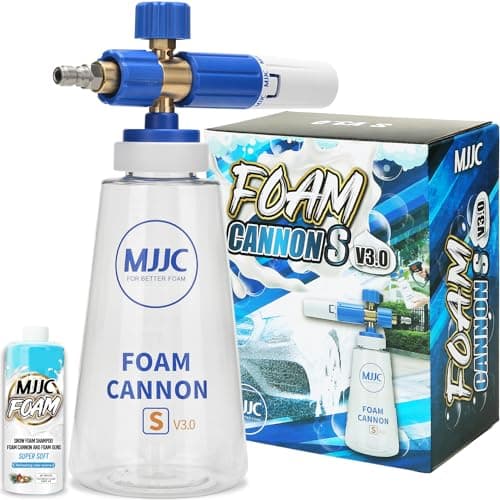
MJJC make the cannon that the rest of the market is measured against, and the S V3.0 produces foam that genuinely clings rather than sliding. Brass internals and a quarter-inch quick connector mean it fits almost any consumer pressure washer.
Who should skip it. Anyone without a pressure washer. A cannon needs the pressure and flow a machine produces, and on a garden hose it does nothing at all.
Foam thickness
9.5
Build
9.0
Adjustability
9.0
Value
7.5
What works
The thickest, longest-clinging foam in this group
Brass internals rather than plastic
Universal quarter-inch fitting
What does not
Useless without a pressure washer
Most expensive cannon here
MJJC does not publish a bottle capacity we could verify
Deep, dense microfiber with enough pile to pull grit up and away from the paint rather than trapping it against the surface. Two in the pack, which matters — a mitt that hits the ground is finished, and having a spare stops people picking it up and carrying on.
Who should skip it. Nothing much. It is more expensive than a chenille mitt and worth it, but if your washing technique is the actual problem a better mitt will not save you.
Grit release
9.0
Capacity
9.0
Durability
8.5
Value
8.0
What works
Deep pile pulls grit away from the panel
Two in the pack, so a dropped mitt is not a crisis
Rinses out cleanly between panels
What does not
More expensive than a chenille mitt
Bulky and slow to dry
The Rag Company does not publish a GSM figure for this one
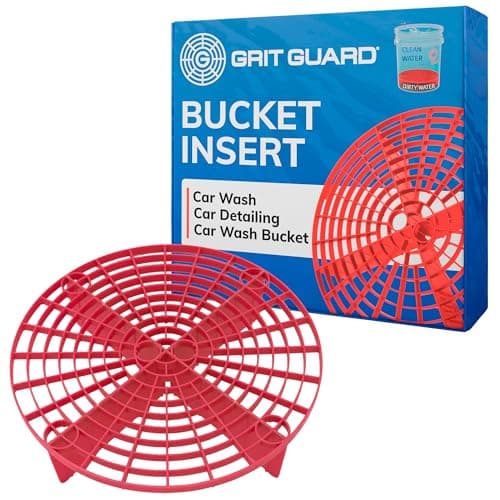
A plastic grid that sits in the bottom of the bucket, keeps settled grit down there, and gives you something to scrub the mitt against. It costs almost nothing and it prevents more paint damage per dollar than any product we have written about.
Who should skip it. Nothing. Buy two — one for the wash bucket and one for the rinse bucket. There is no scenario where a single grit guard is the right answer.
Effectiveness
9.0
Durability
9.5
Fit
9.0
Value
10.0
What works
The cheapest meaningful paint-safety upgrade available
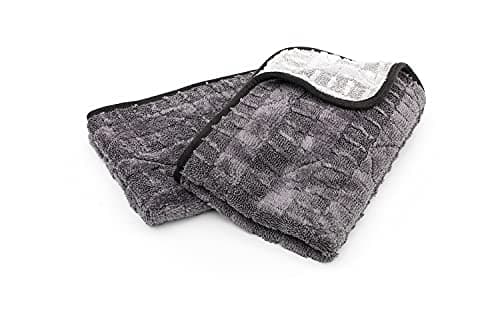
A twisted-loop drying towel absorbs so much water that you can lay it flat and lift it rather than wiping, which is the whole technique. Two in the pack, and two is what a full-size car actually needs.
Who should skip it. Buffing wax or working on glass. Twisted loop is wrong for both — it is a drying-only tool and the pile is far too deep for anything else.
Absorbency
9.5
Softness
8.5
Edge safety
9.5
Value
8.0
What works
Absorbs enough to lay-and-lift rather than wipe
Two in the pack, which a full car genuinely needs
Edges are safe for paint
What does not
Drying only — useless for buffing or glass
Takes a long time to dry after washing
The Rag Company does not publish a GSM for this one
01Rinse the whole car top to bottom, holding the nozzle a foot away.
02Pay attention to the lower third, the arches and behind the wheels, where most grit lives.
03[Foam](/washing/best-foam-cannons) bottom to top so the foam dwells longest where the car is dirtiest.
04Let it dwell three to five minutes, in the shade, never until it dries.
05Rinse top to bottom.
06
Stage three — the contact wash, 15 minutes
Two buckets, both with grit guards, a deep-pile mitt, a slippery shampoo. Wash in straight lines, top panels first, rinsing and scrubbing the mitt on the guard after every panel. The full sequence is on the two bucket method.
Keep panels wet. Work in the shade and re-rinse a panel if it starts drying.
Change the mitt for the lower third. Rockers, lower bumpers and behind the wheels carry the most grit — many people keep a second, older mitt for exactly this.
Do not press. The mitt and the soap do the work; pressure only grinds whatever is in the pile into the paint.
07
Stage four — rinse and dry, 10 minutes
01Final rinse free-flowing. Remove the nozzle and let water sheet off the panels — surface tension takes most of it with it, which is the cheapest drying aid there is.
02Blow out the gaps — mirrors, badges, grille, door shuts — if you have a blower. This is the water that otherwise runs down a dry panel afterwards.
03Mist a panel with [detail spray](/protection/best-detail-spray) as a drying aid.
04Lay a [plush drying towel](/washing/best-car-drying-towels) flat and lift it. Do not wipe.
05Second towel when the first saturates. A saturated towel smears and tempts you to press.
06Glass last, with a dedicated glass cleaner and its own towel.
08
What never to do
The six things that cause the damage
Never
Because
Automatic wash with brushes
Undoes a full paint correction in one pass
Household sponge
Flat surface, no pile depth, holds grit against the paint
Dish soap routinely
Strips every bit of wax and sealant along with the dirt
Wash in direct sun
Soap dries on the panel and water spots form as you work
Waterless wash on a dirty car
Dragging grit across dry paint with a towel
Reuse a dropped mitt
Driveway grit embeds invisibly and scratches all the way round
09
Questions people actually ask
How do you wash a car without scratching it?
Remove as much grit as possible without contact — rinse, foam, dwell, rinse — then contact wash with two buckets, grit guards and a deep-pile mitt in straight lines, then dry by patting or blowing rather than dragging. The whole routine is about 45 minutes.
Do automatic car washes scratch paint?
Brush-type ones, badly and quickly — they can undo a full paint correction in one pass. Touchless automatic washes do not scratch, and they use strong chemicals that shorten the life of wax and sealant. Hand washing properly is better than either.
Is it better to wash a car in the sun or shade?
Shade, always. In direct sun the soap dries on the panel before you can rinse it, water spots form as you work, and the whole job becomes a race. If you have no shade, wash one panel at a time and rinse immediately.
How often should you wash your car?
Every one to two weeks for a daily driver, and sooner if there is salt, bird droppings or tree sap on it. Those three etch into clear coat with time, so the argument for washing is about removing them promptly rather than about appearance.
10
Sources
Every published figure on this page traces to one of these. Where a manufacturer does not publish a number, the page says so rather than estimating it.
Last reviewed October 5, 2026. Think a figure here is wrong? Tell us at contact@detailingandwax.com and we will check it, fix it and date the correction — see our editorial policy.