Independent picks for detailing your own car. We stock nothing, so we have nothing to move.
01
Washing & decon
The best waterless car wash products
A waterless wash is lubricant in a spray bottle. Pick the slick one, use far more than feels reasonable, and know exactly where the method stops working.
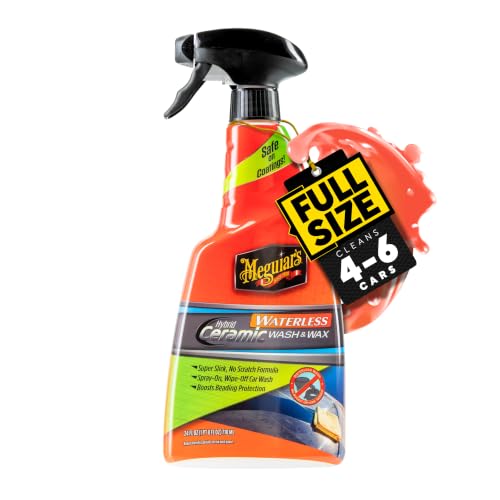
Our top pick: the Meguiar's Hybrid Ceramic Waterless Wash and Wax.
How this is funded: we earn an Amazon commission when you buy through our links, at no extra cost to you. We sell nothing and stock nothing, so a pick is never a product we are trying to move. Prices are pulled live from Amazon and were last checked November 19, 2026; where we cannot verify a price we say so rather than print an old one. Full disclosure.
Research-basedPicked from published manufacturer specifications and the consistent pattern across verified-purchase owner reports. Every product here scores 8.4 or better on our rubric.How we pick
Best waterless washMeguiar's
Meguiar's Hybrid Ceramic Waterless Wash and Wax
An SiO2-based waterless wash that leaves a ceramic layer behind as it cleans, which makes it the efficient choice on an already-coated car: the maintenance wash and the topper become one step.
Our score9.4Best for: cleaning and topping up sio2 protection in the same pass
Tap any row for the full write-up. Prices come straight from Amazon and are never typed in by hand.
The verdict
Meguiar's Hybrid Ceramic Waterless Wash and Wax is the pick: 24 oz for the price of most 16 oz bottles, and the SiO2 in it means the maintenance wash and the protection top-up become one step. Adam's Waterless Wash is slicker and the safer choice on paint you are precious about. If you need the cheapest honest bottle, Rain-X is the budget answer here and treats the glass in the same pass.
02
What a waterless wash actually is
Strip the marketing and a waterless wash is two things in a spray bottle: surfactants that break the bond between dirt and clear coat, and lubricants that let a microfiber towel slide over the loosened dirt instead of dragging it. That is the whole technology. There is no step that removes grit from the paint — the grit is still there, and you are wiping across it.
Which means the only property that genuinely predicts whether a product will scratch your car is lubricity, and no manufacturer publishes lubricity as a number. There is no spec sheet answer here, so this page ranks on what can be verified — volume, what the product leaves behind, what surfaces the maker rates it for — and says the rest in prose with the uncertainty attached.
The honest frame: a waterless wash is a dust-and-film remover that happens to be very good at its job. It is not a substitute for a bucket on a car that has driven through winter. How to wash a car without scratching the paint covers where the real risk sits in any wash method.
The four washing methods and the soil level each one is honest about
Method
Water needed
Soil it can handle
Where it belongs
Waterless wash
None
Dust and light film only
Apartment, garage, show day, between washes
Rinseless wash
Two gallons in a bucket
Light to moderate
No hose access, winter, cold weather
Two bucket hose wash
Full hose access
Anything
The default when you can
Foam cannon pre-wash
Pressure washer
Heavy
Grit you must never touch with a mitt
03
The ranked waterless washes
Ordered on lubricity and value together, because the technique that makes this method safe is using a lot of product — and a bottle you are rationing is a bottle you will under-apply. Prices are live from Amazon.
No. 01Meguiar'sOutstandingSpec-verified
Meguiar's Hybrid Ceramic Waterless Wash and Wax
Best for: Cleaning and topping up SiO2 protection in the same pass
An SiO2-based waterless wash that leaves a ceramic layer behind as it cleans, which makes it the efficient choice on an already-coated car: the maintenance wash and the topper become one step. Meguiar's rates it for paint, ceramic coatings, glass, polished metal and plastic trim, and it needs no buffing afterwards.
Lubricity
Strong
Cleaning
Good
Finish left behind
Exceptional
Value
Exceptional
Why we picked it
Cleans and leaves SiO2 protection in one pass
24 oz for the price of most 16 oz bottles
In every auto parts store, so you can restock on a Saturday
Good to know. The silica it leaves has to be stripped before any correction work
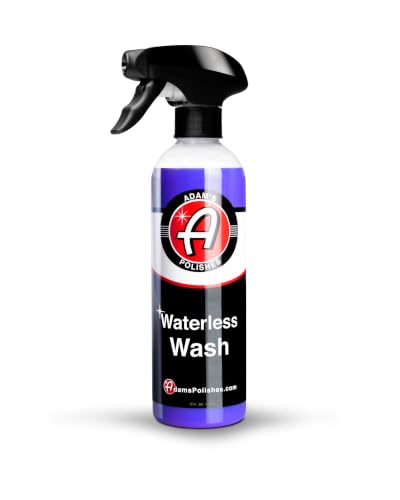
Adam's built this one around lubrication rather than cleaning power, which is the correct priority for a product you are about to wipe across dry paint. On a lightly dusty car it is the closest a waterless wash gets to feeling safe, and it is cheap enough to use generously — which is the actual technique.
Lubricity
Exceptional
Cleaning
Good
Finish left behind
Strong
Value
Strong
Why we picked it
Lubrication is the design priority, which is the right one
Cheapest per use if you buy the larger sizes
No hose, bucket or foam cannon needed
Good to know. 16 oz is a small bottle for a product you should over-apply
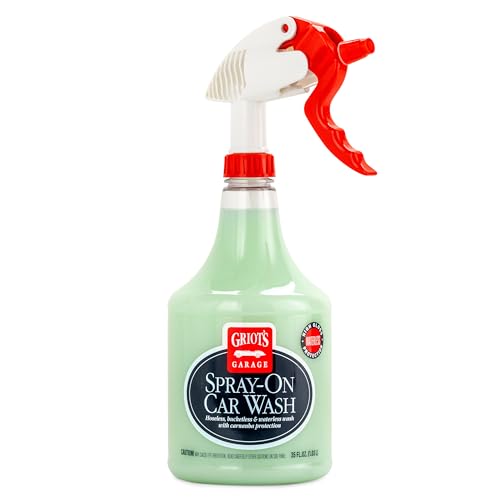
Griot's rate this for both waterless and rinseless use, which is unusual and genuinely useful: the same 35 oz bottle handles a dusty car in a parking garage and a dilute bucket wash in the driveway. It also carries carnauba, so it leaves a little protection rather than nothing.
Lubricity
Strong
Cleaning
Strong
Finish left behind
Strong
Value
Strong
Why we picked it
Works as a waterless spray or a rinseless dilution
35 oz, the largest single bottle here
Carnauba content leaves some protection behind
Good to know. More expensive than the dedicated 16 oz sprays
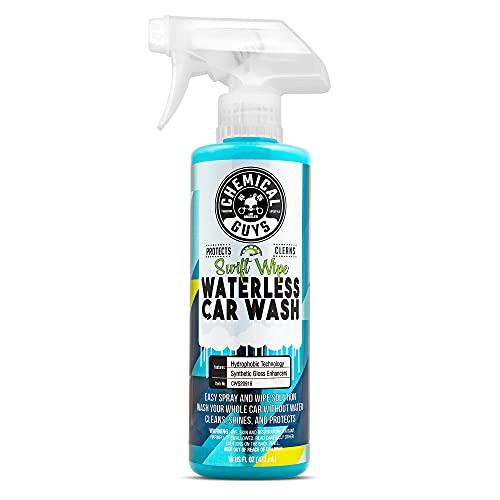
Chemical Guys lead on lubrication here too, and Swift Wipe behaves like a high-lubricity quick detailer that happens to have cleaning agents in it. That makes it the right thing for the thin film a car picks up driving to an event, wiped off one panel at a time with two towels.
Lubricity
Strong
Cleaning
Adequate
Finish left behind
Good
Value
Exceptional
Why we picked it
High lubrication is the stated design goal
Cheapest entry point into the category
Small bottle fits a door pocket or a trunk organizer
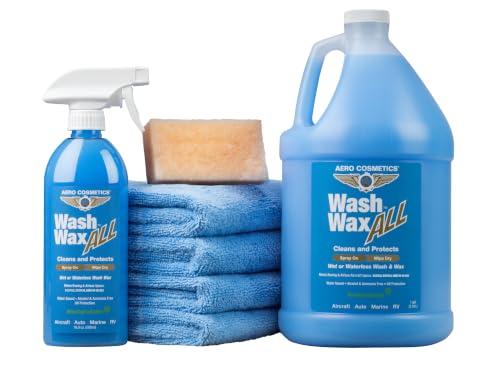
The kit ships a gallon plus a 16 oz spray bottle, four microfiber towels and a bug pad, which is the only package here sized for a surface bigger than a car. Aero publish compliance with Boeing's exterior and interior cleaning specifications, which is a verifiable claim rather than marketing adjectives, and the formula is biodegradable and free of alcohol and ammonia.
Lubricity
Strong
Cleaning
Strong
Finish left behind
Strong
Value
Good
Why we picked it
Gallon plus spray bottle, towels and a bug pad in one kit
Published Boeing exterior and interior cleaning spec compliance
Biodegradable, no alcohol or ammonia, safe on PPF and wrap per Aero
Good to know. Overkill, and overpriced, for one normal-sized car
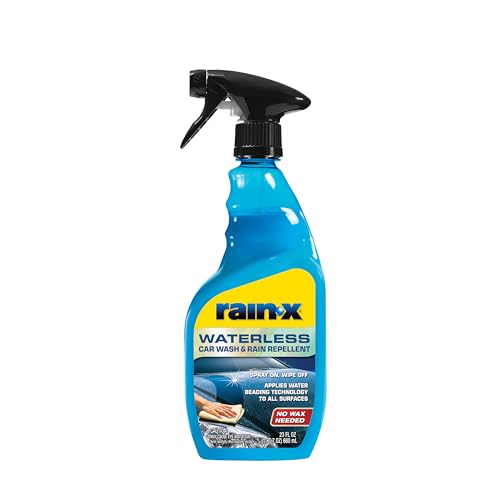
Rain-X put their water-repellent chemistry into a waterless wash, so one pass over the car also leaves the glass beading. It is comfortably the cheapest bottle on the page and the honest budget answer, and 23 oz is more product than the 16 oz bottles.
Lubricity
Adequate
Cleaning
Good
Finish left behind
Good
Value
Exceptional
Why we picked it
By far the cheapest bottle here
23 oz, larger than the 16 oz detailing sprays
Leaves Rain-X repellency on the glass in the same pass
Good to know. Lubricity is the weak point, and lubricity is the whole safety margin
Stated lubricity as the design goal. Adam's and Chemical Guys both lead with lubrication rather than cleaning strength, which is the correct priority for something you wipe across dry paint.
Volume, honestly compared. The per-ounce spread on this page is roughly 4x. A 16 oz bottle sounds fine until you realize correct technique uses four or five sprays per panel.
Whether it leaves protection. An SiO2 or carnauba-bearing formula tops up your protection as it cleans. That is a real benefit on a maintained car and a genuine nuisance before paint correction, when it all has to come off again.
Surface ratings from the maker. Glass, plastic trim, polished metal and PPF are not all the same substrate. The products here that publish a surface list are the ones you can use confidently on a wrapped or coated car.
A spray head that produces a real fan. A misting trigger spreads product thinly, and thin coverage is exactly the failure mode that puts scratches in paint.
05
The technique that makes it safe
01Work one panel at a time, out of direct sun, on a cool surface. Product that flashes dry is product that has stopped lubricating.
02Spray far more than feels reasonable. The panel should look wet, not misted. This is the single biggest difference between people who have good results and people who scratch their car.
03Spray the towel too, not just the panel.
04Wipe in straight lines, not circles, with almost no pressure. You are not scrubbing — you are letting the lubricant carry the dirt onto the towel.
05Turn to a fresh towel face every single pass. If a face looks dirty, it is done.
06Buff dry with the second towel immediately, before any residue has a chance to set.
07Stop and go get a hose the moment you feel grit under the towel.
That last step is not a formality. The feel of grit through a folded towel is unmistakable, and continuing through it is how a five-minute wash becomes a correction job with a polisher and a weekend.
06
Waterless or rinseless? They are not the same thing
These two categories get used interchangeably and they solve different problems. A waterless wash is ready to use, sprayed from the bottle, and rated for dust and light film. A rinseless wash is a concentrate you dilute into a couple of gallons in a bucket, which gives you far more lubricant in play and handles genuinely moderate dirt without a hose or a drain.
If you have access to two gallons of water and a bucket, rinseless is the safer and cheaper method per wash — the best rinseless wash products covers that shelf. Waterless is for when you have nothing at all: a parking garage, a condo lot, a show field, or the ten minutes before you hand the car over.
The one product here that does both
Griot's Garage Spray-On Car Wash is rated by Griot's for waterless and rinseless use, which is unusual. One 35 oz bottle covers both situations, and it carries carnauba so it leaves a little protection behind. The trade is that a dual-purpose formula is the best at neither — it is not as slick as Adam's waterless, and not as strong as a dedicated rinseless concentrate.
07
Where waterless washing fits in a real routine
The people who get the most out of this category are not using it instead of washing. They are using it between washes. A coated or waxed car picks up a thin film of dust in three days and looks tired long before it is actually dirty; a waterless wash puts it back to showroom in fifteen minutes with no setup and no drying time.
On a ceramic-coated car the SiO2 formulas do double duty, cleaning the film off and refreshing the hydrophobic layer in one pass. That overlaps with the job of a quick detailer and a ceramic coating spray, and the practical difference is cleaning strength: a quick detailer assumes clean paint, a waterless wash assumes dusty paint. If the car is dirtier than a waterless wash can handle, a rinseless is the next step up — Optimum No Rinse vs P&S Absolute compares the two leading options.
And where it does not fit
Winter road salt and grit. Not negotiable — this needs volume and pressure.
A car that has sat under trees for a month. The dirt layer is thicker than the lubricant can float.
Before clay, polish or a coating. Everything these products leave behind has to be stripped first, so you are adding work.
Lower rocker panels and behind the wheels, on any car, ever. That is where the sharpest grit lives.
08
Our recommendation
Buy this one
Meguiar's Hybrid Ceramic Waterless Wash and Wax
An SiO2-based waterless wash that leaves a ceramic layer behind as it cleans, which makes it the efficient choice on an already-coated car: the maintenance wash and the topper become one step.
Adam's built this one around lubrication rather than cleaning power, which is the correct priority for a product you are about to wipe across dry paint.
Meguiar's Hybrid Ceramic Waterless Wash and Wax, for the combination of a 24 oz bottle, a low price and SiO2 that refreshes protection as it cleans. Adam's Waterless Wash is the slicker formula and the safer pick on paint you are precious about.
Does waterless car wash scratch paint?
It can, and the variable is almost entirely you. Used on a dusty car with plenty of product and clean plush towels, turned to a fresh face every pass, it is safe. Used on a genuinely dirty car, or sparingly, or with one towel, it drags grit across the clear coat and leaves marring.
How dirty can a car be for a waterless wash?
Dust, pollen, light road film and water spots. That is the honest ceiling, and every manufacturer on this page says some version of 'lightly soiled' in their own instructions. Mud, salt, bug splatter and a month of neglect all need water.
Is waterless wash the same as rinseless wash?
No. Waterless is ready to use from the bottle and handles dust and light film. Rinseless is a concentrate you dilute into a bucket of water, which puts far more lubricant in play and handles moderate dirt. If you can get two gallons of water, rinseless is safer and cheaper per wash.
How many towels do you need for a waterless wash?
Plan on six to eight plush microfiber towels for a full car: one to lift and one to buff per panel group, swapped the moment a face looks dirty. Running out of clean towel faces halfway through is the most common cause of waterless wash scratches.
Can you use a waterless wash on a ceramic coated car?
Yes, and it is one of the best uses for the category. A coated car sheds most dirt and mainly accumulates a light film, which is exactly what these products remove. Pick an SiO2 formula and you refresh the coating's water behavior in the same pass.
10
Sources
Every published figure on this page traces to one of these. Where a manufacturer does not publish a number, the page says so rather than estimating it.
Last reviewed October 12, 2026. Think a figure here is wrong? Tell us at contact@detailingandwax.com and we will check it, fix it and date the correction — see our editorial policy.