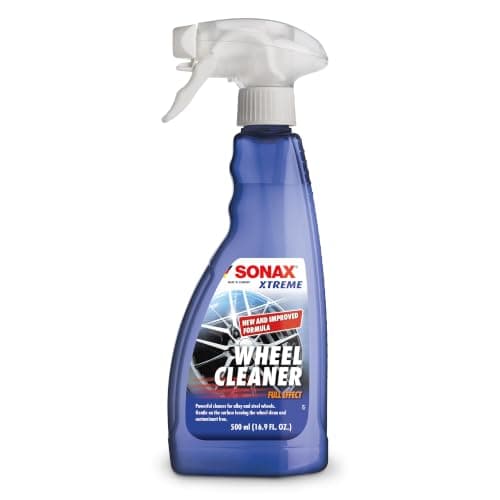
Our top pick: the SONAX SONAX Wheel Cleaner Full Effect.
How this is funded: we earn an Amazon commission when you buy through our links, at no extra cost to you. We sell nothing and stock nothing, so a pick is never a product we are trying to move. Prices are pulled live from Amazon and were last checked October 5, 2026; where we cannot verify a price we say so rather than print an old one. Full disclosure.
Research-basedPicked from published specifications and the pattern across verified-purchase reports. We have not used these ourselves and do not pretend otherwise.How we pick
Tap any row for the full write-up. Prices come straight from Amazon and are never typed in by hand.
The verdict
SONAX Wheel Cleaner Full Effect. Non-acidic, iron-dissolving, and safe on painted, clear-coated and anodized wheels — which covers essentially every modern car. P&S Brake Buster is the better value if you detail several cars, because it dilutes and it cleans the tire sidewall too.
02
Three chemistries, and what each one destroys
The three wheel cleaner chemistries
Chemistry
What it does
Safe on
Destroys
pH-neutral
Lifts dust with surfactants
Everything, including coated wheels
Nothing
Iron-dissolving
Chemically dissolves bonded brake dust
Painted, clear-coated, anodized
Nothing, if rinsed before drying
Acidic
Dissolves heavy deposits aggressively
Painted and bare steel, with care
Polished and anodized aluminum, chrome trim
For almost every home detailer with painted or clear-coated alloy wheels — which is almost every car built this century — a pH-neutral or iron-dissolving cleaner is the correct and permanent answer. Acid belongs in a commercial setting with trained hands and a specific reason.
03
The ranked picks
Ordered on cleaning power balanced against what each is safe on. Prices are live from Amazon.
Non-acidic, color-changing, and it dissolves bonded brake dust rather than relying on you to scrub it off. Safe on painted, clear-coated and anodized wheels, which covers essentially every modern car.
Who should skip it. Baked-on neglect. Even the best chemical cleaner needs a brush for a wheel that has not been touched in two years, and expecting a spray to do it alone is how people conclude nothing works.
Cleaning power
9.5
Finish safety
9.5
Dwell behavior
8.5
Value
7.5
What works
Dissolves bonded brake dust rather than needing scrubbing
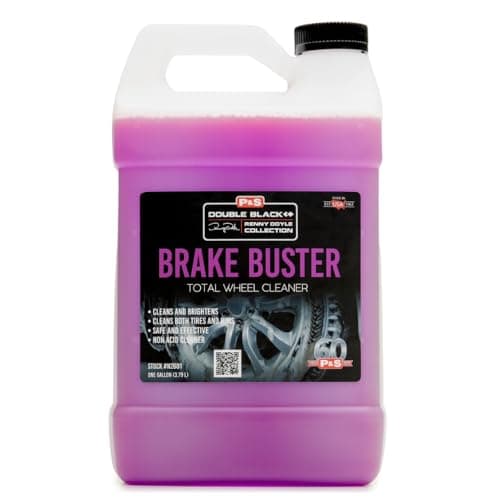
Brake Buster is the professional default, and the reason is that it cleans the tire sidewall as well as the wheel — which is normally two products. Non-acid, dilutable, and a gallon lasts a very long time.
Who should skip it. Heavily bonded iron. It is a surfactant-based cleaner rather than an iron remover, so a wheel with baked-in fallout still wants a dedicated iron product.
Cleaning power
8.5
Finish safety
9.5
Dwell behavior
8.5
Value
9.0
What works
Cleans the tire sidewall as well as the wheel
Dilutable, so it is cheap per wheel
The professional default with a long track record
What does not
Not an iron remover — bonded fallout needs more
No color change, so progress is harder to judge
P&S does not publish a bottle volume we could verify
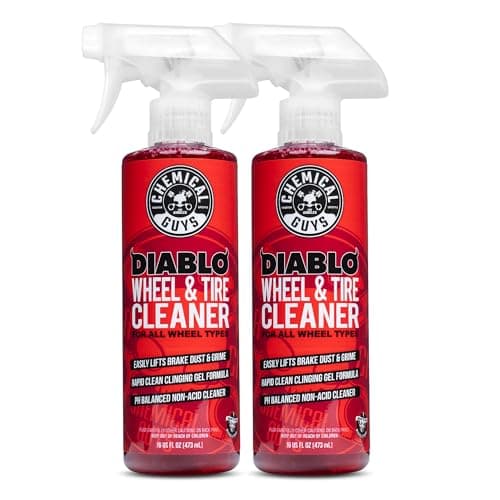
The gel format is the feature: it clings to the wheel instead of running straight off onto the driveway, which means the dwell time is real rather than theoretical. Two 16 oz bottles in the pack.
Who should skip it. Fast work. Gel takes longer to rinse off completely than a thin liquid, and residue in the barrel is a common complaint if you rush it.
Cleaning power
8.5
Finish safety
9.0
Dwell behavior
9.5
Value
8.5
What works
Gel clings, so the dwell time actually happens
Listed safe on polished wheels, which is rare
Two bottles in the pack
What does not
Slower and harder to rinse fully
No color change
Chemical Guys does not publish a dwell time we could verify
Published specifications
Chemistry
Non-acidic gel
Volume
2 x 16 oz
Safe on
Painted, clear-coated and polished wheels, per Chemical Guys
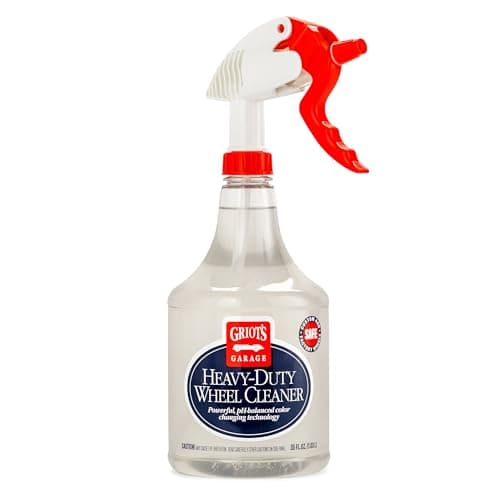
Stronger than the maintenance cleaners and still non-acidic, which is the combination you want on a wheel that has been ignored for a year. Griot's state it is safe on all wheel finishes.
Who should skip it. Weekly use. A heavy-duty cleaner used every wash is harder on the finish over years than it needs to be — keep a mild cleaner for routine work.
Cleaning power
9.0
Finish safety
8.5
Dwell behavior
8.0
Value
8.0
What works
Genuinely strong without being acidic
Listed safe on every wheel finish
Breaks down baked-on deposits a mild cleaner leaves
What does not
More cleaner than weekly washing needs
Griot's does not publish a bottle volume we could verify
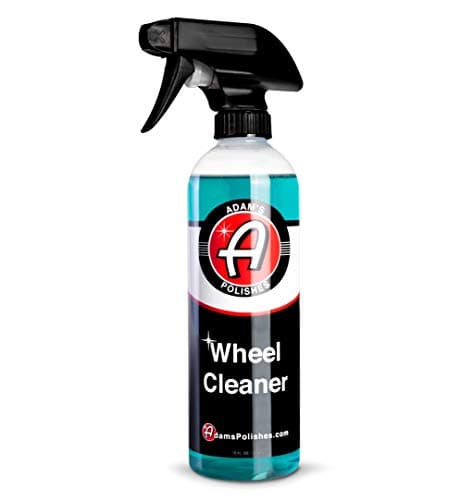
Color-changing iron-dissolving chemistry in a 16 oz bottle, which is the right size for one car's wheels several times over. Safe on painted and coated wheels, and Adam's support is genuinely available if something is wrong.
Who should skip it. Bare or polished aluminum. Adam's does not list it as safe on bare metal, and on an unverified finish the right answer is a pH-neutral cleaner instead.
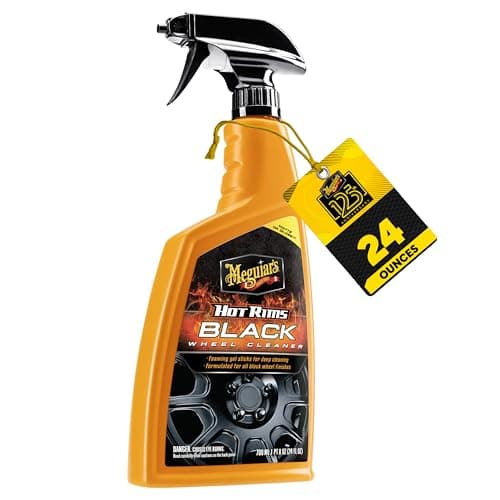
Formulated for the dark and satin-black finishes that have become standard on modern cars, and that some stronger cleaners dull over time. Mild, pH-balanced and cheap enough to use every wash.
Who should skip it. Heavy brake dust. It is deliberately gentle, which is the point, and on a neglected wheel it is simply too mild to finish the job.
Cleaning power
6.5
Finish safety
9.5
Dwell behavior
7.5
Value
9.5
What works
Formulated specifically for dark and satin finishes
A wheel cleaner loosens. A brush removes. The gap between a tidy wheel and a genuinely clean one is almost entirely about whether you reached the barrel, and no chemical reaches the barrel for you.
Which means the honest recommendation is to buy a mid-priced cleaner and a long barrel brush rather than the most expensive cleaner and no brush. The brush is where the result comes from.
05
The routine that keeps wheels easy
01Wheels first, always. Doing them last means overspray on clean paint.
02Cool wheels in the shade, one at a time.
03Rinse the wheel first to remove loose dust and wet the surface.
04Apply the cleaner to the face and the barrel, and let it dwell without drying.
05Agitate the barrel with a long brush, the face with a soft one, and the tire with a stiff one.
A coated wheel releases brake dust far more readily than a bare one, which turns a twenty-minute job into a five-minute one. A dedicated wheel coating like CARPRO DLUX or a SiO2 spray applied to clean, dry wheels makes a genuine difference to how often you need the strong cleaner at all.
It is also the most under-rated coating application on a car — the wheels are the dirtiest part and the one nobody thinks to protect.
07
Questions people actually ask
What is the best wheel cleaner?
SONAX Wheel Cleaner Full Effect for most cars — non-acidic, iron-dissolving, and safe on painted, clear-coated and anodized wheels. P&S Brake Buster is better value if you detail several cars, since it dilutes and cleans tire sidewalls too.
Is acidic wheel cleaner safe?
Not on the finishes most modern wheels use. Acid permanently damages polished and anodized aluminum and chrome trim. It has a place on bare or painted steel in a commercial setting; for painted alloy wheels it is unnecessary risk.
Can you use wheel cleaner on hot wheels?
No. Every wheel cleaner chemistry behaves badly when it flashes dry on a hot rim — staining at best, etching at worst. Work in the shade, on wheels cool enough to touch, and rinse before the product can dry.
Do you clean wheels before or after washing the car?
Before, always. Wheel cleaner overspray and brake dust landing on freshly washed paint is a problem; landing on dirty paint you are about to wash is not. Use separate buckets and brushes for the wheels.
08
Sources
Every published figure on this page traces to one of these. Where a manufacturer does not publish a number, the page says so rather than estimating it.
Last reviewed October 5, 2026. Think a figure here is wrong? Tell us at contact@detailingandwax.com and we will check it, fix it and date the correction — see our editorial policy.