Independent picks for detailing your own car. We stock nothing, so we have nothing to move.
01
Polishers & correction
Can you polish a car by hand?
Yes, and it genuinely fixes some things. It will not remove swirl marks from a whole car, and no amount of effort changes that — the limit is physics, not commitment.
How this is funded: we earn an Amazon commission when you buy through our links, at no extra cost to you. We sell nothing and stock nothing, so a pick is never a product we are trying to move. Prices are pulled live from Amazon and were last checked November 19, 2026; where we cannot verify a price we say so rather than print an old one. Full disclosure.
Research-basedPicked from published manufacturer specifications and the consistent pattern across verified-purchase owner reports. Every product here scores 8.4 or better on our rubric.How we pick
Top pickMeguiar's
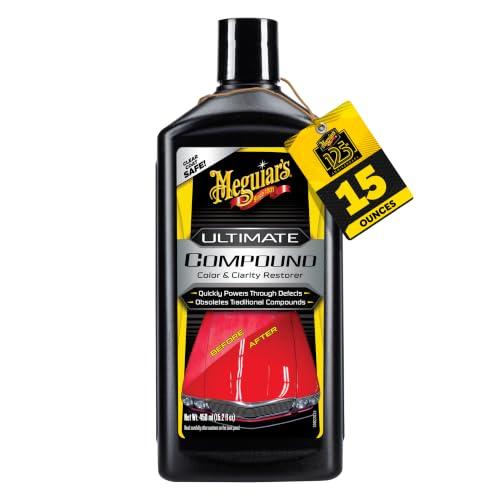
Meguiar's Ultimate Compound
Ultimate Compound is the most widely used correction liquid in home detailing for a straightforward reason: it is inexpensive, it is available everywhere, and it removes light to moderate swirls with very little risk.
Our score9.3Best for: the cheapest way to find out if your swirls will come out
Yes — hand polishing works, within a narrow and specific range. It will remove light oxidation, water spot etching, and isolated scratches you can feel but barely see, on areas up to roughly a door's worth at a time. It will not remove swirl marks across a whole car, and it will not level a scratch that catches your fingernail. For either of those you need a machine, and the honest reason is that a hand cannot sustain the pressure and the consistent speed over a large area.
02
What a hand can and cannot do
Polishing is abrasive work: you are using progressively finer abrasives to shave a few microns off the clear coat until the defect is level with the surface around it. Whether that works depends on three things — the abrasive, the pressure, and the number of times the abrasive passes over the same spot.
A hand supplies a good abrasive and reasonable pressure for about ninety seconds, over an area about the size of a sheet of paper. A machine supplies consistent pressure and thousands of passes per minute, indefinitely, over a whole panel. That is the entire difference, and it explains the pattern of what hand polishing fixes and what it does not.
The honest range of hand polishing
Defect
By hand?
Why
Light oxidation, dull patch
Yes
Sits in the top micron or two and covers a small area
Water spot etching, early
Yes
Shallow, and usually localized to where water sat
A single scratch you cannot feel
Yes
One spot, repeated work in one place is sustainable
Swirl marks on one panel
Partly
Possible but slow, and the finish is usually uneven
Swirl marks across the car
No
Area is the problem, not depth. Hands cannot keep it even.
A scratch that catches a fingernail
No
Too deep to level safely by any method, hand or machine
Holograms from a rotary
No
Needs a dual action machine finishing pass to remove
03
What to look for in a hand polish
Two properties matter, and the second is the one people miss. First, the abrasive needs to be a diminishing one — it breaks down as you work, so the same product cuts at the start of a set and finishes at the end. That is what lets a single bottle both remove a defect and leave gloss behind.
Second, it needs enough lubrication and working time to stay wet under a hand. Machine polishes are often formulated for the heat and speed a machine generates; worked by hand they go dry and dusty in seconds, and a dry abrasive is just grit. A product that explicitly works by hand is not marketing — it is a different formulation.
A diminishing abrasive, so one product cuts and then finishes as it breaks down.
Long working time. If it flashes dry in thirty seconds it was built for a machine.
A foam applicator, not a towel. A towel distributes pressure unevenly across your fingers and leaves a patchy result.
One-step chemistry rather than a dedicated heavy compound. Heavy cut by hand is effort without reward — see compound vs polish.
A clean finishing towel per panel. Buffing residue with a dirty towel reintroduces the marring you just removed.
04
What you actually need to polish by hand
Two one-step polishes with long working times and the applicators that make the pressure even. Four items, which is the whole shopping list. Prices are live from Amazon.
Meguiar'sOutstandingSpec-verified
Meguiar's Ultimate Compound
Best for: The cheapest way to find out if your swirls will come out
Ultimate Compound is the most widely used correction liquid in home detailing for a straightforward reason: it is inexpensive, it is available everywhere, and it removes light to moderate swirls with very little risk. It is not the fastest cutter and it does not need to be.
Cut
Good
Finish
Strong
Ease of use
Exceptional
Value
Exceptional
Why we picked it
Removes light and moderate swirls with very little risk
Works by hand as well as by machine
Costs a fraction of boutique correction liquids
Good to know. Slow on deep scratches and heavy oxidation
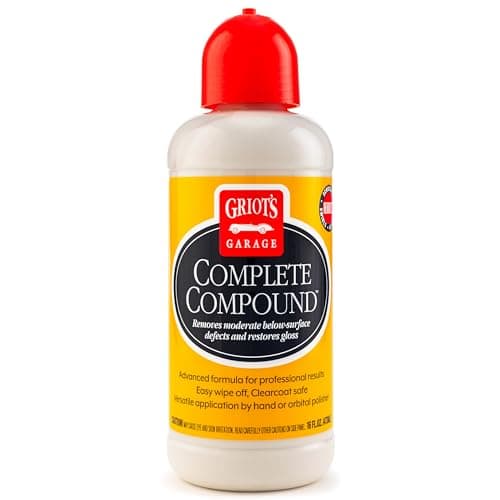
Griot's Complete Compound is their one-step answer, and like 3D ONE it is designed to cut then finish in the same pass. On a G8 or G9 with a correcting pad it is a tidy, predictable system with nothing to think about.
Cut
Good
Finish
Strong
Ease of use
Exceptional
Value
Exceptional
Why we picked it
Predictable and consistent on the matching Griot's machines
Low dust, which matters more than people expect indoors
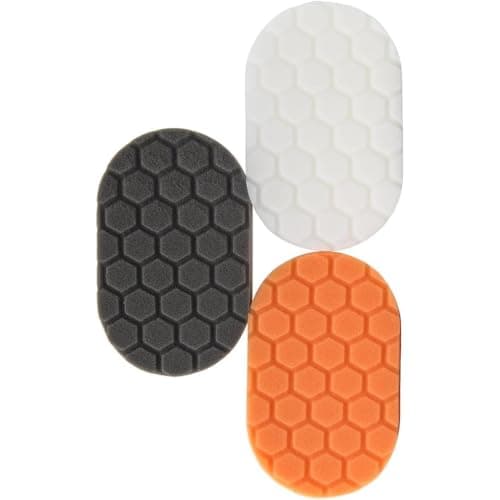
A kit of foam applicators, which is how they should be bought — one applicator per product is the rule, and a shared pad is how wax ends up contaminated with trim dressing. Cheap, washable, and genuinely consumable.
Coverage
Strong
Durability
Strong
Versatility
Good
Value
Exceptional
Why we picked it
Enough pads to dedicate one per product
Washable and reusable many times
Hex pattern holds product evenly
Good to know. Foam absorbs more product than microfiber
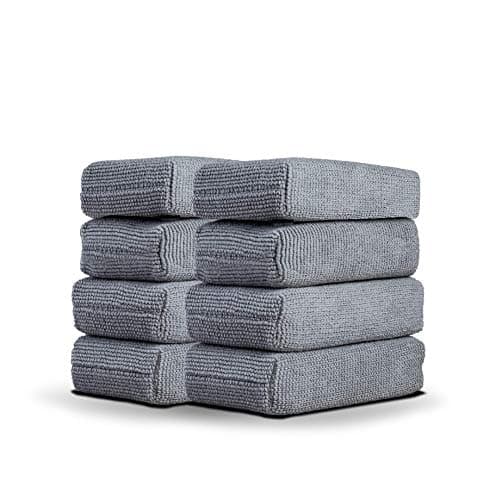
Microfiber applicators absorb far less than foam, which means more of the bottle ends up on the paint instead of inside the pad. Eight in a pack is enough to dedicate one per product and still have spares.
Coverage
Strong
Durability
Strong
Versatility
Strong
Value
Strong
Why we picked it
Absorbs far less product than foam
Eight in the pack
Washes clean and lasts
Good to know. Less effective with heavy paste waxes
Hand polishing is unforgiving of a dirty surface in a way that surprises people. Any grit left on the panel gets dragged under the applicator, and because you are pressing hard in a small area, the marring it creates is worse than what a machine would leave.
02Decontaminate if the paint feels rough.Do you need a clay bar has the ten-second test.
03Work a section about `2` ft square. Any larger and the product dries before you finish it.
04Three or four pea-sized drops on the applicator, spread first with no pressure.
05Then press, and work in overlapping straight lines — not circles. Straight passes in two directions, crosshatched.
06Keep going until the product goes clear, roughly 60 to 90 seconds. Stopping early leaves the abrasive unbroken.
07Buff off with a clean towel, turning to a dry face as it loads up.
08Then protect it. Polishing strips any wax that was there — the best car waxes covers what goes back on.
06
When a machine stops being optional
The threshold is not about severity, it is about area. One scratch on a door is a hand job. The same severity of marring across every panel on the car is not, because a hand cannot deliver the same pressure on panel eight as it did on panel one, and the unevenness shows up as patches under the sun.
If the problem is swirl marks — the fine spiderweb pattern visible in direct light — that is a whole-car defect by definition, because it was put there by washing the whole car. How to remove swirl marks covers that properly, and it needs a machine. The best dual action polishers is where to start, and a free-spinning dual action is forgiving enough that a first-timer is not risking the paint.
The arithmetic nobody mentions
Polishing a full car by hand is roughly a full day of genuinely hard physical work, and the result is usually worse than an afternoon with an entry-level machine. If you are weighing the cost of a polisher against the effort, the comparison is not polish-by-hand against buy-a-machine — it is one day of labor and an uneven finish against three hours and an even one.
07
What hand polishing is genuinely best at
There is one job where a hand beats a machine outright: anywhere a 5 in pad physically cannot sit flat. Mirror caps, the area around badges and door handles, A-pillars, the tight radius at the base of a windshield. People who own machines still polish those spots by hand, and so should you — see what size polishing pad for where the limit falls.
It is also the right tool for a single isolated scratch. Setting up a machine, taping the area and working a 2 ft section is disproportionate when the defect is two inches long. The best scratch removers covers those products specifically, and most of them are designed to be used exactly this way.
08
Our recommendation
Buy this one
Meguiar's Ultimate Compound
Ultimate Compound is the most widely used correction liquid in home detailing for a straightforward reason: it is inexpensive, it is available everywhere, and it removes light to moderate swirls with very little risk.
Yes, for light oxidation, early water spot etching and isolated scratches you cannot feel with a fingernail, over areas up to about a door at a time. It will not remove swirl marks across a whole car — that is a limit of area and consistency, not of effort.
Can you buff out scratches on a car by hand?
Only scratches that do not catch your fingernail. If your nail catches, the scratch is through the clear coat and no abrasive polish will level it safely by hand or by machine. Shallower scratches respond well to a one-step polish on a foam applicator.
What do you need to polish a car by hand?
Four things: a one-step diminishing polish with a long working time, foam hand applicator pads, clean microfiber buffing towels, and a properly washed and decontaminated panel. A heavy cutting compound is not on the list — heavy cut by hand is effort without much reward.
Should you polish in circles or straight lines?
Straight lines, crosshatched in two directions. Circular motion concentrates the abrasion at the center of each circle and leaves visible rings under direct light, which is most obvious on dark paint. Straight overlapping passes distribute the work evenly.
Is hand polishing bad for car paint?
Only if the panel is dirty or the product dries out. Polishing is abrasive, so grit left on the surface gets dragged under the applicator under real pressure, and a polish that flashes dry becomes grit itself. Wash, decontaminate, and keep the product wet.
Is it worth buying a polisher instead?
If the defects cover more than a panel or two, yes. Polishing a whole car by hand is roughly a day of hard work and usually finishes unevenly, against about three hours and an even result with an entry-level dual action machine.
Do you still need to wax after polishing by hand?
Yes. Polishing removes whatever protection was on the paint along with the defect, so the panel is left bare. Apply a wax, sealant or coating afterwards or the freshly polished clear coat is unprotected.
10
Sources
Every published figure on this page traces to one of these. Where a manufacturer does not publish a number, the page says so rather than estimating it.
Last reviewed October 17, 2026. Think a figure here is wrong? Tell us at contact@detailingandwax.com and we will check it, fix it and date the correction — see our editorial policy.