Independent picks for detailing your own car. We stock nothing, so we have nothing to move.
01
Washing & decon
Do you need a clay bar?
Only if the paint still feels rough after a chemical decontamination. Claying smooth paint achieves nothing except a little marring, so the test comes first.
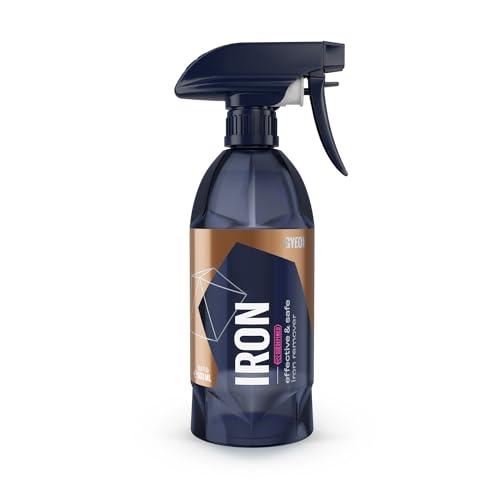
Featured here: the Gyeon Iron Paint Cleaner and Fallout Remover.
How this is funded: we earn an Amazon commission when you buy through our links, at no extra cost to you. We sell nothing and stock nothing, so a pick is never a product we are trying to move. Prices are pulled live from Amazon and were last checked November 19, 2026; where we cannot verify a price we say so rather than print an old one. Full disclosure.
Research-basedPicked from published manufacturer specifications and the consistent pattern across verified-purchase owner reports. Every product here scores 8.4 or better on our rubric.How we pick
Top pickGYEON
Gyeon Iron Paint Cleaner and Fallout Remover
A color-change iron remover that works fast and smells less offensive than most — which sounds trivial until you have sprayed a whole car with the alternative.
Our score9.4Best for: the iron remover to buy if you buy one
Put a thin plastic sandwich bag over your fingertips and run them lightly over washed, dry paint. If it feels gritty, you need to clay. If it feels smooth, you do not. Before you reach for clay, though, use an iron remover — chemical decontamination takes most of what people clay off, with no mechanical contact and no marring at all.
02
The test, and why the bag
Wash and dry the car first, then stretch a thin plastic bag over your fingertips and drag them lightly across the paint — the hood and the lower doors are the two places contamination concentrates. The bag amplifies texture enormously, so bonded particles your bare fingers cannot feel become obvious.
What you are feeling for is bonded contamination: industrial fallout, rail dust, tree sap mist, overspray and tar, all of which stick to clear coat and sit proud of the surface. Clay shears those particles off. It does nothing for scratches, swirls, oxidation or water spots, which is the most common misunderstanding about what clay is for.
A color-change iron remover that works fast and smells less offensive than most — which sounds trivial until you have sprayed a whole car with the alternative. The purple bleed is the reaction dissolving bonded brake dust so a clay bar does not have to tear it out.
Speed
Exceptional
Dwell behavior
Strong
Finish safety
Exceptional
Value
Strong
Why we picked it
Fast, clear color change so you can see it working
Markedly less offensive smell than most
Safe on coated paint and painted wheels
Good to know. Must be rinsed before it dries, which limits panel size in sun
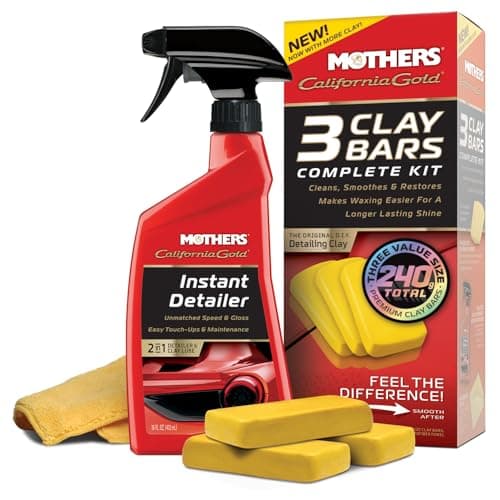
Three 80-gram bars and the lubricant in one box, which is the right way to buy clay for the first time. Three bars matters because the correct response to dropping clay on the ground is to throw it away, and people with one bar do not.
Cutting speed
Good
Marring risk
Strong
Longevity
Good
Value
Exceptional
Why we picked it
Three bars, so a dropped bar is not the end of the job
Lubricant included
Fine grade, which is right for most daily drivers
Good to know. Paying for lubricant you may already own
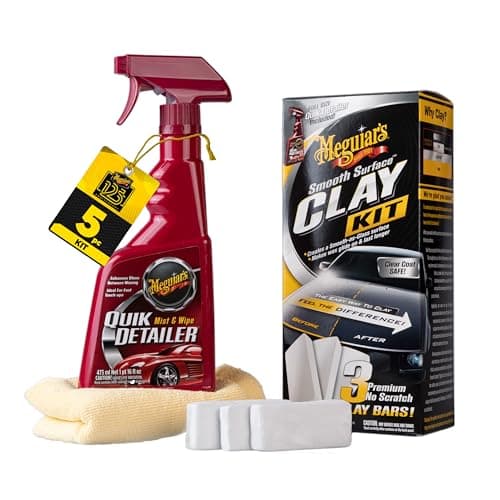
Meguiar's clay is soft, forgiving and comes with a quick detailer as lubricant. Soft clay marrs less and works more slowly, which is exactly the right trade for anyone claying a car for the first time.
Cutting speed
Adequate
Marring risk
Exceptional
Longevity
Good
Value
Exceptional
Why we picked it
Soft clay is the most forgiving option for a first attempt
Lubricant included and genuinely usable afterwards
This is the order that most guides get wrong. An iron remover is a chemical that reacts with embedded ferrous particles and dissolves them, usually turning purple as it does. It touches nothing, marrs nothing, and takes out a large share of what you would otherwise be dragging a clay bar over.
Clay is mechanical — it is a tacky polymer you drag across paint, and anything it picks up that does not stay embedded in the clay is a particle being dragged. That is why clay has a reputation for leaving fine marring: the bar is fine, the grit it collected is not. Doing the chemical step first means the clay has far less to pick up.
02Apply an iron remover to cool, wet paint and wheels. Do not let it dry.
03Rinse thoroughly.
04Re-run the plastic bag test.
05Clay only where it still feels rough, with plenty of lubricant.
06Follow with protection, because decontamination strips whatever was on the paint.
05
The three times you definitely do need to clay
Before a ceramic coating. A coating bonds to whatever is on the surface, so bonded contamination gets locked under it permanently. Do you need to polish before a ceramic coating covers the whole prep sequence.
Before polishing, if the paint is rough. A pad dragging bonded particles across clear coat makes new scratches faster than it removes old ones.
On a newly bought used car, which has an unknown history and usually fails the bag test badly on the lower third.
06
And the times you do not
Every wash. Claying is a twice-a-year job at most, and on a well-protected garaged car far less often.
On smooth paint, where the only thing you achieve is light marring that needs polishing out.
On a ceramic coated car. Clay will abrade the coating. If a coated car feels rough, use a coating-safe iron remover and the correct shampoo — ceramic coating maintenance covers it.
Instead of polishing. Clay removes what sits on the paint. Polishing removes defects in the paint. They are not substitutes.
One practical note on clay itself: drop a bar on the floor and bin it. There is no way to get grit out of a clay bar, and a dropped bar dragged across a hood will leave scratches you will spend an afternoon polishing out. Most kits ship with two or three bars partly for that reason — the best clay bars covers which grades suit which job.
07
Bars, mitts and towels are not the same decision
Clay now comes in three formats and the choice changes the risk rather than the result.
The three clay media, honestly compared
Format
Speed
Marring risk
When it makes sense
Traditional bar
Slowest
Lowest
Dark or soft paint, and a first attempt
Synthetic mitt or pad
Fastest
Highest
A large, light-coloured vehicle you will polish afterwards
Clay towel
Fast
Moderate
A middle option; still wants a light polish on dark paint
The pattern is consistent: every format that saves time increases the chance you will want a light finishing polish afterwards. On a black car that trade is rarely worth it; on a white van it almost always is.
08
Does claying strip your protection?
Yes, and plan for it. Clay removes whatever is sitting on the paint, which includes any wax or sealant. A decontamination session therefore always ends with protection going back on — if you clay a car and leave it, the paint is bare and will pick up contamination faster than before you started.
That is the practical reason claying is a twice-a-year job rather than a monthly one: it is the front half of a sequence that also includes an hour of protecting. The detailing order of operations places it correctly, between the wash and any correction work.
09
Our recommendation
Buy this one
Gyeon Iron Paint Cleaner and Fallout Remover
A color-change iron remover that works fast and smells less offensive than most — which sounds trivial until you have sprayed a whole car with the alternative.
Only if the paint still feels gritty after washing and a chemical decontamination. Stretch a thin plastic bag over your fingertips and run them over the paint — if it feels rough, clay it; if it feels smooth, claying only adds light marring.
Do I need to clay bar before waxing?
Only if the bag test says the paint is rough. Wax over bonded contamination still protects, it just sits on a lumpy surface. A quick iron remover pass takes out most of what matters with no mechanical contact at all.
Do I need to clay bar before polishing?
Yes, if the paint feels rough. A polishing pad dragging bonded particles across clear coat creates new scratches faster than it removes the old ones. Decontaminate chemically, re-test, then clay only where it is still needed.
Do I need to clay bar before a ceramic coating?
Yes, without exception. A coating bonds to whatever is on the surface, so any bonded contamination gets locked underneath it for the life of the coating. Chemical decon, clay, then polish, then coat.
Does a clay bar remove scratches?
No. Clay is not abrasive — it shears off particles sitting on top of the clear coat. Scratches, swirls and oxidation are defects in the clear coat itself and need an abrasive polish.
How often should you clay bar a car?
Twice a year at most for a car kept outside, and considerably less for a garaged, well-protected one. The bag test is the real answer: clay when the paint fails it, not on a schedule.
11
Sources
Every published figure on this page traces to one of these. Where a manufacturer does not publish a number, the page says so rather than estimating it.
Last reviewed October 11, 2026. Think a figure here is wrong? Tell us at contact@detailingandwax.com and we will check it, fix it and date the correction — see our editorial policy.