Independent picks for detailing your own car. We stock nothing, so we have nothing to move.
01
Polishers & correction
The best scratch removers for cars
A scratch remover is an abrasive, not a filler. Which means the useful question is not which bottle is best - it is whether your scratch is shallow enough for any of them.
How this is funded: we earn an Amazon commission when you buy through our links, at no extra cost to you. We sell nothing and stock nothing, so a pick is never a product we are trying to move. Prices are pulled live from Amazon and were last checked November 19, 2026; where we cannot verify a price we say so rather than print an old one. Full disclosure.
Research-basedPicked from published manufacturer specifications and the consistent pattern across verified-purchase owner reports. Every product here scores 8.4 or better on our rubric.How we pick
Best for removable scratchesMeguiar's
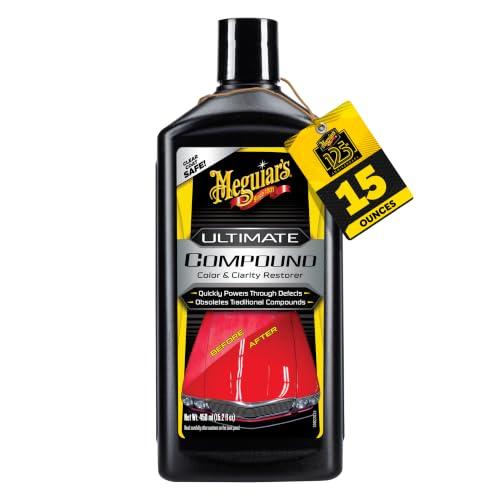
Meguiar's Ultimate Compound
Ultimate Compound is the most widely used correction liquid in home detailing for a straightforward reason: it is inexpensive, it is available everywhere, and it removes light to moderate swirls with very little risk.
Our score9.3Best for: the cheapest way to find out if your swirls will come out
Tap any row for the full write-up. Prices come straight from Amazon and are never typed in by hand.
The verdict
Meguiar's Ultimate Compound is the right first bottle for almost everyone: it removes clear-coat scratches shallow enough to be removable, it works by hand as well as by machine, and it finishes cleanly enough that you rarely need a second liquid. Step up to Menzerna 400 only for hard European clear coat that a consumer compound has visibly failed on.
02
First, the test that decides everything
Run a fingernail across the scratch, perpendicular to it. If your nail catches, the scratch is through the clear coat and no abrasive will remove it. Polishing a scratch that deep only thins the clear coat around it and makes the edge less obvious, which is sometimes a worthwhile cosmetic improvement and is never a repair. That one is a touch-up paint or body shop job.
If your nail glides straight over it, the scratch sits inside the clear coat and an abrasive can level the surface around it until it disappears. That is what every product on this page does — they are compounds and polishes, sold under a friendlier name.
Scratch depth, and the honest outcome for each
What you see
Fingernail
What will actually fix it
Dull haze, spider-web swirls
Glides
A one-step polish, easily
Fine straight scratch, no colour change
Glides
A moderate compound, one or two passes
White-looking scratch line
Catches slightly
Partial improvement only — expect it to remain faintly visible
You can see primer or metal
Catches hard
Touch-up paint or a body shop. No abrasive helps
Transferred paint from another object
Varies
Often a bonded deposit, not a scratch — try clay first
03
The ranked scratch removers
Ordered on usefulness to a home detailer rather than raw cut, because the most aggressive liquid here is the wrong answer for most scratches. Prices are live from Amazon.
No. 01Meguiar'sOutstandingSpec-verified
Meguiar's Ultimate Compound
Best for: The cheapest way to find out if your swirls will come out
Ultimate Compound is the most widely used correction liquid in home detailing for a straightforward reason: it is inexpensive, it is available everywhere, and it removes light to moderate swirls with very little risk. It is not the fastest cutter and it does not need to be.
Cut
Good
Finish
Strong
Ease of use
Exceptional
Value
Exceptional
Why we picked it
Removes light and moderate swirls with very little risk
Works by hand as well as by machine
Costs a fraction of boutique correction liquids
Good to know. Slow on deep scratches and heavy oxidation
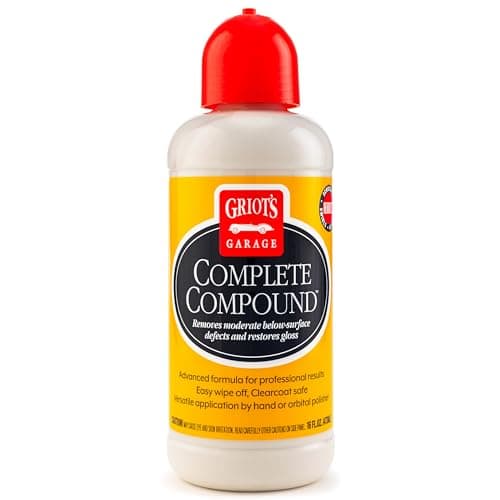
Griot's Complete Compound is their one-step answer, and like 3D ONE it is designed to cut then finish in the same pass. On a G8 or G9 with a correcting pad it is a tidy, predictable system with nothing to think about.
Cut
Good
Finish
Strong
Ease of use
Exceptional
Value
Exceptional
Why we picked it
Predictable and consistent on the matching Griot's machines
Low dust, which matters more than people expect indoors
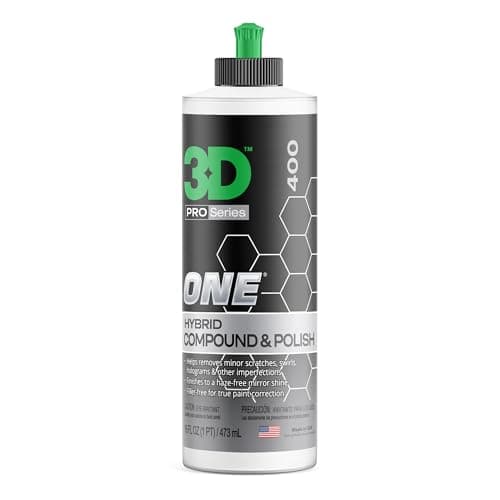
3D ONE is a genuine one-step: it starts as a compound and the abrasives break down as you work, so the same pass that removes the defect also finishes it. On a medium pad it handles most daily-driver swirls and leaves paint that does not need a second liquid.
Cut
Strong
Finish
Exceptional
Ease of use
Strong
Value
Strong
Why we picked it
Truly finishes down, so most cars need only this one liquid
Very low dusting compared with traditional compounds
Flexible — cut level changes with the pad you pair it with
Good to know. Less outright cut than a dedicated heavy compound
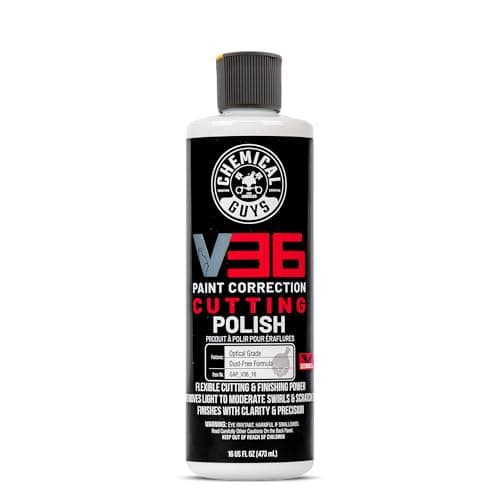
V36 is the cutting stage of Chemical Guys' three-liquid V-line, and it is a competent heavy abrasive — it removes defects a one-step will not touch. Used as intended it is followed by a finishing polish, and skipping that step is why people complain about haze.
Cut
Strong
Finish
Adequate
Ease of use
Good
Value
Strong
Why we picked it
Genuine heavy cut for defects a one-step cannot remove
Long working time for a compound of this grade
Part of a coherent system if you want the full three steps
Good to know. Requires a finishing polish after it — it is half a job
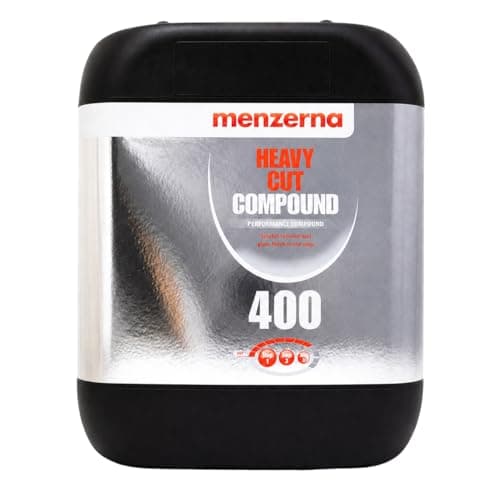
Menzerna's heavy cut is what people reach for when a daily-driver compound has made no visible difference, which happens on hard European clear coat more often than anywhere else. It cuts hard and, unusually for its grade, finishes well enough that one follow-up polish is normally enough.
Cut
Exceptional
Finish
Good
Ease of use
Good
Value
Adequate
Why we picked it
Cuts hard clear coat that consumer compounds cannot touch
Finishes better than most compounds of this abrasive grade
Very low dusting for a heavy cut
Good to know. 128 oz is a professional quantity, not a home one
There is no chemistry that selectively dissolves a scratch. Every product that removes one does it by abrading the clear coat flat, exactly as a polishing compound does. Some bottles sold as scratch removers also carry fillers, which temporarily hide what they cannot level — and those look brilliant for three washes before the scratch reappears.
The liquids ranked above are honest abrasives with a published or inferable cut level. That makes them comparable, which is the point: once you know a scratch needs moderate cut, you can pick the cheapest moderate-cut liquid instead of the one with the best packaging. Compound vs polish covers how the grades relate.
Clear coat is a budget you spend once
A factory clear coat is roughly 40 to 50 microns thick, and a serious correction pass removes a few of them. You can do that a handful of times across the life of a car. Which is why the rule is to start with the least aggressive combination that works, and why a scratch you can only mostly remove is often better left mostly removed.
05
By hand or by machine
By hand works for a single scratch on one panel. Use a foam applicator, work a 6 inch square, and accept that hand pressure is uneven so the result will be too.
By machine is faster, more even and far better at finishing. For a whole car there is no sensible hand option — see the best dual action polishers.
Never by rotary for a first attempt. A rotary generates heat at the edge of a pad, and burning through clear coat on a body line takes seconds.
06
The method, in order
01Wash and dry the panel. Abrading over grit creates new scratches.
03Do the fingernail test and decide what outcome is realistic.
04Start with a moderate liquid on a polishing pad, four to six slow passes.
05Wipe, then inspect under a single bright light from two angles.
06Repeat once. If two passes change nothing, step up the liquid — not the pressure.
07Finish with a light polish if the panel hazes, then seal it. Paint correction steps has the full sequence.
Protect the area afterwards. A freshly abraded clear coat has nothing at all on it, and the scratch you just removed is in the exact spot most likely to be touched again. A sealant takes ten minutes.
One more thing worth checking before you buy anything: a great many so-called scratches are bonded deposits sitting on top of the clear coat rather than cuts into it. If the mark is rough to the touch and sits proud of the surface, an iron remover and clay will take it off with no abrasion at all.
07
Scratch types you will meet, and what each one is
Swirl marks. A spider-web pattern visible under a point light, caused by washing and drying. Correctable with a one-step polish and genuinely preventable — how to wash a car without scratching it is the fix.
Automatic car wash scratches. Long parallel marks, usually across the hood and roof, from a brush gantry. Correctable once. The permanent fix is not going back.
Key and ring scratches. Usually straight, usually through the clear, usually around door handles. Partially improvable at best.
Scuffs from another car's bumper. Often transferred paint rather than a cut. Try clay and a light polish before anything aggressive.
Buffer trails. Hazy arcs left by someone else's rotary. These are a correction problem, not a scratch problem, and a finishing polish removes them.
Knowing which one you have changes the product you need, and the only thing that distinguishes them reliably is a light and a fingernail — not a photograph and not a guess.
08
Why cheap fix-it pens are a different product entirely
Touch-up pens and scratch-repair pens are not abrasives. They deposit lacquer or paint into a channel the clear coat has already lost, so they apply to exactly the scratches the products above cannot help. The result is a filled line that reads as less obvious from a normal viewing distance and as a filled line up close. That is a legitimate outcome for a deep scratch, and it is not what any product on this page does.
What does not work is a filler-bearing product sold as a scratch remover on a deep scratch. Those contain enough oil to mask the mark for a few washes, after which the scratch reappears exactly as it was and you have learned nothing about its depth. Most of these products are designed to be worked by hand on a single defect, and can you polish a car by hand covers the method and its limits.
09
Our recommendation
Buy this one
Meguiar's Ultimate Compound
Ultimate Compound is the most widely used correction liquid in home detailing for a straightforward reason: it is inexpensive, it is available everywhere, and it removes light to moderate swirls with very little risk.
On scratches that sit inside the clear coat, yes — they are abrasives that level the surface until the scratch is gone. On anything deep enough to catch a fingernail, no: nothing removes it, and the most you can do is soften the edge so it reads less obviously.
What is the best scratch remover for cars?
Meguiar's Ultimate Compound for most people. It handles clear-coat scratches, works by hand or machine, finishes cleanly and costs very little. Menzerna 400 is the step up for hard European clear coat where a consumer compound has visibly failed.
How do you know if a scratch can be polished out?
Run a fingernail across it. If the nail glides over, the scratch is in the clear coat and an abrasive can remove it. If the nail catches, it is through the clear coat and polishing will only thin the surrounding paint.
Will a scratch remover damage my paint?
Used sensibly, no — you are removing a few microns of clear coat out of roughly fifty. Used repeatedly on the same panel, or with a rotary near an edge, yes. Start with the least aggressive liquid and pad that works, and tape your edges.
Can you use a scratch remover on a ceramic coated car?
Only by removing the coating in that spot, which an abrasive will do. If the car is coated, either live with the scratch or accept that you are re-coating the panel afterwards. Ceramic coating maintenance covers what is safe on top of a coating.
11
Sources
Every published figure on this page traces to one of these. Where a manufacturer does not publish a number, the page says so rather than estimating it.
Last reviewed October 11, 2026. Think a figure here is wrong? Tell us at contact@detailingandwax.com and we will check it, fix it and date the correction — see our editorial policy.