Independent picks for detailing your own car. We stock nothing, so we have nothing to move.
01
Polishers & correction
What size polishing pad should you use?
A 5.5 inch pad on a 5 inch backing plate is the default for home paint correction. Here is why that overhang is deliberate, and when a smaller pad is the faster choice.
Featured here: the Lake Country 5.5 in HDO Foam Polishing Pad Kit.
How this is funded: we earn an Amazon commission when you buy through our links, at no extra cost to you. We sell nothing and stock nothing, so a pick is never a product we are trying to move. Prices are pulled live from Amazon and were last checked November 19, 2026; where we cannot verify a price we say so rather than print an old one. Full disclosure.
Research-basedPicked from published manufacturer specifications and the consistent pattern across verified-purchase owner reports. Every product here scores 8.4 or better on our rubric.How we pick
Top pickLake Country
Lake Country 5.5 in HDO Foam Polishing Pad Kit
Lake Country makes the foam a great many other brands rebadge, and the HDO line is built specifically for the pressure a long-throw machine puts through a pad.
Our score9.2Best for: buying pads the way you should — a matched set, not a sampler
For a 5 inch backing plate — which is what most dual action polishers ship with — use a 5.5 inch pad. The half inch of overhang keeps the plate from hitting paint and lets the foam flex over curves. Add 3 inch pads on a small plate for pillars, mirrors and spot correction, and skip 6.5 inch pads unless you are polishing something very large and very flat.
02
The short answer, and the reason for it
Pad size is matched to the backing plate, not to the machine. A plate is the hook-and-loop disc that bolts to the polisher's spindle, and the rule is simple: the pad should be about half an inch larger in diameter than the plate behind it. A 5 inch plate takes a 5.5 inch pad; a 3 inch plate takes a 3.5 inch pad.
That overhang does two jobs. It keeps the hard plastic edge of the plate away from paint when the pad tilts, which is the single most common way a beginner marks a panel. And it gives the foam somewhere to deform, so the pad can conform over a curve instead of riding on its rim.
Pad diameters and what each is genuinely for
Pad size
Backing plate
What it is for
Honest trade-off
3 to 3.5 in
3 in
Pillars, mirrors, bumpers, single-scratch spot work
Slow over a whole car; heats up fast
5 to 5.5 in
5 in
The default for home paint correction
None worth naming — this is the right answer
6 to 6.5 in
5 in or 6 in
Large flat panels, roofs, van sides
Harder to keep flat; the machine bogs on curves
Over 6.5 in
6 in
Rotary and professional work
Not appropriate for a home dual action
03
Pads in the sizes that matter
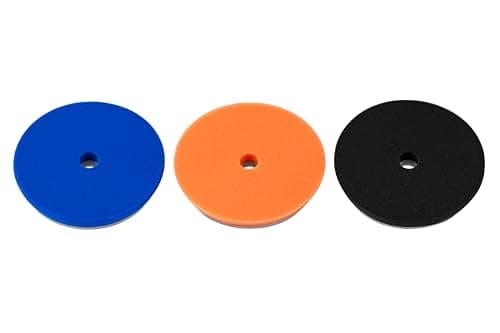
Three pad sets in the 5 to 5.5 inch class that fits a standard 5 inch plate. Prices are live from Amazon.
Lake CountryOutstandingSpec-verified
Lake Country 5.5 in HDO Foam Polishing Pad Kit
Best for: Buying pads the way you should — a matched set, not a sampler
Lake Country makes the foam a great many other brands rebadge, and the HDO line is built specifically for the pressure a long-throw machine puts through a pad. A three-pack of the same pad is more useful than four different ones, because a saturated pad stops cutting and you need a spare mid-panel.
Cut
Strong
Finish
Strong
Longevity
Strong
Value
Strong
Why we picked it
Multiple identical pads, which is how pads should be bought
Built for the pressure a long-throw machine applies
Lake Country foam is the reference other brands rebadge
Good to know. 5.5 in is too large for tight panels — you will want smaller too
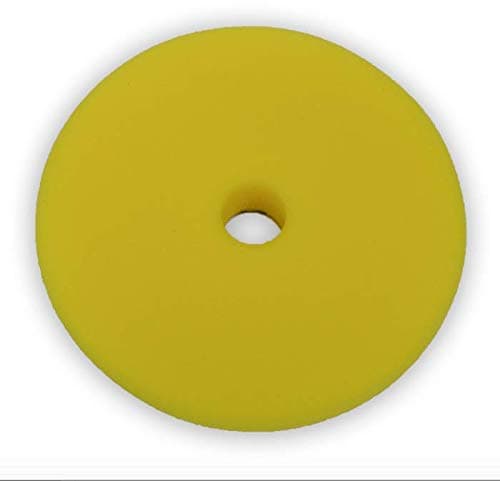
Uro-Tec is color-coded by cut and the yellow is the polishing grade — the middle of the range and the one that does most of the work on a daily driver. At this price there is no reason to own one; buy four and swap when the first saturates.
Cut
Good
Finish
Strong
Longevity
Strong
Value
Exceptional
Why we picked it
Cheap enough to buy the four you actually need
Clear color coding across the range makes cut level unambiguous
5 in is the most useful size on modern panels
Good to know. Sold singly — a single pad is not a correction kit
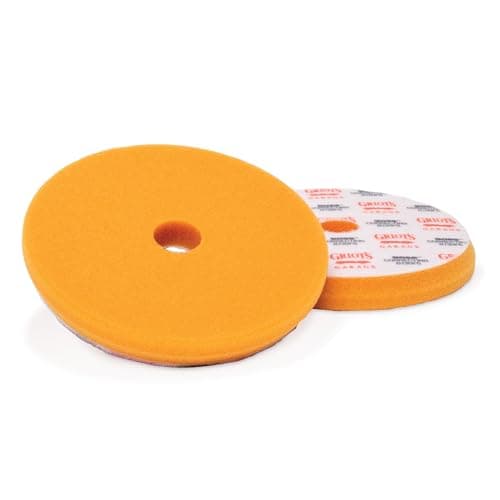
Griot's designed the BOSS foam around their own throw figures, and the pairing shows — on a G8 or G9 these track flatter and run cooler than generic foam of the same nominal density. Correcting pads, so they cut rather than finish.
Cut
Strong
Finish
Good
Longevity
Strong
Value
Strong
Why we picked it
Designed around the throw of the Griot's machines specifically
Runs cooler than generic foam under sustained pressure
Standard 5.5 in size fits any 5 in plate, not just Griot's
Good to know. Costs more than generic foam of similar density
This is counter-intuitive and it is the most useful thing on this page. A dual action polisher produces a fixed amount of torque. Spread that over a 6.5 inch pad and the pressure per square inch of foam drops; concentrate it on a 5.5 inch pad and it rises. Higher pressure per square inch is what removes defects.
So a smaller pad can out-correct a larger one on the same machine, even though it touches less paint per pass. On a soft-paint car with light swirls the large pad wins on speed; on hard clear coat with real defects the smaller pad wins on outcome. When a correction is not working, going down a pad size is a free experiment before buying a more aggressive liquid.
Where the 3 inch pads earn their place
A-pillars and the base of a windscreen, where a 5.5 inch pad cannot sit flat.
Mirror caps and door handles, which are mostly curve.
A single scratch, where working a 6 inch square with a small pad beats setting up for a whole panel.
Bumper corners, where paint is thin and a long-throw machine with a big pad is a genuine risk.
05
Size is not the same as cut
Two pads of identical diameter can behave completely differently depending on the foam. Cut level is signalled by colour and by the manufacturer's own naming, not by size — polishing pad colors explained covers how to read that, and why the colours mean different things across brands.
The practical kit for a home correction is three sizes and two cut levels: 5.5 inch cutting and polishing pads for panels, plus 3 inch versions of both for the tight work. That is four pads, which is fewer than most pad kits contain. The best polishing pads ranks the sets worth buying.
06
Matching the pad to the throw
Throw changes the answer slightly. On a short-throw 8 to 9mm machine a 5.5 inch pad is comfortable everywhere. On a 15mm or longer machine, large pads become awkward because the arc the pad edge travels is wider — many long-throw users run 5 inch pads for exactly that reason. Griot's G9 vs RUPES LHR15 covers how much that actually changes in practice.
Replace pads more often than feels necessary. A saturated, compacted pad stops cutting and starts smearing, and the symptom — work that used to take four passes now takes eight — reads like a liquid problem. Clean pads between sections and retire them when the foam stops springing back.
07
Microfiber pads are sized differently in practice
A microfiber cutting pad behaves as though it were a size larger than its diameter suggests, because the fibre tips cut harder than foam of the same thickness. The practical consequence is that a 5 inch microfiber pad can out-cut a 5.5 inch foam cutting pad on the same machine, and it generates more heat doing it.
That makes microfiber a poor choice for a first correction regardless of size. It cuts fast, it loads up with residue quickly, and it needs a finishing pass with foam afterwards almost without exception. If you are buying one pad type to start with, buy foam.
08
Why pad size is not a universal spec
Manufacturers measure pads differently — some give the foam diameter, some the diameter at the hook-and-loop backing, which on a tapered pad is smaller. A pad sold as 5.5 inch from one brand may measure closer to 5.25 inch at the face than another brand's. The gap is small and it is enough to matter if you are trying to hold a precise half inch of overhang.
The practical rule that survives this: buy pads and plate from the same size family, prefer a slight excess of overhang to a deficit, and check that the pad covers the plate completely when it is sitting flat on a panel. If any part of the plate is visible from the side with the pad under load, the pad is too small. Size also changes how many pads a car takes, which is worked through in how many polishing pads do I need.
09
Our recommendation
Buy this one
Lake Country 5.5 in HDO Foam Polishing Pad Kit
Lake Country makes the foam a great many other brands rebadge, and the HDO line is built specifically for the pressure a long-throw machine puts through a pad.
Uro-Tec is color-coded by cut and the yellow is the polishing grade — the middle of the range and the one that does most of the work on a daily driver.
A 5.5 inch pad on the 5 inch backing plate most dual action polishers ship with. The half inch of overhang keeps the plate edge off your paint and lets the foam flex over curves. Add 3 inch pads with a 3 inch plate for pillars, mirrors and spot work.
Can you use a 6 inch pad on a 5 inch backing plate?
Physically yes, and it is a poor idea. An inch of unsupported foam flexes rather than transmitting pressure, so the pad cuts unevenly and the machine bogs down on curves. Keep the overhang to about half an inch.
Do smaller polishing pads cut better?
Often, yes. The machine's torque is spread over less foam, so pressure per square inch rises and defect removal improves. A smaller pad covers less paint per pass, so it is slower over a whole car but more effective on hard clear coat.
What size backing plate do I need?
Match it to the pads you intend to run, half an inch smaller: a 5 inch plate for 5.5 inch pads, a 3 inch plate for 3.5 inch pads. Most polishers ship with a 5 inch plate, so a 3 inch plate is the one worth adding.
How many polishing pads do you need for one car?
Three or four of each cut level you are using. Pads saturate with product, and compacted residue stops them cutting, so swapping to a clean pad every two or three panels is faster than cleaning one mid-job.
11
Sources
Every published figure on this page traces to one of these. Where a manufacturer does not publish a number, the page says so rather than estimating it.
Last reviewed October 11, 2026. Think a figure here is wrong? Tell us at contact@detailingandwax.com and we will check it, fix it and date the correction — see our editorial policy.