Independent picks for detailing your own car. We stock nothing, so we have nothing to move.
01
Polishers & correction
How often should you polish your car?
Once a year at most, and for most cars once every two or three. Polishing removes clear coat, and clear coat is a budget you can only spend a handful of times.
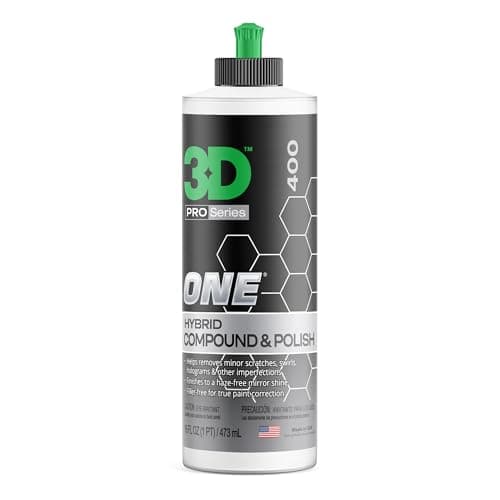
Featured here: the 3D ONE Hybrid Compound and Polish.
How this is funded: we earn an Amazon commission when you buy through our links, at no extra cost to you. We sell nothing and stock nothing, so a pick is never a product we are trying to move. Prices are pulled live from Amazon and were last checked November 19, 2026; where we cannot verify a price we say so rather than print an old one. Full disclosure.
Research-basedPicked from published manufacturer specifications and the consistent pattern across verified-purchase owner reports. Every product here scores 8.4 or better on our rubric.How we pick
Top pick3D
3D ONE Hybrid Compound and Polish
3D ONE is a genuine one-step: it starts as a compound and the abrasives break down as you work, so the same pass that removes the defect also finishes it.
Our score9.3Best for: one bottle doing the work of two
Polish a car once a year at the absolute most, and only when it needs it. A correction removes a few microns of clear coat out of roughly fifty, so a car has perhaps five or six serious corrections in its lifetime. Most owners should correct once, then protect and wash properly, and not touch a machine again for two or three years.
02
The direct answer, and the arithmetic behind it
A factory clear coat is roughly 40 to 50 microns thick. A moderate machine polish removes somewhere in the region of 2 to 5 microns depending on the pad, the liquid and how many passes you make. A heavy compounding stage removes more. The clear coat is also what carries the UV inhibitors protecting the colour beneath it, so running out of it is not cosmetic — it is the start of paint failure.
Do that arithmetic and the ceiling is obvious. Annual polishing is survivable on a well-kept car for a few years and reckless as a lifelong habit. Polishing twice a year is actively destructive. The honest schedule is correct once, properly, and then make it unnecessary.
How often, by how the car is actually used
Situation
How often to polish
What to do instead
New car, washed carefully
Not at all for several years
Protect it and wash it properly from day one
Daily driver, careful two-bucket washes
Every 2 to 3 years
Sealant twice a year, detail spray between
Daily driver, automatic car washes
Yearly, and stop using them
Change the wash method — that is the actual fix
Just bought, swirled by a previous owner
Once now, then reassess in 2 years
One proper correction, then protect
Show car, garaged
When a panel inspection says so
Light finishing polish only, never compound
03
What a once-every-few-years correction needs
A one-step liquid, a finishing polish for the panels that show, and the sealant that makes the correction last. Prices are live from Amazon.
3D ONE is a genuine one-step: it starts as a compound and the abrasives break down as you work, so the same pass that removes the defect also finishes it. On a medium pad it handles most daily-driver swirls and leaves paint that does not need a second liquid.
Cut
Strong
Finish
Exceptional
Ease of use
Strong
Value
Strong
Why we picked it
Truly finishes down, so most cars need only this one liquid
Very low dusting compared with traditional compounds
Flexible — cut level changes with the pad you pair it with
Good to know. Less outright cut than a dedicated heavy compound
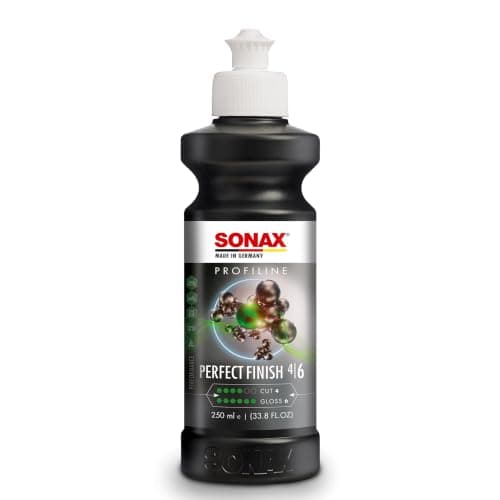
Perfect Finish is the liquid you reach for when the correction is done and you can still see haze under direct sun on black paint. It cuts enough to remove light defects on soft paint and finishes to a genuinely clear gloss that a compound cannot match.
Cut
Trade-off
Finish
Exceptional
Ease of use
Strong
Value
Good
Why we picked it
Finishes to a clarity that compounds do not reach
Enough cut to correct light defects on soft paint in one step
Long working time, so it is hard to rush
Good to know. 250 ml is a small bottle for the money
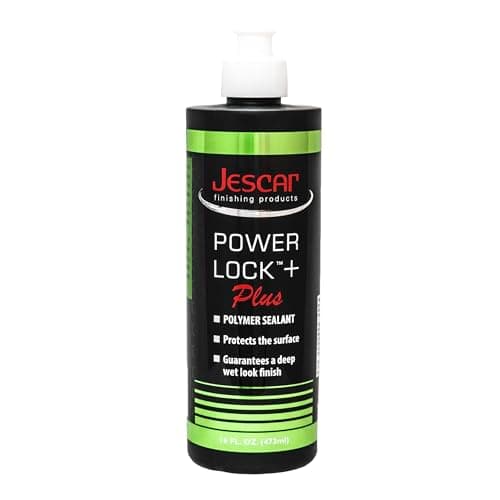
Power Lock Plus is the durability benchmark among consumer sealants, and it applies as easily as anything here — thin coat, short cure, wipe off. If the goal is to protect a car properly and not think about it for six months, this is the product.
Durability
Exceptional
Gloss
Strong
Ease of use
Strong
Value
Strong
Why we picked it
The longest-lasting sealant in this roundup
Easy, forgiving application for its durability class
Works by hand or by machine
Good to know. Needs a properly clean, bare surface to bond
Published specifications
Type
Polymer sealant
Claimed durability
Up to 12 months, per Jescar
Volume
16 oz
Form
Liquid
Coating safe
No — a sealant replaces a coating, it does not top one
01Wash and dry the car properly. Dirt hides defects, so judging dirty paint is pointless.
02Wipe one panel with a dilute isopropyl mix to strip oils and any filler left by a previous product.
03Look along the panel at a shallow angle under direct sun or a single bright point source.
04Decide what you can actually see from 6 feet away in normal light — that is the car other people look at.
05If the defects only appear under a torch held two inches from the paint, the car does not need polishing.
05
What to do in the years between
Everything that makes polishing rare is cheap, quick, and happens at the wash stage. The order of return is roughly this:
Change how you wash. Two buckets, grit guards, a clean mitt and straight-line motions. How to wash a car without scratching it is the highest-value page on this site for anyone who polishes often.
Stop using automatic car washes. Brush washes put in swirls faster than any polish removes them.
Dry with a plush towel or air, never a chamois dragged across a dry panel. Drying towels matter more than most people expect.
Keep protection on the paint. A sealant twice a year means dirt sits on the sealant rather than keying into clear coat — see how often to wax your car.
Decontaminate twice a year with an iron remover and clay. Bonded contamination is what dragging a mitt turns into scratches.
06
Polish, compound and finishing polish are different schedules
The word polishing covers three operations with very different costs. Compounding is the aggressive one and should happen once or twice in a car's life. One-step polishing is the moderate one and is the every-few-years job. A finishing polish removes almost nothing and can be done more freely — it is closer to a wax step than a correction step.
Compound vs polish explains the abrasive difference, and paint correction steps sets out the full sequence so you can tell which one a car actually needs. If the answer is only the finishing stage, you are not spending much clear coat at all.
One last caveat for coated cars: a ceramic coating sits on top of the clear coat, so polishing removes the coating. That makes the schedule above irrelevant and replaces it with the coating's own lifespan — ceramic coating maintenance covers what to do instead of reaching for a machine.
07
How much clear coat you have left
Nobody polishing at home knows this number, and that is worth saying plainly. A paint depth gauge measures total film thickness and costs more than most polishers; without one you are working on inference. The useful inferences are these:
A car that has never been corrected almost certainly has its full factory thickness, minus a little from years of washing.
A used car with suspiciously good paint may have been corrected hard by a dealer or a previous owner. Assume it has less.
Repainted panels are usually thicker than factory but softer, so they correct easily and mar easily.
Edges, body lines and the tops of bumpers are always the thinnest areas on any car, regardless of history.
Any panel showing a patch of dull, flat, grey-looking clear has already failed there. Do not polish it; it will come off.
That uncertainty is the real argument for the long intervals above. When you cannot measure the budget you are spending, the correct response is to spend it slowly.
08
A realistic annual routine instead
01Weekly or fortnightly: a proper two-bucket wash and a careful dry.
02Monthly: a detail spray wipe-down, which takes ten minutes and keeps the gloss up.
03Twice a year: iron remover, clay if the bag test fails, then a sealant. Half a day each time.
04Every two to three years: one machine correction, judged by the six-foot rule rather than by a torch.
05Never: an automatic brush wash, a dry chamois, or a correction because the car is dirty rather than because it is damaged.
That routine keeps a car looking corrected for its whole life while touching a machine twice in a decade, which is the actual answer to how often you should polish it.
09
Our recommendation
Buy this one
3D ONE Hybrid Compound and Polish
3D ONE is a genuine one-step: it starts as a compound and the abrasives break down as you work, so the same pass that removes the defect also finishes it.
Once a year at the very most, and for most cars once every two or three years. Polishing removes a few microns of clear coat from a total of roughly fifty, so a car only has a handful of serious corrections in it. Correct once properly, then protect it.
Can you polish a car too much?
Yes, and it is permanent. Running out of clear coat is not a cosmetic problem — the clear coat carries the UV inhibitors that protect the colour underneath, so paint failure follows. Twice-yearly polishing will get there within the life of a car.
Is polishing the same as waxing?
No. Polishing is abrasive: it removes clear coat to level defects. Waxing adds a sacrificial layer on top and removes nothing. Waxing can be done every few months; polishing should be done every few years.
How do I know if my car needs polishing?
Wash it, strip one panel with a dilute isopropyl mix, then look along the paint at a shallow angle under a single bright light. If you can see swirls from six feet away in normal light, it is due. If they only show under a torch held close, it is not.
How often should you polish a ceramic coated car?
Not at all while the coating is intact — polishing removes the coating. Maintain it with the correct shampoo and an SiO2 topper, and plan the next correction for when the coating itself is due to be replaced.
11
Sources
Every published figure on this page traces to one of these. Where a manufacturer does not publish a number, the page says so rather than estimating it.
Last reviewed October 11, 2026. Think a figure here is wrong? Tell us at contact@detailingandwax.com and we will check it, fix it and date the correction — see our editorial policy.