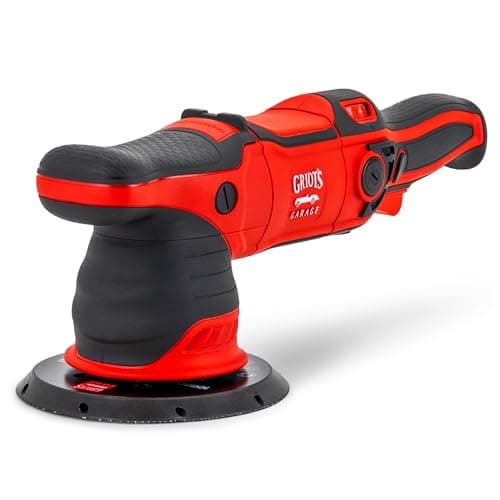
Featured here: the Griot's Garage Griot's Garage G9 Random Orbital Polisher.
How this is funded: we earn an Amazon commission when you buy through our links, at no extra cost to you. We sell nothing and stock nothing, so a pick is never a product we are trying to move. Prices are pulled live from Amazon and were last checked October 5, 2026; where we cannot verify a price we say so rather than print an old one. Full disclosure.
Research-basedPicked from published specifications and the pattern across verified-purchase reports. We have not used these ourselves and do not pretend otherwise.How we pick
The verdict
Buy a dual action. Unless you are removing wet-sanding marks or correcting genuinely severe defects on a car you can afford to repaint, a rotary offers you speed you do not need in exchange for a risk you cannot undo.
02
The mechanical difference
A rotary spins the pad on a fixed axis. The pad's outer edge travels much faster than its center, it generates concentrated heat, and it keeps cutting however hard you press.
A dual action spins the pad and orbits the whole spindle at the same time. The pattern is irregular, heat is spread across a larger area, and — critically — the free-spinning design means that pressing too hard stalls the rotation. The pad keeps orbiting but stops spinning, and it stops cutting. That is a mechanical safety net, not a software one, and it is why a dual action is the machine for a home garage.
The two machine types, side by side
Dual action
Rotary
Cutting speed
Moderate
Highest available
Stall protection
Yes — inherent to the design
None
Holograms
Essentially none
Likely without technique
Heat concentration
Spread over a wider area
Concentrated at the pad edge
Learning curve
An afternoon
Months, on scrap panels first
Right for
Swirls, light to moderate defects, every home job
Wet-sanding marks, severe oxidation, trade work
03
The machines being compared
A representative dual action, a rotary, and a kit option. Prices are live from Amazon.
Griot's GarageSpec-verified
Griot's Garage G9 Random Orbital Polisher
Best for: The default answer for a first serious machine
A 9mm throw and a 1000W motor put the G9 exactly where most home detailers should be: fast enough to finish a car in an afternoon, short enough in the throw to stay predictable near badges and body lines. It is the machine we would buy if we were buying one machine.
Who should skip it. If you already own a competent 8mm machine, this is not the upgrade you think it is — the extra millimeter of throw will not fix inconsistent results. Put the money into better pads and a second liquid instead. It is also heavier than the G8, and you notice that on vertical panels after an hour.
Correction speed
8.5
Control
9.0
Ergonomics
7.5
Build
9.0
Value
8.5
What works
9mm throw is the best general-purpose compromise on the market
1000W does not bog down under pressure on a cutting pad
Griot's lifetime warranty is the strongest in the category
Takes the same 5 in plate and 5.5 in pads as everything else
What does not
Heavier than the G8, which shows on doors and quarters
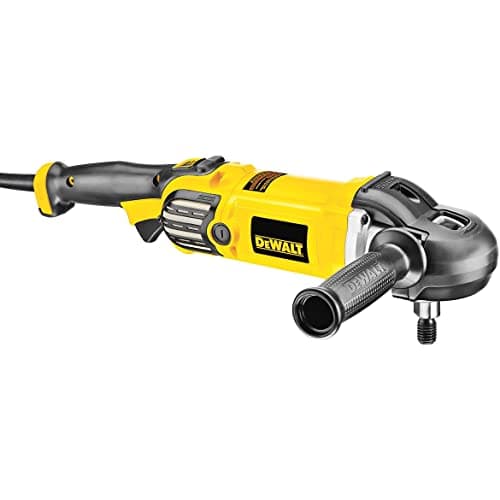
A 12 amp rotary with a soft start and a 0 to 3,500 RPM dial. A rotary removes deep defects and wet-sanding marks that no dual action will touch — and it does it by generating heat in one spot, which is exactly why it is not a first machine.
Who should skip it. Anyone who has not already corrected several cars with a dual action. A rotary does not stall when you press too hard; it keeps cutting, and it will go through clear coat on an edge in seconds. There is no undo.
Correction speed
9.5
Control
4.5
Ergonomics
7.0
Build
9.0
Value
8.0
What works
Removes defects no dual action can reach
Soft start keeps the pad from slinging product on startup
12 amp motor holds speed under heavy pad pressure
What does not
Will burn through clear coat on an edge if you stall it
Large pad sizes are awkward on curved modern bodywork
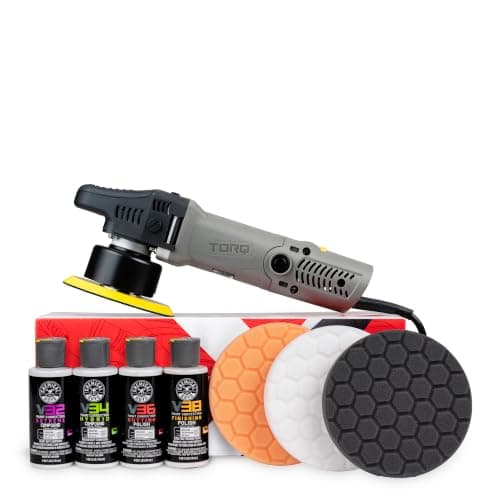
The TORQX is a competent 800W short-throw machine, and the reason to buy it is the kit: it arrives with pads and liquids, so you are correcting the same day rather than placing a second order. For a first-time buyer that convenience is worth real money.
Who should skip it. If you already own pads and compounds, you are paying for a bundle you do not need, and the bare machine is not better than a G8 or G9. The included pads are serviceable rather than good — most people replace them within a year.
Correction speed
7.0
Control
9.0
Ergonomics
8.0
Build
7.5
Value
8.5
What works
Genuinely complete out of the box — pads, liquids, machine
800W is adequate for the short throw it drives
The least intimidating entry point of the serious machines
What does not
Included pads are the weakest part of the package
Worse value than a bare machine if you already have consumables
Chemical Guys does not publish a backing plate size we could verify
This is a real list and it is shorter than rotary enthusiasts suggest:
Wet-sanding marks. After sanding, a rotary removes the sanding scratches in a fraction of the time. This is the genuine case.
Severe oxidation on single-stage paint, particularly on older vehicles, where there is a lot of material to remove and no clear coat to protect.
Deep defects on hard clear coat, where a dual action will take four passes and a rotary takes one.
Production work where time is money and the operator does this every day.
Everything else — ordinary swirl marks, light scratches, a neglected daily driver — is dual action territory, and a long-throw dual action with a microfiber cutting pad closes most of the remaining speed gap. See the dual action roundup.
05
If you are set on a rotary
Three things make the difference between a useful tool and an expensive mistake:
01Practice on a scrap panel. Junkyard hood, fifteen dollars. Burn through it deliberately so you know what it feels like before it happens on your own car.
02Variable speed with a genuine soft start. Starting a loaded pad at full speed slings compound everywhere and jerks the machine out of your hands.
03Keep it moving, always. A rotary stationary on a panel for two seconds is a burn. There is no stall protection to save you.
The paint correction steps guide covers the process itself, which is the same for either machine.
06
Questions people actually ask
Can a beginner use a rotary polisher?
They can, and most should not. A rotary has no stall protection, so it keeps cutting at exactly the moment a dual action would stop, and burning through clear coat on a panel edge takes a couple of seconds. Learn on a dual action first — the skills transfer.
Is a rotary polisher faster than a dual action?
On heavy defects, substantially. On ordinary swirl marks, the gap is much smaller than it sounds, and a rotary often needs a dual action finishing pass to remove holograms — which gives the time back.
What are holograms and how do you remove them?
Faint curved buffer trails left by a rotary's fixed rotation pattern, visible on dark paint in direct sunlight. Remove them with a dual action, a soft finishing pad and a fine polish. Our compound roundup has suitable finishing polishes.
Do I need both a dual action and a rotary?
Almost certainly not. Owning both makes sense if you do paint repair work that involves wet sanding. For maintaining your own cars, one good dual action and a proper set of pads covers everything you will encounter.
07
Sources
Every published figure on this page traces to one of these. Where a manufacturer does not publish a number, the page says so rather than estimating it.
Last reviewed October 5, 2026. Think a figure here is wrong? Tell us at contact@detailingandwax.com and we will check it, fix it and date the correction — see our editorial policy.