How this is funded: we earn an Amazon commission when you buy through our links, at no extra cost to you. We sell nothing and stock nothing, so a pick is never a product we are trying to move. Prices are pulled live from Amazon and were last checked October 5, 2026; where we cannot verify a price we say so rather than print an old one. Full disclosure.
Research-basedPicked from published specifications and the pattern across verified-purchase reports. We have not used these ourselves and do not pretend otherwise.How we pick
The verdict
They are not alternatives. Foam first, then hand wash — the foam removes the loose grit that would otherwise end up in your mitt, which is what makes the hand wash safe. A touchless foam wash on its own leaves a visibly dirty car.
02
What foam alone actually removes
Dirt on a car comes in two forms. Loose material sitting on the surface — dust, sand, road grime — and bonded material that is stuck to the clear coat. Foam addresses the first and almost none of the second.
So a touchless foam wash leaves the car cleaner and still visibly dirty. That is the honest outcome, and anyone selling a cannon as a complete wash is overselling it.
03
Both halves of the sequence
A cannon and a snow foam for the pre-wash, a mitt and a grit guard for the contact wash. Prices are live from Amazon.
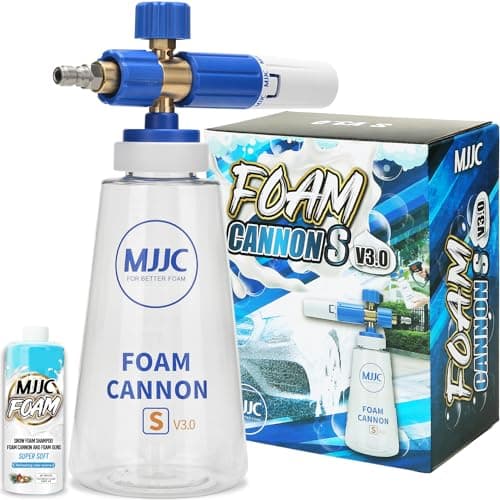
MJJC make the cannon that the rest of the market is measured against, and the S V3.0 produces foam that genuinely clings rather than sliding. Brass internals and a quarter-inch quick connector mean it fits almost any consumer pressure washer.
Who should skip it. Anyone without a pressure washer. A cannon needs the pressure and flow a machine produces, and on a garden hose it does nothing at all.
Foam thickness
9.5
Build
9.0
Adjustability
9.0
Value
7.5
What works
The thickest, longest-clinging foam in this group
Brass internals rather than plastic
Universal quarter-inch fitting
What does not
Useless without a pressure washer
Most expensive cannon here
MJJC does not publish a bottle capacity we could verify
Deep, dense microfiber with enough pile to pull grit up and away from the paint rather than trapping it against the surface. Two in the pack, which matters — a mitt that hits the ground is finished, and having a spare stops people picking it up and carrying on.
Who should skip it. Nothing much. It is more expensive than a chenille mitt and worth it, but if your washing technique is the actual problem a better mitt will not save you.
Grit release
9.0
Capacity
9.0
Durability
8.5
Value
8.0
What works
Deep pile pulls grit away from the panel
Two in the pack, so a dropped mitt is not a crisis
Rinses out cleanly between panels
What does not
More expensive than a chenille mitt
Bulky and slow to dry
The Rag Company does not publish a GSM figure for this one
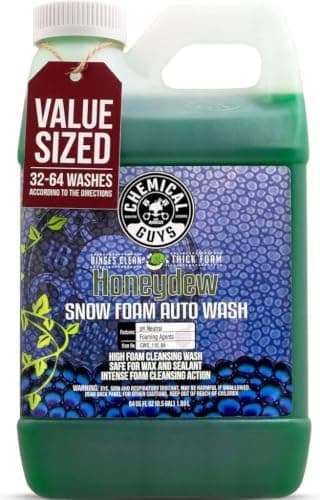
Honeydew is built for a foam cannon rather than a bucket, and the difference shows: it clings to vertical panels long enough to actually lift grit rather than sliding off in thirty seconds. That dwell time is the entire value of a pre-wash.
Who should skip it. Contact washing. It is a pre-wash product, and using it as your bucket soap wastes both the foam and the money.
Lubricity
7.5
Cleaning
8.5
Suds
9.5
Coating safe
9.0
Value
8.0
What works
Clings to vertical panels, which is what buys dwell time
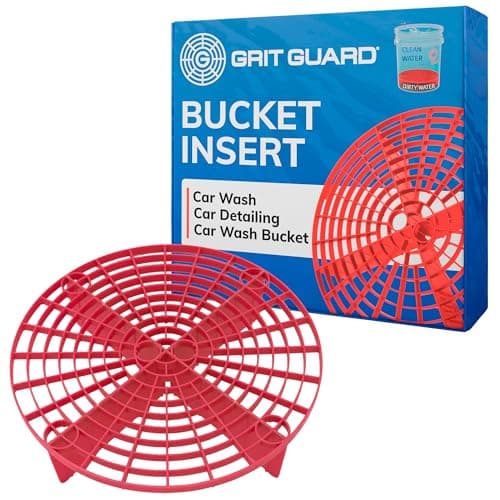
A plastic grid that sits in the bottom of the bucket, keeps settled grit down there, and gives you something to scrub the mitt against. It costs almost nothing and it prevents more paint damage per dollar than any product we have written about.
Who should skip it. Nothing. Buy two — one for the wash bucket and one for the rinse bucket. There is no scenario where a single grit guard is the right answer.
Effectiveness
9.0
Durability
9.5
Fit
9.0
Value
10.0
What works
The cheapest meaningful paint-safety upgrade available
Swirl marks come from grit in the wash mitt being dragged across the clear coat. Every particle the foam removes is a particle that never reaches the mitt. On a dirty car that is the difference between a wash that adds marring and one that does not.
Which reframes the value: the cannon is not a labor-saving device, it is a paint-protection device. Its benefit is invisible on the day and compounds over years — it is the reason a carefully washed car still looks good at 60,000 miles.
05
The complete sequence
01Wheels and arches first, with a dedicated wheel cleaner and separate tools. Never last — the overspray lands on clean paint.
02Rinse the whole car top to bottom to remove the loosest material.
03Foam, bottom to top, and let it dwell three to five minutes without drying.
04Rinse, top to bottom.
05Contact wash with two buckets, grit guards and a deep-pile mitt. Top panels first.
06Final rinse, free-flowing without a nozzle, so surface tension carries the water off.
No. A foam pre-wash removes most of the loose grit and leaves the car visibly dirty — road film and bonded contamination need contact. What the cannon does is make the hand wash far safer, which is a better claim than replacing it.
Can you wash a car with just a foam cannon?
On a car that is dusty rather than dirty, foam, dwell and rinse is a reasonable maintenance wash and it is safer than touching light dust with a mitt. On a genuinely dirty car it leaves most of the road film behind.
Does a foam cannon prevent swirl marks?
It prevents a large share of them, by removing the grit that would otherwise end up in your wash mitt. It does not prevent the marks caused by bad contact technique — two buckets, grit guards and a deep-pile mitt still matter.
What order should you wash a car in?
Wheels and arches first with separate tools, then rinse, then foam and dwell, then rinse, then the contact wash top down, then a free-flowing final rinse, then dry. Wheels first is the step people get backwards.
07
Sources
Every published figure on this page traces to one of these. Where a manufacturer does not publish a number, the page says so rather than estimating it.
Last reviewed October 5, 2026. Think a figure here is wrong? Tell us at contact@detailingandwax.com and we will check it, fix it and date the correction — see our editorial policy.