Featured here: the Chemical Guys Chemical Guys Heavy Duty Water Spot Remover Gel.
How this is funded: we earn an Amazon commission when you buy through our links, at no extra cost to you. We sell nothing and stock nothing, so a pick is never a product we are trying to move. Prices are pulled live from Amazon and were last checked October 5, 2026; where we cannot verify a price we say so rather than print an old one. Full disclosure.
Research-basedPicked from published specifications and the pattern across verified-purchase reports. We have not used these ourselves and do not pretend otherwise.How we pick
Water spots are what is left when water evaporates off paint instead of being removed from it. Everything dissolved in that water — calcium, magnesium, whatever the sprinkler was carrying — stays behind on the clear coat, and over time it can eat into it.
02
Step one — which problem do you have
01Wash and dry the panel.
02Run a fingernail across a spot.
03Slight raised crust: a mineral deposit. Chemical removal, twenty minutes.
04Perfectly smooth but still visible: etching. Polishing, an afternoon.
05Both, in different places: common. Do the chemical route first and reassess.
03
Both routes, with live prices
Two chemical removers and the machine and compound for the polishing route.
Chemical GuysSpec-verified
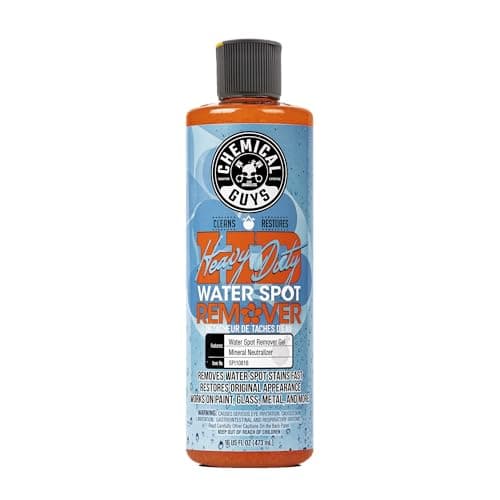
Chemical Guys Heavy Duty Water Spot Remover Gel
Best for: Mineral spots that a wash will not touch
Hard water spots are mineral deposits, not dirt, and they need an acidic remover rather than more soap. The gel format is the useful part: it stays where you put it on glass and vertical panels instead of running off.
Who should skip it. Etched spots. If the mineral has eaten into the clear coat, no chemical removes it — that is a polishing job, and this product will not help.
Effectiveness
8.5
Finish safety
7.0
Ease of use
8.0
Value
8.5
What works
Removes mineral deposits that washing cannot
Gel stays on vertical panels and glass
Works on glass as well as paint
What does not
Useless once a spot has etched into the clear coat
Acidic — keep it off trim and let nothing dry
Chemical Guys does not state coating compatibility we could verify
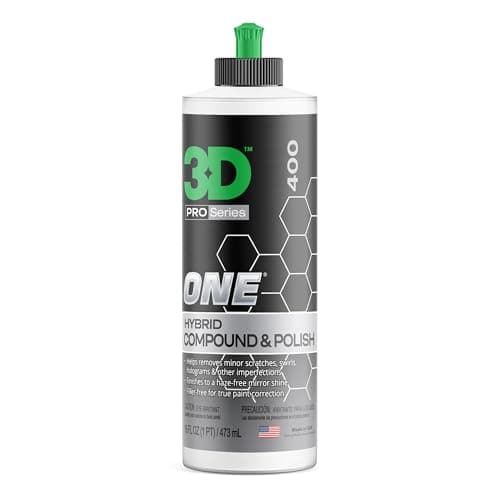
3D ONE is a genuine one-step: it starts as a compound and the abrasives break down as you work, so the same pass that removes the defect also finishes it. On a medium pad it handles most daily-driver swirls and leaves paint that does not need a second liquid.
Who should skip it. Anyone who wants maximum cut. A dedicated heavy compound removes more, faster. ONE is a time-saver and a simplifier, not a defect-removal champion.
Cut
8.0
Finish
9.0
Ease of use
8.5
Value
8.0
What works
Truly finishes down, so most cars need only this one liquid
Very low dusting compared with traditional compounds
Flexible — cut level changes with the pad you pair it with
What does not
Less outright cut than a dedicated heavy compound
Costs noticeably more per ounce than Ultimate Compound
Needs working properly; rushing the pass wastes the diminishing abrasive
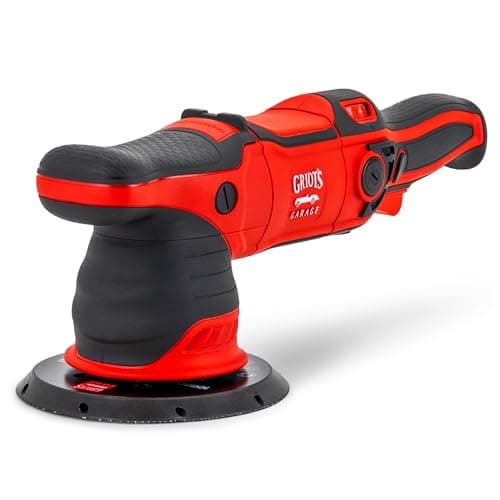
A 9mm throw and a 1000W motor put the G9 exactly where most home detailers should be: fast enough to finish a car in an afternoon, short enough in the throw to stay predictable near badges and body lines. It is the machine we would buy if we were buying one machine.
Who should skip it. If you already own a competent 8mm machine, this is not the upgrade you think it is — the extra millimeter of throw will not fix inconsistent results. Put the money into better pads and a second liquid instead. It is also heavier than the G8, and you notice that on vertical panels after an hour.
Correction speed
8.5
Control
9.0
Ergonomics
7.5
Build
9.0
Value
8.5
What works
9mm throw is the best general-purpose compromise on the market
1000W does not bog down under pressure on a cutting pad
Griot's lifetime warranty is the strongest in the category
Takes the same 5 in plate and 5.5 in pads as everything else
What does not
Heavier than the G8, which shows on doors and quarters
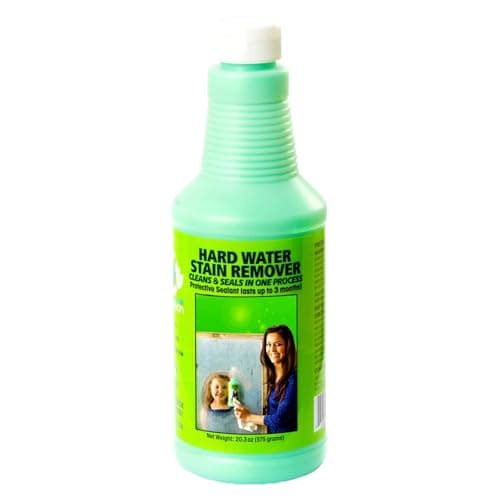
A mild abrasive paste rather than an acid, which makes it the right answer for glass with baked-in mineral staining that chemical removers will not shift. It is genuinely abrasive, so it is a glass product with paint used as a last resort.
Who should skip it. Routine paint work. Mild abrasive on clear coat is a polishing operation, and a dedicated polish does it better and more predictably.
Hard physical work compared with a chemical remover
Will dull a coating if used on paint
Published specifications
Type
Mild abrasive paste
Volume
20.3 oz
Surfaces
Glass primarily
Dwell time
Work it, do not let it dry
Coating safe
No — abrasive
04
Route one — chemical, for deposits
01Wash the car first. Dirt wastes product and blocks contact with the deposit.
02Work in the shade on a cool panel. Acidic removers stain if they dry.
03Apply to one panel, gel format preferred so it stays on vertical surfaces.
04Dwell as the label states — usually a minute or two, never to dryness.
05Agitate gently with a soft microfiber towel.
06Rinse thoroughly, including every panel gap.
07Repeat once if needed, and stop after two attempts.
08Reprotect the panel. Acidic removers strip wax and sealant, so it is bare — see sealants.
05
Route two — polishing, for etching
Etching is physical damage: the mineral has eaten a shallow crater into the clear coat. Removing it means leveling the clear coat down to the bottom of that crater, which is machine polishing.
01Test one spot with a polishing pad and a one-step compound before committing to the panel.
02Inspect under direct sun or an inspection light after two passes.
03If it has improved, continue across the panel.
04If two passes made no difference, step up to a cutting pad and test again.
05If a cutting pad makes no difference, stop. The etching is deeper than the clear coat safely allows, and the honest answer is to accept it.
06Protect the same day, because polished paint is bare.
Water spots etch glass readily and chemical removers are often less effective there. A mild abrasive paste designed for glass — the kind sold for shower doors — handles baked-in glass staining that nothing else shifts, and glass tolerates abrasion far better than clear coat does.
Work in small sections, keep it off the paint and trim, and rinse thoroughly.
07
Prevention, which is the actual answer
Never let a car air dry, especially in sun. This is the cause.
[Blow out the gaps](/washing/best-car-dryer-blowers) — mirrors, badges, trim — which is where the water that spots a dry panel comes from.
Do not park under sprinklers. Irrigation water is usually far harder than tap water and it etches quickly in sun.
Keep protection on the paint. A beading surface holds far less standing water for minerals to dry out of.
On very hard water, a rinse filter is the only real fix if the tap water itself is the problem.
08
Questions people actually ask
How do you remove hard water spots from a car?
Try a chemical remover first — an acidic or gel-format water spot remover shifts mineral deposits in about twenty minutes. If a fingernail test shows the surface is smooth and the mark is still visible, it has etched and needs polishing instead.
Will clay bar remove water spots?
Sometimes, for light surface deposits. Clay shears bonded material off the surface, and a light mineral film qualifies. It will not touch etching, and for heavier deposits a chemical remover is faster and does not risk marring.
Can water spots be removed from glass?
Yes, and glass often needs a mild abrasive paste rather than a chemical remover — the kind sold for shower doors. Glass tolerates abrasion far better than clear coat does, so this is safe there and not on paint.
How do you prevent water spots on a car?
Never let it air dry, blow the trapped water out of mirrors and gaps before it drips onto a dry panel, keep protection on the paint so water beads rather than standing, and stay out of sprinkler range.
09
Sources
Every published figure on this page traces to one of these. Where a manufacturer does not publish a number, the page says so rather than estimating it.
Last reviewed October 5, 2026. Think a figure here is wrong? Tell us at contact@detailingandwax.com and we will check it, fix it and date the correction — see our editorial policy.