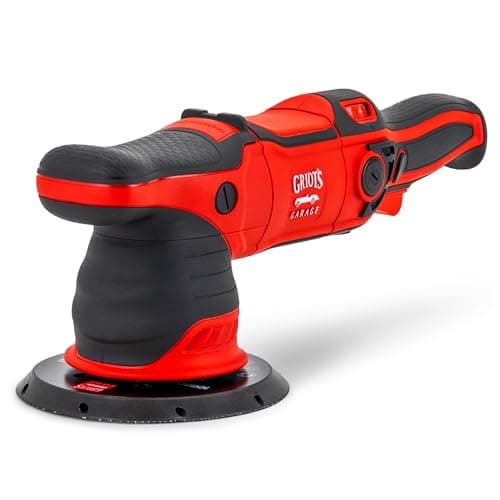
Featured here: the Griot's Garage Griot's Garage G9 Random Orbital Polisher.
How this is funded: we earn an Amazon commission when you buy through our links, at no extra cost to you. We sell nothing and stock nothing, so a pick is never a product we are trying to move. Prices are pulled live from Amazon and were last checked October 5, 2026; where we cannot verify a price we say so rather than print an old one. Full disclosure.
Research-basedPicked from published specifications and the pattern across verified-purchase reports. We have not used these ourselves and do not pretend otherwise.How we pick
The verdict
Stay at 9mm unless you are correcting more than one car a year. A long-throw machine saves genuine time on big flat panels and gives back some of it in the extra care needed around every edge, badge and body line — and on a curved modern car there are a lot of those.
02
What a longer throw actually buys
A 15mm machine moves the pad through a larger orbit, so each pass abrades a wider band of paint. On a flat hood that is a straightforward speed advantage: fewer passes for the same correction. On a quarter panel with a swage line through it, the same property means the pad is more likely to catch an edge.
Where each throw wins
9mm
15mm
Hood, corner to corner
Slower
Noticeably faster
Door with a body line
Comfortable
Needs deliberate care
Bumpers and curves
Good
Awkward
Pillars and mirrors
Marginal — use a mini machine
Not usable
Edge margin for error
Generous
Thin
Vibration over an hour
Moderate
Higher
03
The machines compared
A 9mm, a 15mm and a 12mm middle ground. Prices are live from Amazon; the long-throw machines here are sold as tools only.
Griot's GarageSpec-verified
Griot's Garage G9 Random Orbital Polisher
Best for: The default answer for a first serious machine
A 9mm throw and a 1000W motor put the G9 exactly where most home detailers should be: fast enough to finish a car in an afternoon, short enough in the throw to stay predictable near badges and body lines. It is the machine we would buy if we were buying one machine.
Who should skip it. If you already own a competent 8mm machine, this is not the upgrade you think it is — the extra millimeter of throw will not fix inconsistent results. Put the money into better pads and a second liquid instead. It is also heavier than the G8, and you notice that on vertical panels after an hour.
Correction speed
8.5
Control
9.0
Ergonomics
7.5
Build
9.0
Value
8.5
What works
9mm throw is the best general-purpose compromise on the market
1000W does not bog down under pressure on a cutting pad
Griot's lifetime warranty is the strongest in the category
Takes the same 5 in plate and 5.5 in pads as everything else
What does not
Heavier than the G8, which shows on doors and quarters
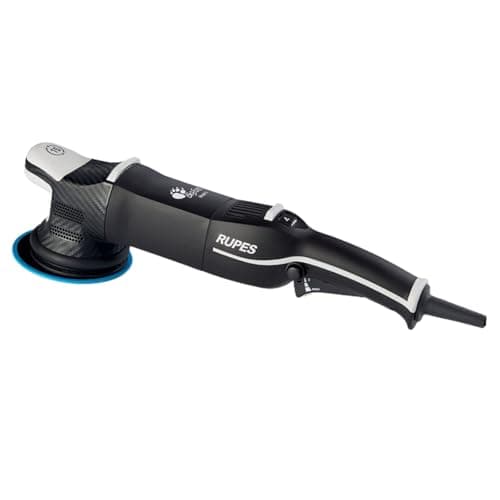
A 15mm throw machine from the company that popularized long-throw polishing. It corrects a full car in meaningfully less time than a 9mm machine, and the balance is the best in the category. Sold here as a tool only.
Who should skip it. Almost anyone buying a first machine. It costs several times a G9, the 15mm throw is less forgiving near edges, and the tool-only listing means pads and liquids are extra. If you are not correcting multiple cars a year the money is better spent elsewhere.
Correction speed
9.5
Control
7.5
Ergonomics
9.5
Build
9.5
Value
6.0
What works
15mm throw genuinely halves the time on large flat panels
Best-balanced machine in this roundup by a clear margin
The long-throw design RUPES is known for, from the originator
What does not
Several times the price of machines that do 80% of the job
Tool only — budget for pads and liquids on top
15mm throw is less forgiving around edges and badges
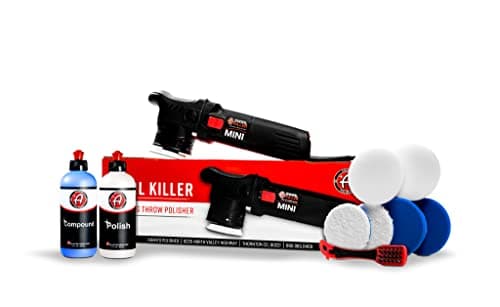
12mm sits deliberately between the two established throws, and in practice it behaves much closer to a 15mm machine than a 9mm one — faster across a panel, and wanting more attention near an edge. A reasonable pick if you have used a short-throw machine and want more speed.
Who should skip it. A first machine. The in-between throw means it is neither the most forgiving nor the fastest, which is a fine place to be on your second polisher and a confusing one on your first.
Correction speed
8.0
Control
8.0
Ergonomics
8.0
Build
8.0
Value
7.5
What works
12mm throw is a genuine step up in speed from 8 to 9mm
Better balanced than most machines near this price
Adam's support and parts availability are good
What does not
The in-between throw suits a second machine, not a first
Adam's does not publish a wattage figure we could verify
On a mid-size sedan, a careful single-stage correction with a 9mm machine is most of a day. A 15mm machine does not halve that, because the flat panels — hood, roof, trunk — are maybe a third of the surface area, and everything else is where the long throw has to slow down anyway. Expect to save a couple of hours on a full car, not a morning.
Which reframes the decision: a few hours saved per correction, against a machine that costs several times as much and asks more of your technique. If you correct one car every two years, that is a poor trade. If you correct four cars a year, it is an obvious one.
05
If you do go long-throw
Tape everything. Every body line, every badge, every edge. On a 15mm machine this moves from advisable to necessary.
Keep a short-throw machine for the tight areas. The long machine physically cannot work a mirror cap or an A-pillar.
Expect more vibration. Larger orbits mean more mass moving further, and after an hour you will know about it.
Budget for pads and liquids. Both long-throw machines here are tool-only listings.
The correction process itself is identical either way — paint correction steps covers it.
06
Questions people actually ask
Is a 15mm polisher harder to use than a 9mm?
Yes, specifically near edges and body lines. The larger orbit means the pad is more likely to catch a raised edge, and the consequences of catching one are the same as always. On open flat panels the difference in difficulty is negligible.
How much time does a long throw polisher actually save?
A couple of hours on a full-size sedan, not a morning. Flat panels are roughly a third of a car's surface, and that is the only place a long throw is meaningfully faster — everywhere else it has to slow down for the same reasons a short throw does.
Can you use a 15mm polisher on a small car?
On the hood, roof and doors, yes. Around bumpers, mirrors and pillars it becomes awkward, and most people running a long-throw machine keep a smaller one for those areas. On a small car with a lot of curvature the long throw's advantage largely disappears.
07
Sources
Every published figure on this page traces to one of these. Where a manufacturer does not publish a number, the page says so rather than estimating it.
Last reviewed October 5, 2026. Think a figure here is wrong? Tell us at contact@detailingandwax.com and we will check it, fix it and date the correction — see our editorial policy.