Independent picks for detailing your own car. We stock nothing, so we have nothing to move.
01
Interior
The best car interior protectants
A dashboard does not fade because it was dirty. It fades because nothing on it was blocking UV — and most of the bottles sold to fix that publish no UV figure at all.
Our top pick: the 303 Automotive Protectant (30382).
How this is funded: we earn an Amazon commission when you buy through our links, at no extra cost to you. We sell nothing and stock nothing, so a pick is never a product we are trying to move. Prices are pulled live from Amazon and were last checked November 19, 2026; where we cannot verify a price we say so rather than print an old one. Full disclosure.
Research-basedPicked from published manufacturer specifications and the consistent pattern across verified-purchase owner reports. Every product here scores 8.4 or better on our rubric.How we pick
Best interior protectant303 Products
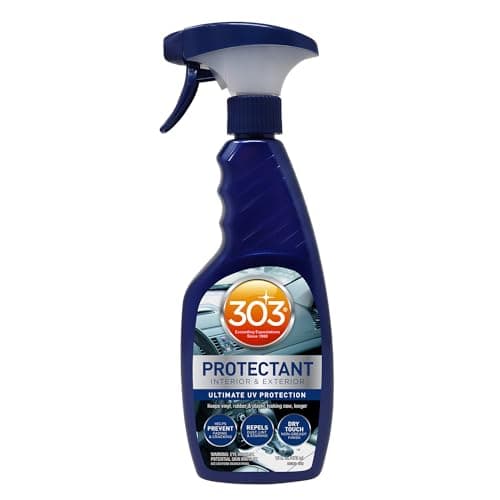
303 Automotive Protectant (30382)
303 is the protectant that treats UV blocking as the product rather than as a bullet point: it publishes an SPF 40 rating, a 30-45 day service life and a reapplication interval, and it dries to a matte finish instead of a shine.
Our score9.4Best for: the only one here with a published spf number
Tap any row for the full write-up. Prices come straight from Amazon and are never typed in by hand.
The verdict
303 Automotive Protectant is the pick, because it is the only product here that publishes an actual UV rating (SPF 40), an actual service life (30 to 45 days) and a reapplication interval — and it dries matte, which is what a modern interior is supposed to look like. If you want a visible satin finish without the grease, Chemical Guys VRP is the better buy. Armor All's Original Protectant is the cheapest way to make tired plastic look new, and that is a different job from protecting it.
02
What a protectant is actually protecting against
The failure mode on a car interior is photodegradation. Ultraviolet light breaks the polymer chains in vinyl, in the soft-touch coating on a dash top, and in the plasticizers that keep that material flexible. As the plasticizer gasses off, the surface loses the ability to flex with heat cycling, and it goes chalky, then brittle, then cracked. A dash that has split along the top of the instrument binnacle did not get there from dirt. It got there from about eight summers of unfiltered sun.
So a protectant has exactly one job that matters: put something between that surface and the UV. Everything else a bottle does — the shine, the scent, the dust repellency, the slickness under your hand — is a side effect of the carrier it uses to deliver that layer. This is the distinction the category deliberately blurs, because shine is immediately visible and UV blocking is invisible for eight years and then obvious all at once.
That is why the ranking on this page leads with a question most roundups skip: does the maker publish a UV figure you could hold them to? Exactly one product here does. The rest claim UV protection in words — 'UV blockers', 'UVA and UVB protection', 'UV clear coat technology' — and words are a marketing position, not a specification. None of that makes them bad products. It does mean you are buying a formula on reputation rather than on anything measurable.
03
The four finishes, and why the choice is not cosmetic
Everything in this category lands on one of four finish levels, and the finish is not just taste. A glossy dressing on a dash top throws sunlight into the windshield at low sun angles, which is a genuine visibility problem on an evening commute. A greasy finish holds dust, which means the panel looks worse a week later than it did before you treated it. The matte formulas exist because of both of those, not because matte is fashionable.
The four finish levels every interior protectant lands on
Finish
What it looks like
Honest trade
Matte
Clean, factory-correct, invisible
Looks like you did nothing — some buyers will think it failed
Satin / dry to the touch
A low sheen that does not feel slick
Mild glare on a black dash in full sun
Glossy
The 'new car' look, high reflectance
Windshield glare, and it reads as dressed rather than clean
Greasy / wet-look
Deepest color, wettest appearance
Collects dust immediately and transfers to clothes
The practical rule is that the dash top and the steering column want matte or satin, and the lower door cards, kick panels and trunk sill can take whatever you like because nobody is looking into them against the sun. Nothing stops you from owning one bottle of each; most people who care end up doing exactly that, because the alternative is accepting a compromise on the one panel that matters most.
04
The ranked interior protectants
Ordered on published UV protection first, then on the finish and on how much dust the result attracts. Prices are live from Amazon.
No. 01303 ProductsOutstandingSpec-verified
303 Automotive Protectant (30382)
Best for: The only one here with a published SPF number
303 is the protectant that treats UV blocking as the product rather than as a bullet point: it publishes an SPF 40 rating, a 30-45 day service life and a reapplication interval, and it dries to a matte finish instead of a shine. If you want the dashboard protected and you do not want it glossy, this is the answer.
UV protection
Exceptional
Finish
Exceptional
Dust resistance
Exceptional
Value
Good
Why we picked it
Publishes an actual SPF figure — nobody else in this group does
Matte finish leaves no glare on the dash top
Rated for finished leather and acrylic as well as vinyl and plastic
Publishes a reapplication interval, so you know when it has stopped working
Good to know. Highest cost per ounce of the sprays here
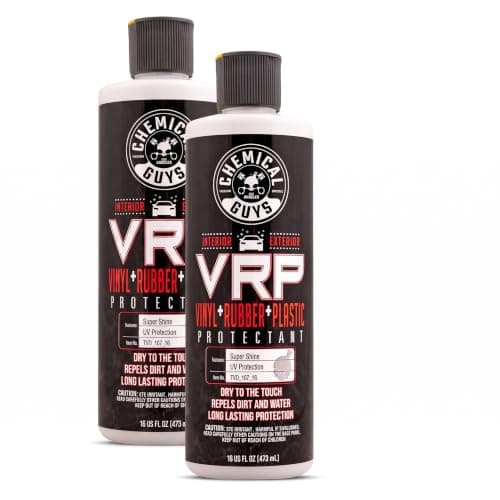
VRP is the compromise bottle: it gives the satin shine people actually want from a dressing, and Chemical Guys build the formula around drying to the touch so it does not sit there collecting dust. It is also the one product on this page that is genuinely at home on interior plastic, exterior trim and tires.
UV protection
Good
Finish
Strong
Dust resistance
Strong
Value
Strong
Why we picked it
Dries to the touch rather than staying tacky, so it does not gather dust
One bottle covers dash, door cards, exterior trim and tires
Satin level is the finish most buyers are actually after
Cheapest route to a shine that is not greasy
Good to know. Needs spreading with an applicator — spray-and-walk-away leaves patches
Published specifications
Published UV rating
Not published
Finish
Satin, dry to the touch
Published service life
Not published
Reapply interval
Not published
Bottle size
16 oz
Rated surfaces
Vinyl, rubber, plastic — interior and exterior trim, tires
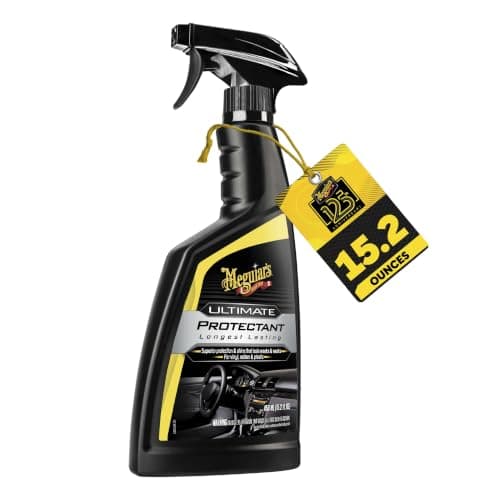
Meguiar's build this one around what they call UV clear coat technology, and they aim it squarely at the surfaces that take the worst of the sun — exterior trim, moldings and tires — as well as the interior. The claim they stand behind is that it survives washing and rain without streaking, which is the usual way a trim dressing fails.
UV protection
Strong
Finish
Good
Dust resistance
Strong
Value
Strong
Why we picked it
Published as wash- and rain-resistant without streaking
Darkens faded exterior trim as well as protecting interior plastic
Dries fast, so it is not a wet mess an hour later
Widely stocked, which keeps the price honest
Good to know. Glossy by design — the wrong pick for a matte interior
Published specifications
Published UV rating
Not published
Finish
Glossy, non-greasy
Published service life
'Weeks' — no figure given
Reapply interval
Not published
Bottle size
15.2 oz
Rated surfaces
Vinyl, rubber, plastic — dashboards, door panels, trim, tires
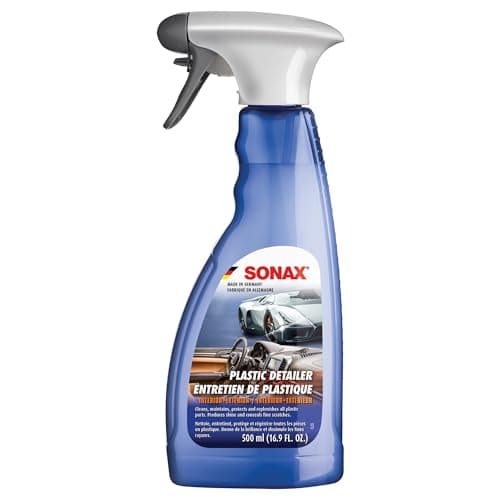
SONAX sell this as an interior plastic cleaner and protectant that doubles as an engine dressing and a trim restorer, and that breadth is the point: one bottle for the three plastic jobs that usually need three products. German-market detailing chemistry, and priced accordingly.
UV protection
Good
Finish
Strong
Dust resistance
Strong
Value
Good
Why we picked it
Cleans and protects, and is rated for engine bay plastic as well
Restores faded exterior trim without a dedicated trim product
Does not leave the heavy shine the drugstore dressings do
Good to know. Mid-range price for a bottle whose size is not published on the listing
Published specifications
Published UV rating
Not published
Finish
Not published
Published service life
Not published
Reapply interval
Not published
Bottle size
Not published
Rated surfaces
Interior plastic, exterior trim, engine bay plastic
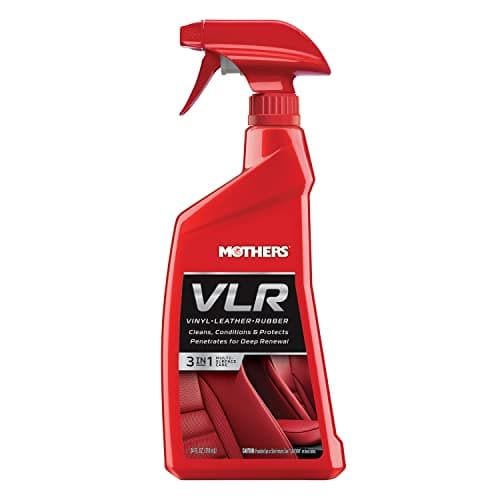
VLR is published as a one-step clean, condition and protect, and that is the honest reason to buy it: on a car that is dusty rather than dirty, it saves you doing two passes with two products. It is also the cheapest big bottle in this group by a wide margin.
UV protection
Good
Finish
Good
Dust resistance
Good
Value
Exceptional
Why we picked it
Cleans and protects in one pass on a lightly dusty interior
Largest bottle here and the lowest price of the sprays
Published as safe on leather as well as vinyl and rubber
Good to know. Not a substitute for a dedicated cleaner on heavy soiling
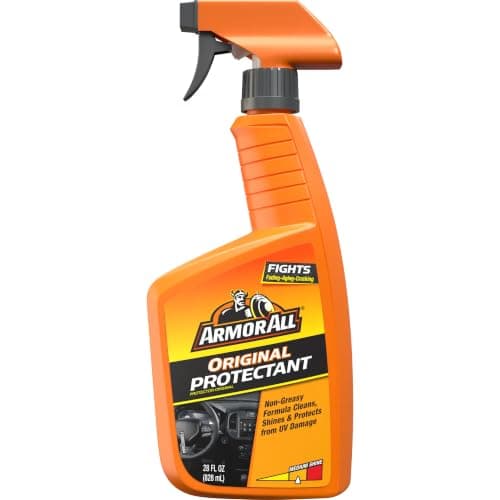
This is the bottle that defined the category, and it still does one thing better than anything else here: it makes tired plastic look new again for almost no money. Armor All publish UVA and UVB protection against cracking, fading and discoloration, and the current formula is sold specifically as streak-free.
UV protection
Good
Finish
Adequate
Dust resistance
Adequate
Value
Exceptional
Why we picked it
By far the lowest cost per ounce on this page
Published UVA and UVB protection against cracking and fading
Available in essentially every grocery and auto store in the country
The current formula is sold as streak-free, which the old one was not
Good to know. The shiny finish is the opposite of a factory interior look
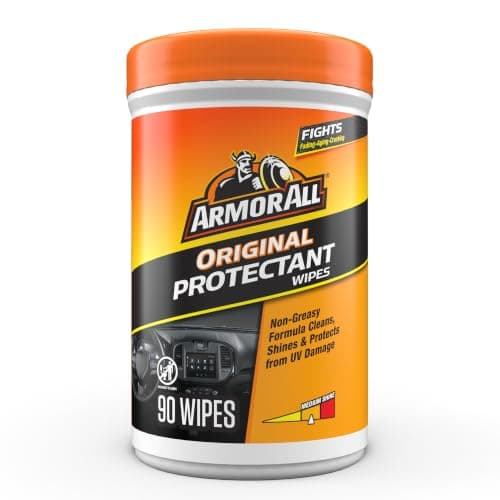
Wipes are a format decision, not a chemistry decision, and the format genuinely matters: a tub in the door pocket gets used, and a bottle and towel in the garage does not. Ninety wipes is enough to touch up the dash and door cards every couple of weeks for a long time.
UV protection
Good
Finish
Adequate
Dust resistance
Adequate
Value
Good
Why we picked it
The format that actually gets used, because it lives in the car
No overspray onto glass or pedals
Resealable tub keeps 90 wipes usable over months
Good to know. Most expensive way to buy this formula per application
Every product on this page is designed to leave a film. Apply one to a dusty dash and the film goes on over the dust, which bonds it to the surface and makes the next clean harder, not easier. Worse, on a soft-touch panel a layer of grit under a dressing becomes a very fine abrasive the next time you wipe it, and that is how the matte coating on a modern dash top acquires shiny patches that never come out.
The sequence is: dry dust removal with a soft brush and a vacuum, then a dedicated interior cleaner on a towel, then the protectant. The best car interior cleaners covers the middle step, and best detailing brushes covers the first one, which is the one most people skip. Mothers VLR is the single exception on this page — it is published as a one-step clean-and-protect, which is a real convenience on an interior that is dusty rather than dirty, and a compromise on anything worse.
01Vacuum and brush the panel dry. Compressed air or a soft detailing brush into a running vacuum nozzle, not a dry towel pushed around.
02Clean with a dedicated interior cleaner sprayed onto the towel, never onto the panel — overspray onto glass and pedals is the usual regret.
03Let the surface dry completely. A protectant applied over residual cleaner streaks, and on gloss black trim the streaks are permanent-looking until you redo it.
04Apply the protectant to an applicator pad or towel, then to the panel. Spraying directly puts product on the windshield and into the vents.
05Wipe the panel completely dry with a second clean towel. This is the step that decides matte versus greasy, with every product here.
06
Interior versus exterior: the same bottle, different expectations
Three of the products here — 303, Meguiar's Ultimate Protectant and SONAX's Plastic Detailer — are published for exterior trim as well as interior plastic, and that breadth is genuinely useful. Faded exterior trim and a chalky dash top are the same chemistry failing in two places, and the same UV-blocking film fixes both.
What changes is durability. An interior panel sees UV through glass and never sees rain; an exterior trim piece sees unfiltered sun, rain, car wash chemicals and road salt. The same product that lasts a month inside will be gone from exterior trim in two weeks of bad weather. If what you actually want is faded black plastic brought back permanently, a dressing is the wrong tool — the best trim restorers covers the products that bond rather than sit on top.
Leather is a separate conversation
Mothers VLR is published as safe on leather, and 303 lists finished leather among its rated surfaces. That is true and it is not the same as conditioning leather. Coated automotive leather needs a pH-appropriate cleaner and a conditioner that feeds the finish, not a plastic dressing that sits on it — and the interval is different too, which is the whole point of how often to condition leather car seats. Treat a protectant as UV insurance for leather, and the best leather conditioners as the actual care routine.
07
How often, and how to tell when it has stopped working
303 is the only maker here that answers this: 30 to 45 days of service life, reapply every three to five weeks for maximum UV protection. Everyone else says 'weeks' or says nothing. That is a reasonable interval to apply to all of them, with one adjustment — a car that lives outdoors in Phoenix is not on the same schedule as a car that lives in a garage in Seattle.
The usable test is a water drop on a treated panel. A fresh protectant film beads it; a spent one lets it spread and wet out. It is the same test as on waxed paint and it works for the same reason. Run it on the dash top rather than on a door card, because the dash is always the first panel to go and it tells you what the whole interior needs.
There is no benefit to layering. Unlike a paint sealant, an interior protectant film is not building thickness — reapplying over a surface that is still protected just leaves excess product to attract dust. If the water test still beads, leave it alone. Twice a season on a garaged car and monthly on a car that parks in the sun is, in practice, the whole maintenance program.
08
What this category does not fix
A protectant cannot restore a panel that has already failed. Once the soft-touch coating has gone chalky, the material it was bonded to has lost plasticizer, and no film puts that back. A dressing will darken the chalky area temporarily and make it look recovered for a week, and then the chalk returns. The honest answer for a cracked dash top is a cover or a replacement panel, and the honest answer for a chalky but intact one is to protect it now so it stops getting worse.
It also cannot save screens and gauge lenses, which need nothing but a dry or barely damp microfiber — every protectant here will haze an anti-glare coating. And it does nothing for the headliner, Alcantara, or any napped surface; a film on a textile is just a stain waiting to be noticed. The car interior detailing guide has the surface-by-surface version of this, and it is worth reading once before the first bottle goes on the car.
09
Our recommendation
Buy this one
303 Automotive Protectant (30382)
303 is the protectant that treats UV blocking as the product rather than as a bullet point: it publishes an SPF 40 rating, a 30-45 day service life and a reapplication interval, and it dries to a matte finish instead of a shine.
Chemical Guys VRP Vinyl, Rubber & Plastic Protectant (16 oz)
VRP is the compromise bottle: it gives the satin shine people actually want from a dressing, and Chemical Guys build the formula around drying to the touch so it does not sit there collecting dust.
303 Automotive Protectant, because it is the only product in this group that publishes a UV rating (SPF 40), a service life (30 to 45 days) and a reapplication interval, and it dries matte rather than glossy. If you want a visible satin finish instead, Chemical Guys VRP is the better choice; if price is the deciding factor, Armor All's Original Protectant is the cheapest per ounce by a wide margin.
Do interior protectants actually prevent dashboard cracking?
They slow the mechanism that causes it. Cracking comes from UV breaking down the polymer and gassing off the plasticizer that keeps the panel flexible, so a film that blocks UV genuinely reduces the rate of damage. What no protectant can do is reverse it — once a panel has gone chalky or split, the material has already lost what made it flexible and a dressing only hides it for a few days.
Is Armor All bad for your dashboard?
The old reputation came from early solvent-carried formulas and from people applying far too much. The current Original Protectant is sold as a non-greasy, streak-free formula with published UVA and UVB protection, and applied to a towel and wiped dry it is a perfectly reasonable product. The real objection today is cosmetic: it leaves a shine, which is the opposite of how a modern interior is supposed to look.
What is the difference between an interior cleaner and an interior protectant?
A cleaner removes soil and leaves nothing behind. A protectant deliberately leaves a UV-blocking film and has little cleaning ability. Combined products exist — Mothers VLR is published as a one-step clean, condition and protect — and they are a genuine convenience on a dusty interior and a compromise on a dirty one. On anything worse than dust, clean first with a dedicated cleaner and protect second.
How often should you apply interior protectant?
Every three to five weeks is the only published interval in this group, from 303. In practice, monthly for a car that parks outside in strong sun and twice a season for a garaged car is enough. Test it with a water drop on the dash top: if it still beads, the film is working and reapplying only adds dust-attracting excess.
Can you use interior protectant on a steering wheel?
No. Any protectant on a wheel rim makes it slick, and no finish level changes that. Clean the wheel with an interior cleaner on a towel and leave it bare. The same applies to pedal faces and the gear selector — every surface your grip depends on should stay undressed.
Does matte or glossy interior protectant last longer?
Finish and durability are independent — the shine comes from the carrier, not from the protective film. The practical difference is that glossy and greasy finishes attract dust faster, so the treated panel looks spent sooner even when the UV film is still intact. That is a cosmetic failure rather than a protection failure, and it is why the matte formulas look better for longer.
11
Sources
Every published figure on this page traces to one of these. Where a manufacturer does not publish a number, the page says so rather than estimating it.
Last reviewed October 26, 2026. Think a figure here is wrong? Tell us at contact@detailingandwax.com and we will check it, fix it and date the correction — see our editorial policy.