Independent picks for detailing your own car. We stock nothing, so we have nothing to move.
01
Compare
Chemical Guys vs Armor All
One sells to people who enjoy detailing; the other sells to people who want the car to look clean on Sunday. Almost every real difference between them follows from that.
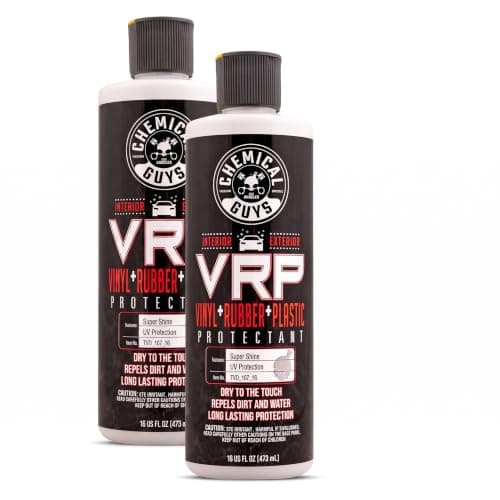
Featured here: the Chemical Guys VRP Vinyl, Rubber & Plastic Protectant (16 oz).
How this is funded: we earn an Amazon commission when you buy through our links, at no extra cost to you. We sell nothing and stock nothing, so a pick is never a product we are trying to move. Prices are pulled live from Amazon and were last checked November 19, 2026; where we cannot verify a price we say so rather than print an old one. Full disclosure.
Research-basedPicked from published manufacturer specifications and the consistent pattern across verified-purchase owner reports. Every product here scores 8.4 or better on our rubric.How we pick
Top pickChemical Guys
Chemical Guys VRP Vinyl, Rubber & Plastic Protectant (16 oz)
VRP is the compromise bottle: it gives the satin shine people actually want from a dressing, and Chemical Guys build the formula around drying to the touch so it does not sit there collecting dust.
Our score9.2Best for: shine without the greasy feel
Chemical Guys if you are going to own more than four bottles and you care what the finish looks like. Armor All if you want one or two products from a grocery store that make the car presentable for very little money. The mistake is buying Armor All expecting a detailing result, or buying Chemical Guys expecting the shortcut Armor All is actually good at.
02
Two companies selling to two different people
Armor All is a mass-market consumer brand distributed through grocery, drug and big-box stores. Its products are designed to be bought on impulse, used once without instructions, and to produce an immediately visible result. Chemical Guys is an enthusiast brand built on a very large catalog, aggressive pricing within that catalog, and heavy content marketing to people who already enjoy the hobby.
Neither of those is a criticism. They are different businesses with different constraints, and the constraints explain almost every product difference. An Armor All bottle has to work for someone who will not read the label, which pushes it toward strong visible shine and generous forgiveness. A Chemical Guys bottle is sold to someone who will watch a video first, which allows a more specific product with a narrower correct use.
The two brands, side by side
Chemical Guys
Armor All
Range breadth
Very wide — often several near-identical options
Narrow and category-complete
Typical finish
Satin and dry-to-the-touch by design
Shine, by design
Price per ounce
Low for a detailing brand
Lower than almost anything else
Where you buy it
Online and specialist, some big-box
Essentially every store in the country
Documentation
Extensive but variable in quality
Minimal — the label is the documentation
Published figures
Rarely a hard number
Rarely a hard number
Best for
Someone building a real detailing kit
Someone who wants two bottles and a Sunday result
03
An interior dressing and a glass cleaner from each
Directly comparable pairs so the price and finish difference is concrete rather than theoretical. Prices are live from Amazon.
Chemical GuysOutstandingSpec-verified
Chemical Guys VRP Vinyl, Rubber & Plastic Protectant (16 oz)
VRP is the compromise bottle: it gives the satin shine people actually want from a dressing, and Chemical Guys build the formula around drying to the touch so it does not sit there collecting dust. It is also the one product on this page that is genuinely at home on interior plastic, exterior trim and tires.
UV protection
Good
Finish
Strong
Dust resistance
Strong
Value
Strong
Why we picked it
Dries to the touch rather than staying tacky, so it does not gather dust
One bottle covers dash, door cards, exterior trim and tires
Satin level is the finish most buyers are actually after
Cheapest route to a shine that is not greasy
Good to know. Needs spreading with an applicator — spray-and-walk-away leaves patches
Published specifications
Published UV rating
Not published
Finish
Satin, dry to the touch
Published service life
Not published
Reapply interval
Not published
Bottle size
16 oz
Rated surfaces
Vinyl, rubber, plastic — interior and exterior trim, tires
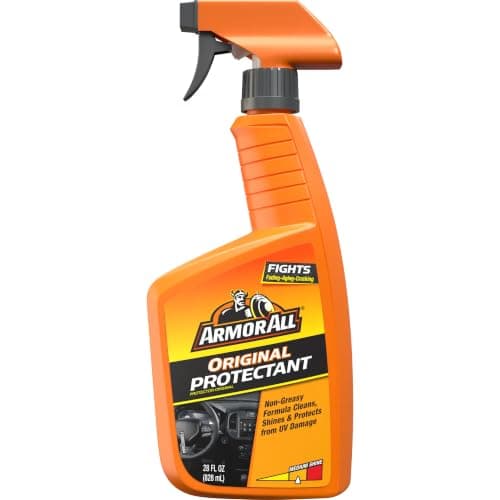
This is the bottle that defined the category, and it still does one thing better than anything else here: it makes tired plastic look new again for almost no money. Armor All publish UVA and UVB protection against cracking, fading and discoloration, and the current formula is sold specifically as streak-free.
UV protection
Good
Finish
Adequate
Dust resistance
Adequate
Value
Exceptional
Why we picked it
By far the lowest cost per ounce on this page
Published UVA and UVB protection against cracking and fading
Available in essentially every grocery and auto store in the country
The current formula is sold as streak-free, which the old one was not
Good to know. The shiny finish is the opposite of a factory interior look
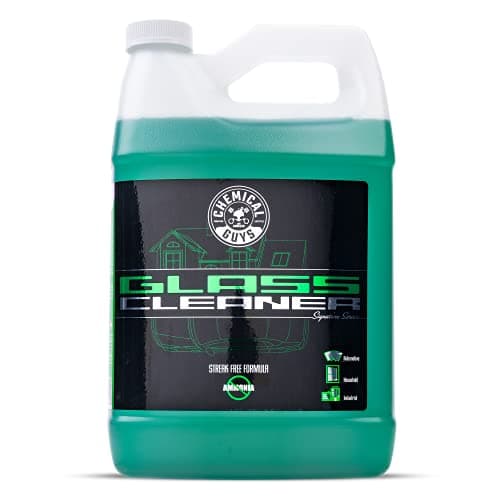
A gallon of ammonia-free, tint-safe glass cleaner to refill a spray bottle from. The chemistry is conventional; the format is the reason to buy it, and it works out considerably cheaper per use than aerosols.
Streak freedom
Strong
Tint safety
Exceptional
Ease of use
Good
Value
Exceptional
Why we picked it
Cheapest per use by a distance
Ammonia free and tint safe
Refills whatever bottle you prefer
Good to know. A gallon is a multi-year supply for one car
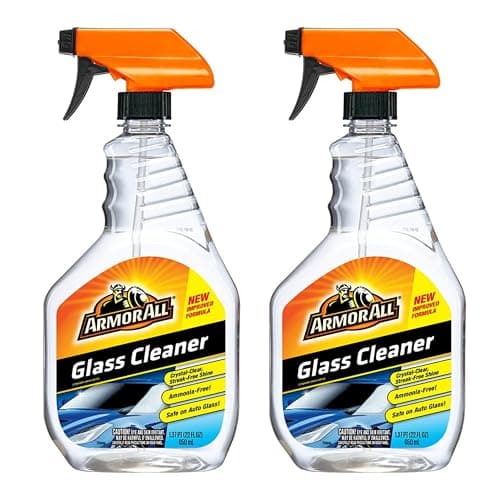
Armor All's glass cleaner is the plainest possible version of the product: a trigger spray that cuts interior film without ammonia, sold two bottles at a time for less than one bottle of most detailing-brand equivalents. For a reader who just wants the inside of the windshield clear, it is enough.
Film removal
Good
Streak resistance
Good
Safety
Strong
Value
Exceptional
Why we picked it
Two bottles for the price of one specialist bottle
Ammonia-free, so it is safe around interior coatings and screens
Stocked everywhere, which is worth something when you run out mid-detail
Good to know. Less solvent strength than a dedicated detailing glass cleaner
Two categories, and both of them are about price per ounce. The first is basic interior protectant. Armor All's Original Protectant is published with UVA and UVB protection, it is sold in a 28 ounce bottle, and it costs a fraction of any detailing-brand dressing per ounce. If the goal is to get *some* UV protection onto a neglected dash this weekend and move on, nothing beats it on cost.
The second is glass cleaner. Ammonia-free glass cleaner is a commodity, Armor All sell it two bottles at a time, and the inside of a windshield does not care whose logo was on the trigger. There is a real quality step up to a detailing glass cleaner for heavy interior film, but for routine cleaning the cheap bottle is the rational one — which is a different conclusion from the one the best car glass cleaners reaches for the harder cases.
Armor All's third strength is pure distribution. A product you can buy at 9pm from the store down the road has a real advantage over one that ships in three days, and anyone who has run out of something mid-detail knows exactly how much that is worth.
05
Where Chemical Guys is not close
Everything that requires the product to be specific. Chemical Guys sell iron removers, clay lubes, pH-neutral shampoos, snow foams, interior cleaners with a stated surface list, polishing compounds, ceramic sprays and foam guns. Armor All does not compete in most of those categories at all, and where it does, the product is a consumer simplification rather than a detailing tool.
Finish control. Chemical Guys formulate for satin and dry-to-the-touch because that is what the enthusiast market wants. Armor All formulate for shine because that is what reads as 'clean' to a mass-market buyer. If a factory-correct interior is the goal, this difference decides the question on its own.
Decontamination and correction. Iron removers, clay bars, compounds and polishes — Armor All has nothing meaningful here, and these are the stages that actually change how paint looks. Paint correction steps is the sequence, and none of it is a mass-market product.
Wash chemistry. A pH-neutral shampoo that will not strip a sealant, a high-foaming snow foam, a dedicated rinseless — all Chemical Guys categories. The best car wash soaps has the comparison.
Breadth as a feature. When you need a specific thing — a bug remover, a trim restorer, a wheel cleaner safe on a particular finish — the big catalog is the point, even though it is also the brand's biggest usability problem.
06
The shine question, honestly
Armor All's reputation among enthusiasts is bad, and the reason is almost entirely cosmetic rather than chemical. The brand's house style is a glossy dressed finish, which on a modern soft-touch dashboard looks like plastic that has been coated rather than cleaned — and it throws glare into the windshield at low sun. That is a legitimate objection and it is a matter of taste, not of damage.
The older criticism — that Armor All dries out and cracks dashboards — came from early solvent-carried formulas and from people applying far too much of them. The current Original Protectant is sold as non-greasy and streak-free with published UVA and UVB protection, and applied to a towel and wiped dry it behaves like any other consumer dressing. Repeating the 1990s version of that claim in 2026 is not honest.
The flip side is worth saying too. Chemical Guys' scents are strong, their labels oversell, and several of their interior products are close enough to each other that the choice between them is arbitrary. Where the two brands overlap directly, Armor All vs Chemical Guys for interiors is the product-level version of this comparison, and the best car interior protectants ranks both of them against five others.
07
Which one should you actually buy
The deciding question is how many bottles you intend to own. At one or two, Armor All wins on cost, availability and simplicity, and the shine is a reasonable price to pay for not thinking about it. At six or more, you are building a kit, and a kit needs products that are specific about what surface they are for — which is Chemical Guys' entire proposition.
The middle case is the interesting one. A lot of people are best served by buying both: Armor All's glass cleaner because glass cleaner is a commodity, and a detailing-brand interior cleaner and dressing because that is where finish control actually shows. Brand loyalty is the least useful way to buy car care, and the per-category answer is usually not the same brand twice.
If you are choosing between Chemical Guys and something else
Armor All is the mass-market end of the comparison. For the enthusiast-brand comparisons, Chemical Guys vs Adam's Polishes is the one about support and documentation, and Meguiar's vs Chemical Guys is the one about consistency and big-box availability. Meguiar's sits almost exactly between the two brands on this page, which makes it the obvious compromise for a buyer who finds Armor All too crude and Chemical Guys too much work.
08
Our recommendation
Buy this one
Chemical Guys VRP Vinyl, Rubber & Plastic Protectant (16 oz)
VRP is the compromise bottle: it gives the satin shine people actually want from a dressing, and Chemical Guys build the formula around drying to the touch so it does not sit there collecting dust.
This is the bottle that defined the category, and it still does one thing better than anything else here: it makes tired plastic look new again for almost no money.
For building a real detailing kit, yes — Chemical Guys compete in categories Armor All does not enter at all, and they formulate for a satin finish rather than a shine. For buying one or two bottles cheaply from a store you are already in, Armor All is the better answer. The question is really how many products you intend to own.
Does Armor All damage your dashboard?
Not the current formula, applied normally. The cracking reputation comes from early solvent-carried products and from heavy over-application. Today's Original Protectant is sold as non-greasy and streak-free with published UVA and UVB protection, and wiped on with a towel and buffed dry it behaves like any consumer dressing. The real objection is cosmetic: it leaves a shine that looks wrong on a modern soft-touch interior.
Is Armor All glass cleaner as good as a detailing brand?
For routine interior glass, close enough that the price difference decides it — ammonia-free glass cleaner is largely a commodity and Armor All sell it two bottles at a time. For heavy interior film from smoking or off-gassed plasticizer, a dedicated detailing glass cleaner has more solvent behind it and will clear it in fewer passes.
Why is the Chemical Guys range so confusing?
Because breadth is the brand's commercial strategy. They sell several products that overlap heavily, under names that do not describe the difference, and the marketing copy rarely resolves it. That is a real cost in your time and the most common reason people switch away. The upside is that when you need something specific, they almost certainly make it.
Can you mix Chemical Guys and Armor All products?
Yes. There is no chemical incompatibility to worry about between a consumer dressing and detailing-brand cleaners, and buying the best product per category rather than per brand is the more sensible approach. The one thing to avoid is layering two dressings on the same panel — the second one just sits on the first and attracts dust.
Which brand is cheaper overall?
Armor All, clearly, on price per ounce in the categories where both compete. Chemical Guys are inexpensive for a detailing brand but not inexpensive against mass-market consumer products. Where the comparison gets closer is concentrates: a Chemical Guys shampoo or all-purpose cleaner that dilutes heavily can end up cheaper per wash than a ready-to-use consumer bottle.
10
Sources
Every published figure on this page traces to one of these. Where a manufacturer does not publish a number, the page says so rather than estimating it.
Last reviewed October 26, 2026. Think a figure here is wrong? Tell us at contact@detailingandwax.com and we will check it, fix it and date the correction — see our editorial policy.