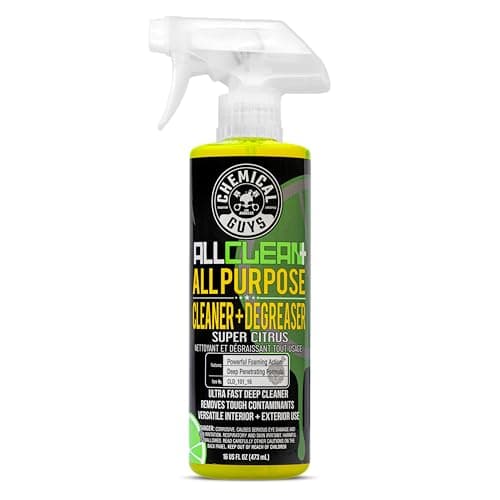
Featured here: the Chemical Guys Chemical Guys All Clean+ Citrus All-Purpose Cleaner.
How this is funded: we earn an Amazon commission when you buy through our links, at no extra cost to you. We sell nothing and stock nothing, so a pick is never a product we are trying to move. Prices are pulled live from Amazon and were last checked October 5, 2026; where we cannot verify a price we say so rather than print an old one. Full disclosure.
Research-basedPicked from published specifications and the pattern across verified-purchase reports. We have not used these ourselves and do not pretend otherwise.How we pick
An all-purpose cleaner is a concentrated alkaline surfactant, and alkalinity is exactly what lifts grease out of carpet and exactly what strips the coating off a soft-touch dashboard. The answer is therefore entirely about surface and dilution, and it is worth knowing before the bottle is open.
A dilutable citrus APC is the most useful bottle in a detailing cupboard, because the same concentrate goes from a gentle interior mix to a strong wheel-well mix. The ratio is the whole product — get it wrong on a dash and the damage is permanent.
Who should skip it. Use at full strength on anything in a cabin. Neat APC lifts the coating off soft-touch plastic, and there is no correction step for that.
Cleaning
9.0
Surface safety
6.0
Versatility
9.5
Value
9.5
What works
One bottle covers every cleaning job at different ratios
Citrus rather than solvent smell
Very cheap per diluted quart
What does not
Destructive on soft-touch plastic if used neat
Needs a spray bottle and a label
Not for leather, Alcantara or screens at any dilution
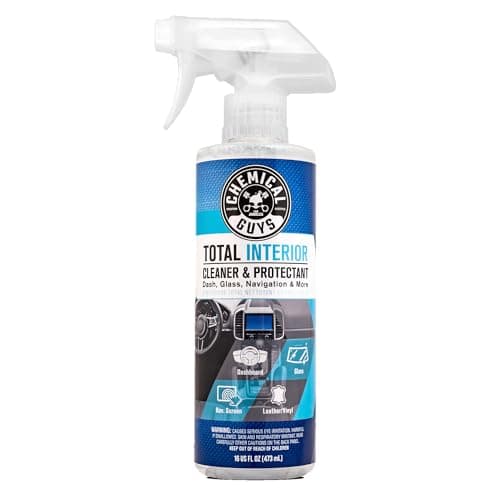
Cleans and protects in one pass across plastic, vinyl and coated leather, and leaves a matte finish rather than the greasy sheen that marks an over-dressed interior. For most people this single bottle replaces three.
Who should skip it. Heavy soiling. It is a maintenance cleaner, and genuinely dirty door cards want a diluted all-purpose cleaner first.
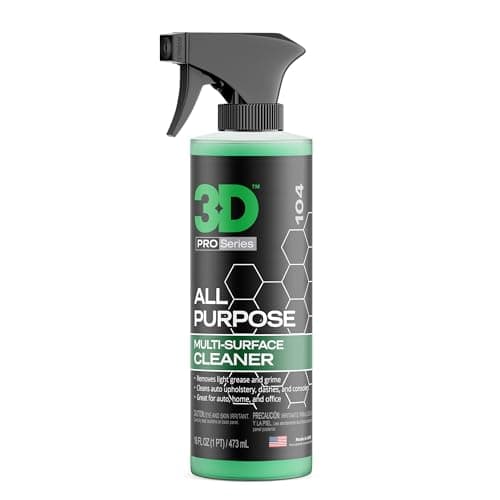
3D publishes dilution ratios by task more clearly than most, which in this category is the single most useful thing a manufacturer can do. The chemistry is a conventional dilutable APC and it performs like one.
Who should skip it. Delicate interior surfaces at strong ratios. Published guidance helps, but it does not change the fact that a strong APC mix and a soft-touch dash are incompatible.
Cleaning
8.5
Surface safety
7.5
Versatility
9.0
Value
8.5
What works
Clear published dilution guidance by task
Conventional, predictable chemistry
Good value as a concentrate
What does not
Still unsafe at strong ratios on soft-touch surfaces
3D does not publish a bottle volume we could verify
Needs its own labeled spray bottle
Published specifications
Volume
Not published
Type
Dilutable APC
Dilution
Published by task, per 3D
Interior safe
Diluted only
Suits
Vinyl, leather, carpet, plastic at the stated ratios
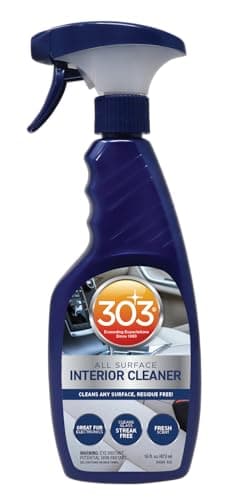
303 is formulated to be safe on the anti-glare coatings that ammonia-based cleaners haze permanently, which makes it the correct product for the screen that now dominates most dashboards. It also handles the dash and the glass around it.
Who should skip it. Protection. It cleans and leaves nothing behind, so you still want a UV protectant on a dash that bakes in the sun.
Surface safety
10.0
Cleaning
7.5
Finish
8.5
Value
8.5
What works
Genuinely safe on touchscreens and instrument lenses
01Mix your dilution and label the bottle with the ratio and the date.
02Pick a hidden area — under a seat, behind a kick panel, the underside of a door card.
03Spray the towel, apply, and wipe immediately.
04Wait five minutes and look at it in good light, from an angle.
05Any change in sheen means stop. That is the coating lifting, and it will look worse in a week.
05
Why a dedicated interior cleaner exists at all
If APC did everything, nobody would buy interior cleaner. The difference is that an interior product is formulated around the specific coatings used inside cars — pH-balanced rather than alkaline, with no solvents that attack polyurethane, and usually with a UV absorber added.
It also costs very little. The case for using APC on a dashboard is almost entirely 'I already had it in the garage', and that is not a good enough reason given what it can do.
06
Mixing and storing safely
Dilute into water, not water into concentrate, which reduces splashing.
Label every bottle with the ratio and date, in permanent marker.
Never mix APC with anything else, particularly anything acidic or chlorine-based.
Store out of sunlight and out of reach, in the original or a properly labeled container.
Gloves for strong dilutions. A 4:1 mix is hard on skin.
07
Questions people actually ask
Can you use all purpose cleaner on a car dashboard?
Not on a soft-touch dashboard. APC is alkaline and lifts the polyurethane coating, leaving a permanent shiny patch. On hard textured plastic a 20:1 dilution is usually safe, but a dedicated interior cleaner is both safer and inexpensive.
What dilution of APC is safe for car interiors?
10:1 for carpet, fabric mats and door jambs; 20:1 for hard plastic and seat belts; never neat anywhere in a cabin. Confirm against your own bottle's label, since manufacturers' concentrates vary in strength.
Can you use APC on leather seats?
No. Alkaline cleaners strip the coating on modern pigmented leather and dry out uncoated hide. Use a pH-balanced leather cleaner, applied to a soft brush rather than sprayed onto the seat.
How do you test an APC dilution safely?
Mix it, label the bottle, and try it on a hidden area — under a seat or the underside of a door card. Wipe immediately, wait five minutes, and look at it in good light from an angle. Any change in sheen means the dilution is too strong.
08
Sources
Every published figure on this page traces to one of these. Where a manufacturer does not publish a number, the page says so rather than estimating it.
Last reviewed October 5, 2026. Think a figure here is wrong? Tell us at contact@detailingandwax.com and we will check it, fix it and date the correction — see our editorial policy.